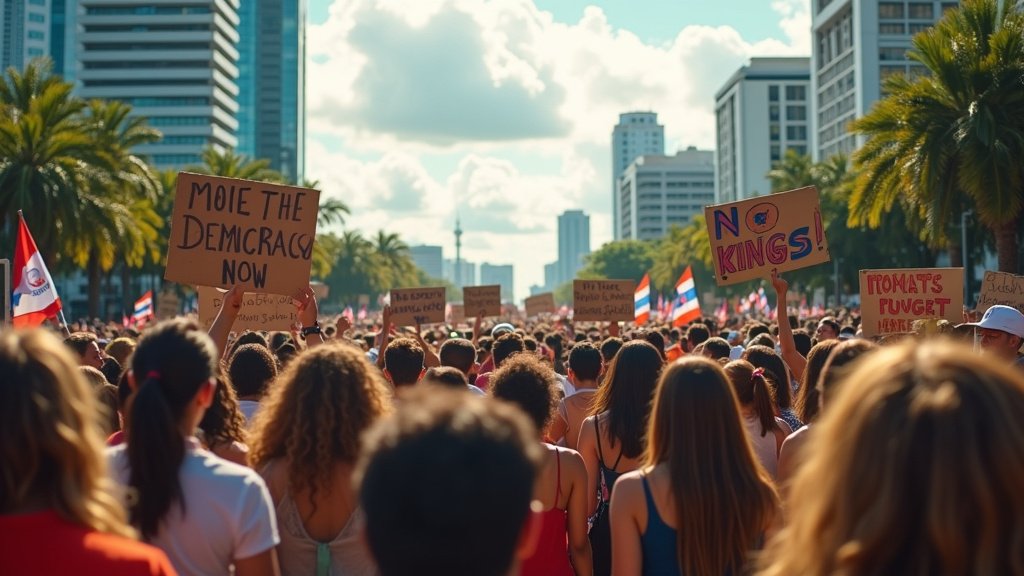
Thousands of demonstrators across South Florida took to the streets on Saturday, October 18, 2025, participating in a nationwide “No Kings” movement aimed at protesting what organizers describe as President Donald Trump’s authoritarian agenda and defending fundamental civil rights. The sprawling demonstrations, which spanned multiple counties, represented an expansion of earlier rallies held in June, with organizers anticipating even larger turnouts to voice their concerns over executive overreach and a wide array of policy issues.
The ‘No Kings’ Movement: A Call to Defend Democracy
The “No Kings” movement, which gained significant traction following President Trump’s first five months in office, centers on the principle that the United States should not have absolute rulers. This core message, echoing the nation’s revolutionary origins, has become a powerful rallying cry for millions nationwide. Organizers, including prominent groups like Indivisible, Hope and Action Indivisible, the ACLU, and Public Citizen, have emphasized the peaceful nature of the demonstrations, focusing on community engagement and a shared commitment to democratic ideals.
“In America, we don’t put up with would-be kings,” stated organizers, underscoring their fight against “chaos, corruption, and cruelty.” The current wave of protests follows similar large-scale mobilizations on June 14, 2025, which coincided with President Trump’s birthday and an Army anniversary parade. This latest event, held across more than 2,700 locations nationwide, including approximately 90 in Florida, aimed to build upon the momentum and send an “unmistakable message” that power belongs to the people.
Key Issues Fueling South Florida’s Protests
The demonstrations on October 18, 2025, addressed a broad spectrum of grievances against the Trump administration’s policies. Central to the protesters’ concerns were issues surrounding birthright citizenship, the dismantling of diversity initiatives, and the erosion of protections for transgender Americans. Participants also voiced opposition to healthcare cuts, demanded the restoration of women’s rights, and called for decisive action on immigration and the ongoing government shutdown.
“We want our kids to live in a safe country where they can speak their opinions freely and their rights are protected,” shared a mother of two, highlighting concerns about the education system and the perceived erosion of freedom of speech. Another protester, an 82-year-old veteran from Coral Gables, expressed that the current situation felt “worse” than the era of the Vietnam War protests, reflecting a deep-seated worry about the direction of the nation.
‘Alligator Alcatraz’: A Symbol of Contention
A significant point of protest highlighted during these rallies was the controversial “Alligator Alcatraz” migrant detention center located deep in the Everglades. Activists have widely condemned this facility, fast-tracked earlier in the year, as a symbol of harsh immigration enforcement tactics and a threat to the fragile ecosystem and sacred Indigenous lands. Protests against the facility have been ongoing, with critics pointing to inhumane conditions and environmental concerns, issues that resonated with the broader “No Kings” message of challenging government overreach and protecting vulnerable populations.
Community and Joy: The Spirit of the Movement
Despite the serious nature of the issues, organizers and participants emphasized a spirit of “community and joy” at the rallies. In downtown Miami’s Bayfront Park, music, including popular artists like Bad Bunny, set a vibrant mood as hundreds gathered. Attendees crafted handmade signs with messages such as “The United States needs rules not rulers” and “WE ARE ALL IMMIGRANTS.” An ad-hoc choir even performed a rendition of Woody Guthrie’s “All You Fascists Bound to Lose.” This blend of passionate protest and communal spirit aimed to create an inclusive and empowering environment for all who participated.
South Florida Mobilizes: A Network of Demonstrations
Across South Florida, the “No Kings” protests were widespread, with events scheduled in numerous cities. Locations included:
* Miami: Torch of Friendship at Bayfront Park (301 Biscayne Blvd.), 10 a.m. – 1 p.m.
* Fort Lauderdale: 3200 N. Federal Hwy., 12 p.m. – 5 p.m., and Fort Lauderdale Beach at Sunrise Boulevard and Jimmy Buffett Memorial Highway, 12 p.m. – 5 p.m.
* Hollywood: Young Circle (1 N. Young Cir.), 10 a.m. – 12 p.m.
* Boca Raton: 201 W. Palmetto Park Rd., 10 a.m. – 12 p.m.
* Coral Springs: West Sample Road and North University Drive, 9:30 a.m. – 11 a.m.
* Florida City: 404 W. Palm Dr., 10 a.m. – 5 p.m.
* Key Largo: 102050 Overseas Hwy., 10 a.m. – 12 p.m.
* Key West: 1320 Truman Ave., 10 a.m. – 12 p.m.
* Lake Worth Beach: 7 N. Dixie Hwy., 10 a.m. – 11:30 a.m.
* Marathon: Sombrero Beach Road and Overseas Highway, 10 a.m. – 12 p.m.
* Palm Beach Gardens: 3188 PGA Blvd., 10 a.m. – 12 p.m.
* West Palm Beach: 1760 Palm Beach Lakes Blvd., 11 a.m. – 1 p.m.
These diverse locations, from the Keys to the Palm Beaches, underscored the broad reach of the movement throughout the region.
A Peaceful Stand Against Authoritarianism
Organizers consistently highlighted their commitment to nonviolent action and de-escalation. Training sessions were provided to participants to ensure a peaceful demonstration, even in the face of potential confrontation. While the protests aimed to be a powerful display of dissent, the message was clear: to defend democratic institutions and civil liberties through peaceful means. This extensive news coverage of the “No Kings” protests in Miami and across South Florida provides a crucial look at the ongoing national dialogue about the future of American democracy and the citizen’s role in its preservation.