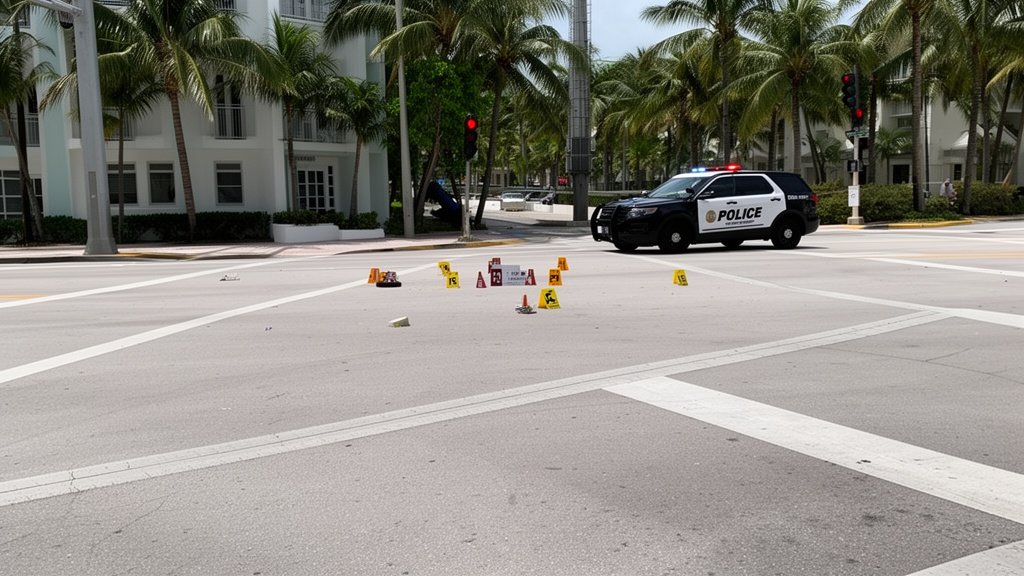
A Hialeah man was arrested and charged with three counts of aggravated battery after he allegedly turned a traffic dispute into a violent collision, intentionally ramming his vehicle into another car on a busy Miami Beach thoroughfare, resulting in significant injuries to a passenger. The incident, which highlights the growing dangers of aggressive driving in South Florida, has prompted local law enforcement to reiterate their zero-tolerance policy regarding vehicular violence in the tourist corridor.
Key Highlights
- Suspect Details: A Hialeah man has been taken into custody and faces three counts of aggravated battery.
- Nature of Incident: Police reports indicate the crash was not an accident, but an intentional act of ramming another vehicle.
- Casualties: A passenger inside the targeted vehicle sustained injuries during the impact.
- Law Enforcement Response: Authorities in Miami Beach are classifying the event as an act of criminal aggression rather than a traffic dispute, emphasizing the severity of the charges.
The Anatomy of Vehicular Aggression
The Miami Beach corridor, characterized by high pedestrian density, narrow streets, and volatile tourist traffic, has seen a spike in aggressive driving incidents over the past fiscal year. The recent arrest of the Hialeah resident is part of a broader pattern that legal experts identify as the weaponization of personal vehicles. Unlike a standard traffic accident, where negligence or lack of attention is usually the culprit, the legal threshold for this case rests entirely on the suspect’s intent.
Defining Aggravated Battery with a Deadly Weapon
In the state of Florida, aggravated battery occurs when an individual intentionally causes great bodily harm, permanent disability, or permanent disfigurement, or uses a deadly weapon during the commission of the battery. Prosecutors have increasingly argued that a vehicle, when used to intentionally ram another, qualifies as a deadly weapon under Florida statute. The fact that the Hialeah man faces three distinct counts suggests that the prosecution is looking at the number of individuals put in danger or harmed, potentially elevating the sentencing guidelines significantly. This charge is a felony, and convictions often carry mandatory minimums, underscoring the legal system’s attempt to deter road rage through strict punitive measures.
Establishing Intent in Traffic Investigations
One of the most complex aspects of this case will be the reconstruction of the events leading up to the collision. Investigating officers utilize a combination of eyewitness testimony, traffic camera footage, and Electronic Data Recorders (EDR) often referred to as a vehicle’s “black box.” These devices record acceleration, braking, and steering input in the seconds preceding a crash. In instances where a driver claims they “lost control,” the EDR often tells a different story. If the data shows full acceleration into the rear or side of a victim’s car without any braking attempt, it becomes a crucial piece of forensic evidence that disproves a claim of accident and confirms intent.
The Socio-Economic Impact of Traffic Tension
Beyond the immediate legal fallout, this incident shines a spotlight on the broader issue of road rage in Miami Beach. The area serves as a melting pot of transient traffic, residents, and vacationers, creating a high-stress environment. The “tourist corridor effect”—where drivers are frequently unfamiliar with the area, combined with high temperatures and traffic congestion—can trigger rapid escalations in behavior. When minor traffic disputes transition into physical altercations or intentional vehicular contact, it places an immense strain on public safety resources.
The Psychological Toll on Public Safety
Emergency responders in Miami Beach are trained to handle high-stress situations, but the shift toward intentional vehicular violence complicates their response. First responders often arrive at scenes where the trauma is not just the result of a crash, but of a deliberate violent act. This necessitates a multi-agency response, often involving both traffic homicide investigators and violent crimes detectives. The allocation of these specialized units to a single incident diverts resources away from other public safety priorities, highlighting the ripple effect caused by aggressive drivers.
Future Prevention and Surveillance
In response to incidents like this, there is growing pressure for the city of Miami Beach to expand its “Smart Traffic” surveillance network. While speed cameras and red-light cameras are common, there is a push to utilize AI-driven traffic monitoring systems that can detect erratic driving patterns before they escalate. By identifying vehicles that are tailgating excessively or weaving through traffic, law enforcement hopes to implement a preemptive deterrent strategy. However, this raises questions about privacy and the feasibility of managing such a high volume of data in a city as busy as Miami Beach.
The Legal Road Ahead
The Hialeah man’s legal proceedings will serve as a bellwether for how similar cases are handled in Miami-Dade County. Because the charges are severe, the defense will likely focus on the circumstances leading up to the confrontation. Was there a pursuit? Was the defendant being provoked? These questions are standard in defense strategies for aggravated battery. However, in Florida, the “stand your ground” laws and self-defense statutes are notoriously difficult to apply in the context of vehicular altercations, making the prosecution’s case against the accused quite strong.
Ultimately, this case serves as a grim reminder that a vehicle is not merely a tool for transportation, but a machine capable of inflicting catastrophic harm. As the legal system prepares to adjudicate this matter, the community is left to grapple with the increasing volatility on local roadways.
FAQ: People Also Ask
What is the difference between road rage and a traffic accident?
A traffic accident is typically characterized by negligence, distraction, or failure to follow traffic laws without the intent to cause harm. Road rage involves a willful, malicious act where a driver uses their vehicle or physical force to threaten, intimidate, or harm another person.
What penalties do aggravated battery charges carry in Florida?
Aggravated battery is a second-degree felony in Florida. If convicted, a defendant can face up to 15 years in prison, 15 years of probation, and fines reaching $10,000. These sentences can increase if a weapon (including a vehicle) was used to cause serious injury.
How is the intent to ram a vehicle proven in court?
Intent is proven through a combination of forensic evidence (such as EDR data showing acceleration instead of braking), video surveillance from intersection cameras, and consistent witness testimony. Prosecutors build a timeline to show that the defendant had multiple opportunities to avoid the collision but chose to strike the other vehicle instead.