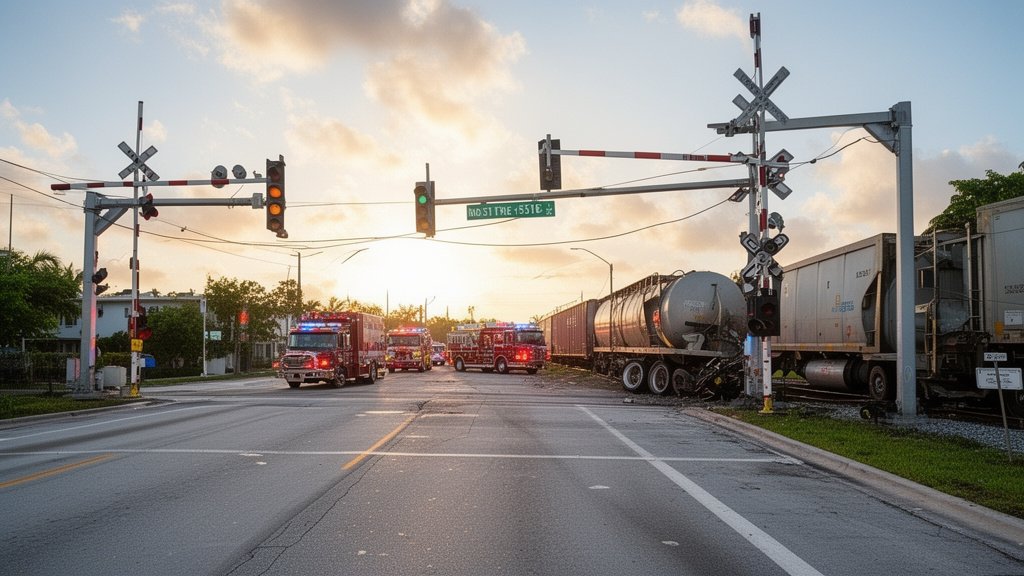
Emergency crews were scrambled to the intersection of Northeast 151st Street and Biscayne Boulevard in North Miami on Monday evening following reports of a collision between a commercial truck and a freight train. The incident, which paralyzed traffic in one of the city’s busiest corridors, triggered an immediate response from local law enforcement and first responders. Authorities have since confirmed that while the collision caused significant property damage and widespread traffic delays, there were no serious injuries reported among the involved parties.
Key Highlights
- Incident Location: The collision occurred at the intersection of Northeast 151st Street and Biscayne Boulevard, a major transit artery in North Miami.
- Vehicles Involved: A freight train and a commercial truck were the primary vehicles involved in the collision.
- Injury Status: Despite the scale of the impact, Miami-Dade authorities confirmed that no serious injuries were sustained by anyone on the scene.
- Traffic Impact: The surrounding roads were severely congested as first responders secured the perimeter and cleared the intersection.
- Ongoing Investigation: Local officials are currently analyzing the circumstances surrounding the crash to determine the exact sequence of events.
Navigating the Intersection Incident: Analyzing Rail-Road Safety
The intersection of Northeast 151st Street and Biscayne Boulevard serves as a critical junction for commuters and commercial freight transport alike. When these two modes of logistics intersect, the margins for error are razor-thin. Monday evening’s incident serves as a stark reminder of the complexities involved in maintaining safety at railway grade crossings within dense urban environments. While the outcome could have been catastrophic, the absence of serious injuries allows analysts to focus on the procedural failures that may have precipitated the crash rather than a tragedy of life.
The Mechanics of the Emergency Response
Upon receiving the emergency calls, the North Miami Police Department and Miami-Dade Fire Rescue mobilized units to the scene. The primary priority was immediately twofold: ensuring the well-being of the truck driver and any rail personnel, and securing the scene to prevent secondary accidents. In incidents involving heavy freight, the kinetic energy involved often results in significant wreckage, even at lower speeds. Emergency protocols dictate that the area must be treated as a hazardous environment due to the potential for fuel leaks, compromised cargo, and electrical instability from the rail signal infrastructure. The efficiency of the responders in stabilizing the site was instrumental in reopening the thoroughfare to traffic, albeit after significant delays.
Rail Infrastructure and Urban Logistics
Biscayne Boulevard acts as a central nervous system for North Miami traffic. The placement of freight rail lines in such high-density, high-traffic zones creates an inherent tension between the speed requirements of freight logistics and the safety needs of local motorists. The freight rail operators in the region, often coordinating with the Florida East Coast Railway corridor, must adhere to strict regulatory standards regarding signaling and crossing gate operations.
Analysts note that incidents like this prompt a deeper review of “Grade Crossing Safety.” This involves evaluating sightlines for truck drivers, the timing of warning gates, and whether increased traffic volume in North Miami necessitates upgrades to passive or active safety systems. For the trucking industry, these intersections require rigorous driver training regarding clearance procedures—ensuring a vehicle can fully clear the tracks before entering the crossing.
Examining Secondary Impacts
Beyond the immediate physical damage, the secondary impacts of such a collision are substantial. First, there is the supply chain disruption; any freight train delay has a ripple effect on the regional movement of goods. Second, the socioeconomic impact of road closures at a major junction like 151st and Biscayne affects thousands of commuters. Finally, there is the logistical challenge of clearing heavy vehicles from rail tracks. This requires specialized equipment, often delaying the resumption of rail traffic for several hours. Understanding these facets provides a more comprehensive view of why authorities treat these accidents with such extreme caution and resources.
FAQ: People Also Ask
Q: What should drivers do if they get stuck on railroad tracks?
A: If a vehicle becomes immobilized on tracks, occupants should exit the vehicle immediately and move away from the tracks at a 45-degree angle in the direction of the oncoming train to avoid being hit by flying debris. Do not attempt to move the vehicle.
Q: Why do these collisions still happen at modern crossings?
A: Most incidents are attributed to human error, such as miscalculating the clearance time, heavy traffic preventing a truck from moving forward, or distractions. While technology like gated crossings and warning lights is advanced, it cannot fully account for all variables in complex urban traffic patterns.
Q: Will there be legal or regulatory consequences for the truck driver?
A: That depends entirely on the investigation by the North Miami Police Department. They will review logs, traffic camera footage, and witness statements to determine if a traffic violation occurred. Regulatory bodies may also conduct a separate review if the truck was a commercial carrier involved in interstate commerce.
Q: How do authorities determine fault in a train-truck crash?
A: Investigators look at signal maintenance records, train speed data from the locomotive’s “black box,” and the positioning of the truck relative to the crossing signals. If the signals were operational and the gate was down, the burden of fault often leans toward the vehicle operator.