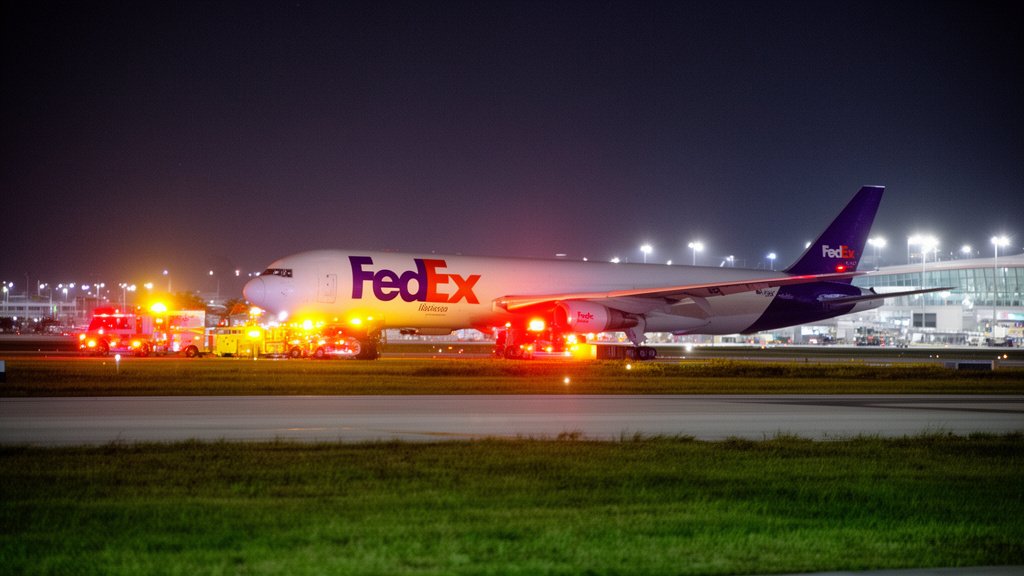
A FedEx cargo plane overran a runway at Miami International Airport (MIA) on Wednesday night, necessitating an immediate emergency response and triggering a temporary closure of the airport’s primary runway operations. The incident, which occurred just as the facility braced for the record-breaking travel volumes associated with the Thanksgiving holiday, prompted swift action from air traffic controllers and emergency services. Fortunately, officials confirmed that no injuries were reported among the flight crew, and the aircraft remained upright despite its departure from the paved surface.
Key Highlights
- Incident Specifics: A FedEx cargo aircraft, a Boeing 767, exited the runway surface at Miami International Airport (MIA) late Wednesday night.
- Operational Status: The incident forced a temporary suspension of most runway operations at the airport, causing minor ripples in flight schedules during the lead-up to the busy Thanksgiving travel window.
- Safety Outcome: There were zero injuries reported among the crew members on board.
- Immediate Response: Local emergency crews and airport staff contained the scene, and federal aviation authorities have been notified to conduct a standard post-incident investigation.
Runway Safety and Operational Integrity at MIA
The aviation industry operates on narrow margins of error, and runway excursions—where an aircraft drifts off the designated pavement during landing or takeoff—are serious events that trigger comprehensive regulatory reviews. At a major hub like Miami International Airport, which serves as a critical artery for both passenger travel and global cargo logistics, any runway closure has immediate, quantifiable consequences. When the FedEx cargo jet overran the runway on Wednesday, the primary concern of local authorities was ensuring the safety of the crew, followed immediately by the containment of potential environmental hazards and the restoration of airport throughput.
The Anatomy of a Runway Excursion
In aviation parlance, a runway excursion occurs when an aircraft departs the end or the side of the runway surface. While the public often equates these events with high-drama catastrophic outcomes, the vast majority of these incidents, particularly those involving cargo carriers, result in minimal structural damage to the airframe and no casualties. The Wednesday night incident involving the FedEx 767 freighter is being treated as a priority by the Federal Aviation Administration (FAA). Investigators will be looking at several key variables: meteorological conditions at the time of the landing, the braking performance of the aircraft, and the specific inputs provided by the flight crew during the landing roll.
Runway surface conditions are a critical factor in these investigations. Miami’s climate often presents challenges, including sudden tropical downpours and high humidity that can affect surface friction coefficients. However, runway infrastructure is designed with advanced drainage systems and grooving to mitigate these risks. The National Transportation Safety Board (NTSB) will likely analyze the runway surface state at the exact moment of the touchdown to determine if hydroplaning or other surface-related factors played a role in the excursion.
The Thanksgiving Factor: Logistics Under Pressure
Timing is everything in the logistics sector. The incident occurred just as the Thanksgiving holiday period—the most intense travel week of the year in the United States—was beginning. MIA is not only a passenger gateway but also one of the largest cargo hubs in the nation. The disruption, while temporary, created a bottleneck effect. Cargo operations are sensitive to delay; a single hour of closure at a major hub can lead to cascading delays for global supply chains that rely on FedEx’s precision scheduling.
Airport authorities had to perform a delicate balancing act: cordoning off the affected area for investigation while simultaneously managing the influx of passenger flights and other cargo movements. The efficiency of the recovery speaks to the robust nature of Miami’s airport management protocols, which are tested regularly for exactly this type of scenario. By limiting the operational closure, the airport prevented a total logistics meltdown, showcasing the resilience of modern air traffic control systems.
Technical Aspects: Cargo Safety and Regulatory Oversight
Cargo flights operate under the same stringent safety regulations as passenger carriers, yet they often face unique operational pressures. The Boeing 767 freighter involved is a workhorse of the global logistics network. Investigating an overrun of this magnitude involves parsing the flight data recorder (FDR) and the cockpit voice recorder (CVR) to reconstruct the final moments of the flight.
Key questions for the NTSB will include:
1. Was there a mechanical malfunction during the landing roll, such as brake failure or thrust reverser issues?
2. Did the aircraft experience a localized wind shear or sudden change in wind direction, which can be difficult to detect at ground level?
3. Were there any runway surface anomalies that contributed to the drift?
Because the aircraft remained upright and the crew was safe, the investigation can proceed without the complexities of a crash site recovery, allowing for a more methodical analysis of the technical data. This transparency is vital for the aviation industry; findings from such incidents are often shared globally to improve runway design and pilot training modules, ensuring that similar events are avoided in the future.
FAQ: People Also Ask
Q: Was the airport closed entirely after the FedEx incident?
A: No. While the specific runway involved in the incident was closed for investigation and recovery, Miami International Airport continued to operate using other runways. This limited the impact on the broader flight schedule.
Q: What is the NTSB’s role in this investigation?
A: The National Transportation Safety Board (NTSB) is the federal agency responsible for investigating civil aviation accidents. They will gather evidence, analyze flight data, and issue a report that determines the probable cause of the runway excursion.
Q: Are there more runway overruns during the holiday season?
A: Statistically, there is no direct link between the holiday season and an increase in runway excursions. However, the higher volume of flights and the pressure to maintain schedules can heighten the operational tempo, requiring extreme precision from pilots and air traffic controllers.
Q: Why do cargo planes sometimes overrun runways?
A: Runway excursions can be caused by various factors, including adverse weather, mechanical issues, pilot error, or runway surface conditions. Each case is unique, and investigations typically look at the interplay between these variables.