President Donald Trump announced a new era for Venezuela, with the United States taking temporary Venezuela US Control following a dramatic military operation that captured Venezuelan President Nicolás Maduro. His wife, Cilia Flores, was also taken. This major news broke on January 3, 2026, and it quickly became a trending headline globally, marking a significant shift in Venezuelan politics and US intervention efforts.
Maduro Captured in Bold Military Strike
U.S. special forces executed a swift military raid, apprehending Maduro and Flores in the dead of night. Explosions echoed in Caracas, and power was cut in parts of the capital. U.S. officials described it as a large-scale strike. The captured couple boarded the USS Iwo Jima and were then flown to New York, where they face serious federal charges. The indictment includes narco-terrorism conspiracy and cocaine importation, echoing earlier indictments stemming from a 2020 grand jury filing. U.S. Attorney General Pam Bondi vowed swift justice, stating they would face “full wrath of American justice.” Maduro has consistently denied these charges, and Venezuelan authorities condemned the U.S. action, calling it an “imperialist attack.”
US Control of Venezuela: A Temporary Measure
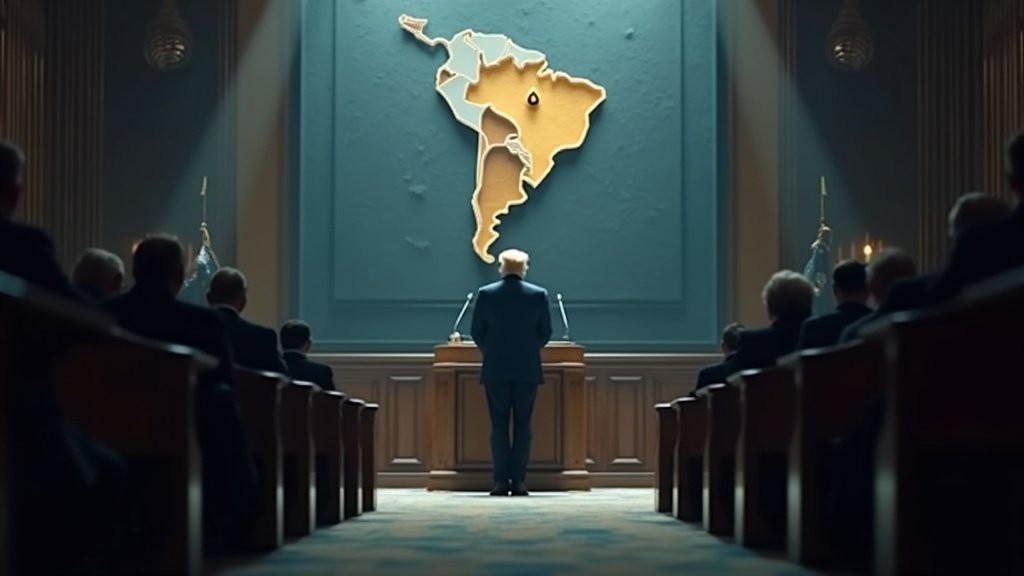
Trump declared the U.S. would temporarily assume Venezuela US Control until a “safe, proper, and judicious transition” occurred. He made this announcement at a press conference from his Mar-a-Lago estate near Miami, stressing a temporary role and vowing to ensure stability. The president suggested U.S. oil companies would lead this effort, investing billions to repair infrastructure. Venezuela possesses vast oil reserves, estimated at 303 billion barrels, representing a fifth of global reserves. U.S. companies would tap these oil reserves and sell oil to other nations. Trump stated the U.S. would be reimbursed, with oil revenues covering intervention costs. He expressed confidence in U.S. companies, calling them the “biggest anywhere in the world,” and that they would “start making money for the country.” This move was framed as beneficial for Venezuelans, with Trump promising they would “be rich, independent and safe.” The implications for US oil firms and their role in Venezuela US Control are significant.
Venezuela’s Government Reacts Amidst US Control
Venezuela’s vice president, Delcy Rodríguez, responded strongly, appearing on live television and demanding Maduro’s immediate release, calling him Venezuela’s “only president.” However, Venezuela’s Supreme Court made its own ruling, with the Constitutional Chamber ordering Rodríguez to assume the role of acting president to ensure “administrative continuity” and safeguard the nation’s defense, citing Maduro’s “forced absence.” This internal legal maneuver deepened the political uncertainty. Allies of Caracas condemned the U.S. action, labeling it a violation of sovereignty.
Background and U.S. Policy Shift on Venezuela US Control
The operation followed months of escalating pressure. The Trump administration had long accused Maduro’s regime of being a “narco-state” that financed drug terrorism. Past U.S. actions included seizing oil tankers and conducting strikes against suspected drug vessels. This intervention marks a significant U.S. military action, the most assertive in Latin America since 1989. Some critics labeled it “rank imperialism” and questioned its legality, noting it echoed the 2003 Iraq invasion. Trump’s policy shift was striking; he previously criticized foreign entanglements but also vowed to avoid wars. His administration had previously recognized opposition leader Juan Guaidó during the 2019 presidential crisis. U.S. relations with Venezuela had long been strained. Decades of mismanagement and sanctions had crippled its oil industry, with production falling drastically from its peak. Rebuilding infrastructure requires massive investment, a challenge now under Venezuela US Control.
Economic and Political Repercussions of Venezuela US Control
Trump’s plan to revitalize Venezuela’s oil sector under Venezuela US Control faces hurdles, as the infrastructure has severely decayed. Experts estimate billions are needed for repairs. U.S. oil companies have remained largely silent, with Chevron being one of the few still operating there. Analysts noted the market is currently well-supplied, so immediate oil price spikes were not expected. However, long-term production increases could impact global prices. The U.S. economy could benefit, with increased oil supply potentially lowering inflation and supporting U.S. equity valuations. This move could reshape inflation and interest rates. National security implications are also profound. Politically, the intervention drew sharp criticism. Democrats called it unacceptable and demanded immediate congressional briefings. Some legal experts questioned the operation’s legality, noting the lack of prior congressional notification. Many condemned the potential for a dangerous precedent, warning against imposing solutions by force. The specter of U.S. regime change returned to Latin America, and this action could destabilize the region, raising concerns among neighboring countries. Some leaders expressed outrage, fearing Washington’s aggressive new stance and its impact on Venezuelan politics.
An Uncertain Future for Venezuela Under US Control
The situation in Venezuela remains fluid. The U.S. has taken Venezuela US Control of its oil resources, aiming to oversee a transition, though the timeline remains unclear. Maduro is in U.S. custody, and Delcy Rodríguez now holds interim power in Venezuela, yet U.S. officials have questioned her legitimacy. Trump himself expressed doubts about opposition leader María Corina Machado’s support. The future governance structure is undefined. The news was a major headline, capturing global attention. The long-term consequences of this unprecedented U.S. intervention, including the potential for Venezuela reconstruction and economic recovery, are yet to fully unfold. It represents a bold, potentially transformative, but highly controversial chapter for Venezuela and the Western Hemisphere. The country now awaits its fate under a new, U.S.-influenced direction, with the full impact of Trump Venezuela and the capture of Maduro still being assessed.