U.S. Military Venezuela: Reports of Imminent Attacks Spark Regional Tensions Amidst Escalating ‘War on Drugs’
Washington D.C. – Reports emerged Friday, October 31, 2025, suggesting the Trump administration had made a decision to strike military installations within Venezuela, potentially within days or even hours. The alleged escalation of **US Military Venezuela** involvement, detailed by sources speaking to the Miami Herald, marks a significant intensification of U.S. policy aimed at the regime of Venezuelan President Nicolás Maduro and its alleged ties to Venezuela drug cartels.
The initial news broke from the Miami Herald, which cited anonymous sources indicating that President Trump had authorized strikes on Venezuelan military targets as part of an expanded campaign against the so-called “Soles cartel” and the Maduro regime. These targets, the report claimed, could be reached by air swiftly, with the objective of disrupting alleged drug-trafficking operations and potentially “decapitating” the Cartel de los Soles leadership. The Pentagon’s stated rationale for its heightened presence in the region has been to combat drug trafficking, with officials asserting that illicit narcotics are being trafficked into the United States, highlighting the critical nature of the **US Military Venezuela** situation.
However, the White House and President Trump himself moved quickly to tamp down the reports. White House Deputy Press Secretary Anna Kelly stated, “Unnamed sources don’t know what they’re talking about. Any announcements regarding Venezuela policy would come directly from the President.” President Trump, speaking to reporters aboard Air Force One, denied having made a decision on attacking military sites inside Venezuela. Secretary of State Marco Rubio also publicly addressed the news, suggesting the sources cited in the reporting had been misled. Despite these denials, the sheer scale of the U.S. military deployment in the Caribbean, particularly concerning the **US Military Venezuela** posture, has fueled intense speculation about impending actions.
A Significant Caribbean Military Buildup for US Military Venezuela Operations
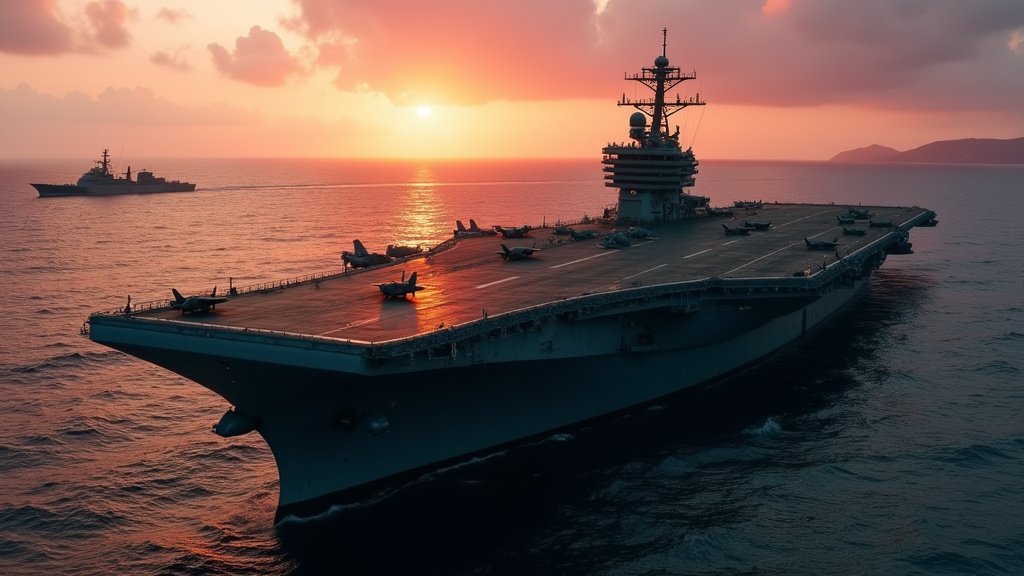
The context for these reports is a substantial and unprecedented U.S. military buildup in the Caribbean Sea near Venezuela, which began in August 2025. This deployment includes the USS Gerald R. Ford, the U.S. Navy’s newest and most advanced aircraft carrier, along with its accompanying strike group, comprising destroyers and other support vessels. The Joint Task Force established for this operation also includes F-35B fighter jets staged in Puerto Rico and MQ-9 Reaper drones. U.S. officials have characterized this military posture as a crucial component of an expanded “war on drugs” aimed at disrupting narcotics trafficking and dismantling transnational criminal organizations, directly involving the **US Military Venezuela** directive.
One of the primary targets of this U.S. campaign is the “Cartel de los Soles” (Cartel of the Suns), a group the U.S. government alleges is led by President Maduro and other high-ranking Venezuelan officials. In July 2025, the U.S. Department of the Treasury officially designated the Cartel de los Soles as a Specially Designated Global Terrorist (SDGT) organization, citing its material support for other foreign terrorist organizations like Tren de Aragua and the Sinaloa Cartel. The U.S. has also significantly increased the bounty on Maduro’s head, with the Department of State offering up to $50 million for information leading to his arrest and/or conviction for violating U.S. narcotics laws. Similar large bounties are offered for other key regime figures. Military analysts suggest that while the official line emphasizes drug interdiction, the strategic deployment of assets like the USS Gerald R. Ford indicates a readiness for more decisive, potentially politically motivated actions against the regime itself, underscoring the **US Military Venezuela** strategic importance.
Escalating Tensions and International Responses to US Military Venezuela Actions
The U.S. military has already conducted numerous strikes against vessels alleged to be transporting drugs, particularly off Venezuela’s coast. Since early September, these operations have resulted in the deaths of at least 61 individuals, described by U.S. officials as suspected traffickers. However, these actions have drawn significant criticism regarding the **US Military Venezuela** operations. The United Nations human rights office has labeled these strikes as potentially “extrajudicial killings” and called for investigations. Critics argue that the U.S. military is not typically tasked with law enforcement operations of this nature and that the justification for using lethal force lacks sufficient public evidence.
President Maduro has vehemently denounced the U.S. military presence and actions as acts of aggression and a pretext for regime change. Venezuela has sought to bolster its defenses by appealing for advanced military support from Russia, China, and Iran. Leaked U.S. documents indicate that Caracas has requested missile systems, radar technology, aircraft repairs, and financing from Moscow and Beijing, and has coordinated drone shipments from Iran. This outreach highlights Venezuela’s ongoing strategic reliance on these nations, despite Russia’s current focus on the conflict in Ukraine and international sanctions. The potential for the **US Military Venezuela** to engage in conflict remains a high-stakes possibility.
Analysts Weigh In: Regime Change or Counter-Narcotics in US Military Venezuela Context?
While the Trump administration maintains that its actions are solely focused on combating drug trafficking, many military analysts and observers interpret the significant military buildup and reported readiness for strikes as preparations for a potential regime-change operation or decapitation strike against Maduro and his inner circle. The extensive naval and air presence is seen as more than is necessary for merely intercepting drug boats, particularly in the context of the **US Military Venezuela** operation. Experts note that Venezuela’s military, though possessing some Russian-made equipment, is severely degraded by corruption, neglect, and sanctions, making any direct confrontation with U.S. forces likely to be swift and decisive.
The potential implications of U.S. military action inside Venezuela are far-reaching. Such a move would dramatically escalate tensions in an already volatile region, potentially drawing in other global powers and exacerbating existing geopolitical rivalries. It also raises questions about the long-term U.S. commitment and the risk of getting entangled in protracted conflict, despite President Trump’s stated aversion to foreign wars. The narrative of a “war on drugs” may serve to garner domestic support, but the underlying strategic objectives and potential consequences continue to be subjects of intense debate and analysis, with the situation remaining highly fluid and the **US Military Venezuela** role at the center of discussions.
This developing news, originating from reports in outlets like the Miami Herald, underscores the complex and perilous geopolitical landscape surrounding Venezuela. The international community watches closely as the specter of direct military confrontation looms, a stark reminder of the persistent challenges in addressing regional instability and illicit activities. The lack of definitive official statements beyond denials leaves the situation shrouded in uncertainty, with the possibility of significant military engagement remaining a pressing concern in the current news cycle and the **US Military Venezuela** implications significant.