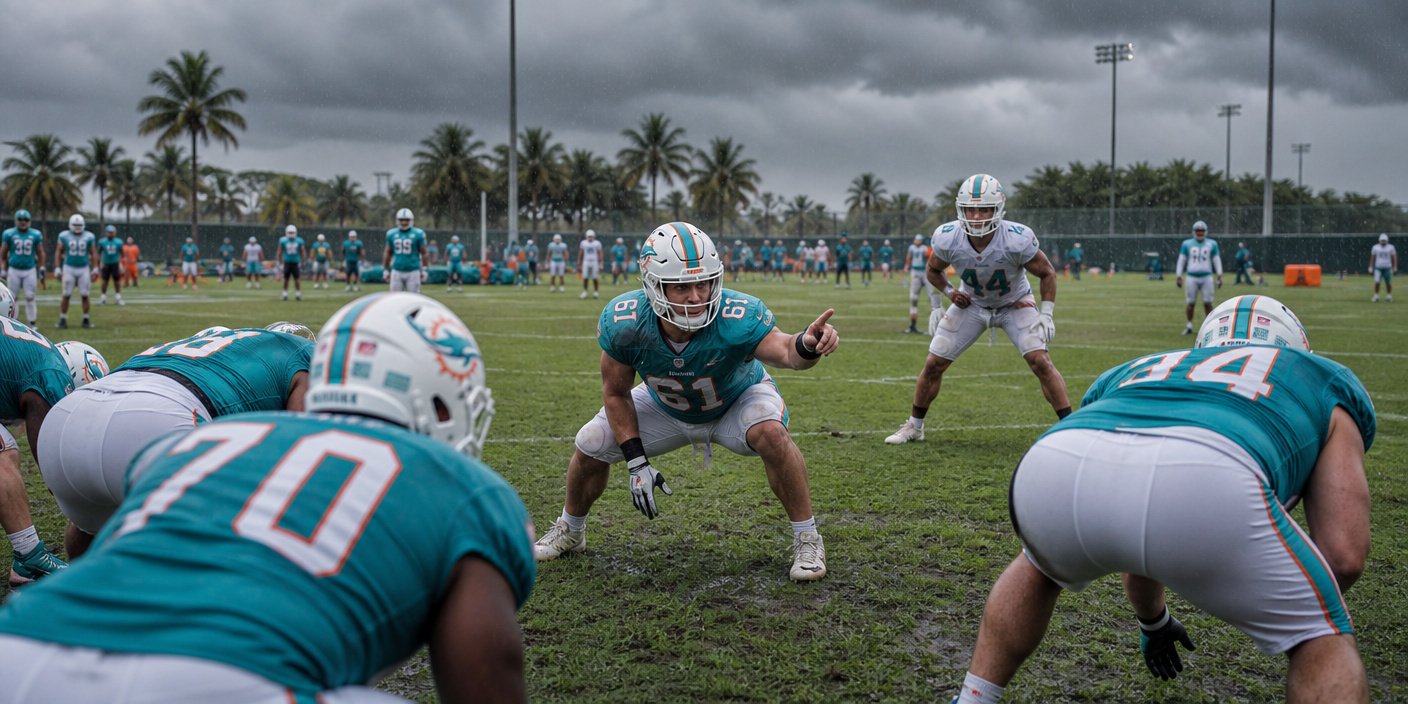
Practice 7 of the 2026 Miami Dolphins training camp brought a unique set of challenges as players and coaching staff navigated volatile weather conditions, forcing significant adjustments to the scheduled competitive drills. Despite the atmospheric variables, the team demonstrated remarkable adaptability, with the focus shifting heavily toward situational football and the refinement of individual unit cohesion. The session proved to be a pivotal moment for leadership on the offensive line and defensive intensity, with center Aaron Brewer and rookie linebacker Jacob Rodriguez emerging as the standout performers of the day.
Key Highlights:
- Operational Resilience: The coaching staff successfully navigated weather-related disruptions, maintaining high-intensity competitive periods despite the shifting conditions.
- Veteran Stability: Center Aaron Brewer showcased elite consistency, anchoring the offensive line and providing reliable communication throughout the altered drill schedule.
- Rookie Emergence: Linebacker Jacob Rodriguez solidified his defensive presence, displaying advanced coverage instincts and physical readiness during team scrimmage segments.
- Tactical Adaptability: The practice reinforced the team’s ability to maintain focus and execute complex playbooks under less-than-ideal environmental variables.
Navigating the Elements: Operational Adaptability at Practice 7
In the high-stakes environment of the NFL, the ability to pivot is just as critical as raw athletic talent. For the Miami Dolphins, Practice 7 served as an inadvertent test of that internal philosophy. As weather patterns shifted rapidly across the South Florida training grounds, the coaching staff was forced to modify the flow of the session, condensing specific individual drills into tight, high-intensity team segments.
The Shift in Training Methodology
When the forecast fluctuates, the margin for error in training camp narrows significantly. The adjustments made during this seventh practice were not merely about safety; they were about forcing players to adapt their communication styles under pressure. In the NFL, audibles are called in loud, distracting stadiums, but they are also called in torrential rain or blistering humidity. By accelerating the tempo of the scrimmage periods, the Dolphins staff pushed the players to prioritize precision over pure speed. This environment provided a clearer picture of who could maintain professional standards when the rhythm of practice is disrupted.
The Value of Environmental Testing
For a team with championship aspirations, these types of sessions are invaluable. They break the monotony of a standard training camp schedule and force the team into a ‘game-day’ mindset. The coaching staff emphasized rapid transitions between drill sets, ensuring that players remained locked into their assignments regardless of the exterior interruptions. This level of discipline is often what separates fringe roster players from starters as the team looks toward the mid-season grind of the 2026 campaign.
The Veteran Anchor: Aaron Brewer’s Command
At the center of the offensive line, both figuratively and literally, Aaron Brewer has become the bedrock of the unit. During Practice 7, his performance was a masterclass in reliability. While younger offensive linemen might struggle with the nuances of a shifting snap count or altered blocking assignments due to the weather, Brewer operated with a veteran’s poise.
Communication and Line Identity
Brewer’s role goes beyond the physical act of snapping the ball. His ability to identify defensive fronts and relay protection adjustments to his guards and tackles is essential to the offensive scheme. During the competitive drills, Brewer was seen consistently directing the offensive line, ensuring that even as the practice structure shifted, the blocking assignments remained sound. His experience provides a level of comfort for the quarterback, knowing that the interior of the line is secure regardless of the situation.
Developing the Core
As the 2026 season progresses, the continuity established by veterans like Brewer will be the engine of the offense. His performance in Practice 7 reinforces why the coaching staff prioritizes his presence in the middle. His work ethic is setting a standard for the younger players on the squad, emphasizing the ‘next play’ mentality that is crucial for a successful offensive season.
The Rookie’s Ascent: Jacob Rodriguez in the Spotlight
Perhaps the most compelling story from Practice 7 was the emergence of rookie linebacker Jacob Rodriguez. Often, rookies in training camp are characterized by moments of brilliance interspersed with fundamental errors as they adjust to the speed of the professional game. However, Rodriguez showed a level of instinctual awareness during this practice that caught the attention of both the defensive staff and veteran teammates.
Defensive Versatility
Rodriguez demonstrated an impressive ability to read the offense’s intentions, particularly during the modified scrimmages. His closing speed was evident when tracking the ball carrier, and more importantly, his ability to diagnose screen passes—often a trouble spot for incoming rookies—was precise. During one particular sequence, his ability to drop into zone coverage while keeping eyes on the backfield allowed him to disrupt a pass attempt, showcasing the lateral quickness that made him a draft priority.
Building Towards the Season
It is one thing to show potential in shorts, but it is another to demonstrate that potential while adhering to complex defensive schemes. Rodriguez is currently moving up the depth chart by showing that he understands his assignments. His performance in Practice 7 was not just about athletic plays; it was about ‘football IQ.’ If he continues to refine his gap discipline and communication, he could be a significant contributor to the Dolphins’ defensive rotation in 2026.
FAQ: People Also Ask
How do weather-related adjustments impact NFL training camp performance?
Weather adjustments force players to adapt to changing field conditions, which tests their focus and ability to execute plays under pressure. It also allows the coaching staff to simulate the unpredictable nature of actual game days, helping build mental toughness.
Why is Aaron Brewer critical to the 2026 Dolphins offensive line?
As a veteran center, Brewer acts as the ‘quarterback’ of the offensive line. His ability to read the defense, manage snap counts, and communicate protection schemes is essential for maintaining stability, especially for a unit integrating new strategies for the 2026 season.
What makes Jacob Rodriguez’s performance in Practice 7 notable?
Rodriguez displayed a high ‘football IQ’ by diagnosing plays and demonstrating elite closing speed. His ability to handle complex defensive assignments during a disrupted practice session suggests he is adjusting quickly to the professional level and could earn a larger role in the defensive rotation.
How are players selected for competitive drills during camp?
Coaches monitor performance in individual position drills and strength and conditioning sessions. High-performers are then tested in competitive ‘live-action’ drills to gauge their ability to translate practice skills into real-time, game-like scenarios.