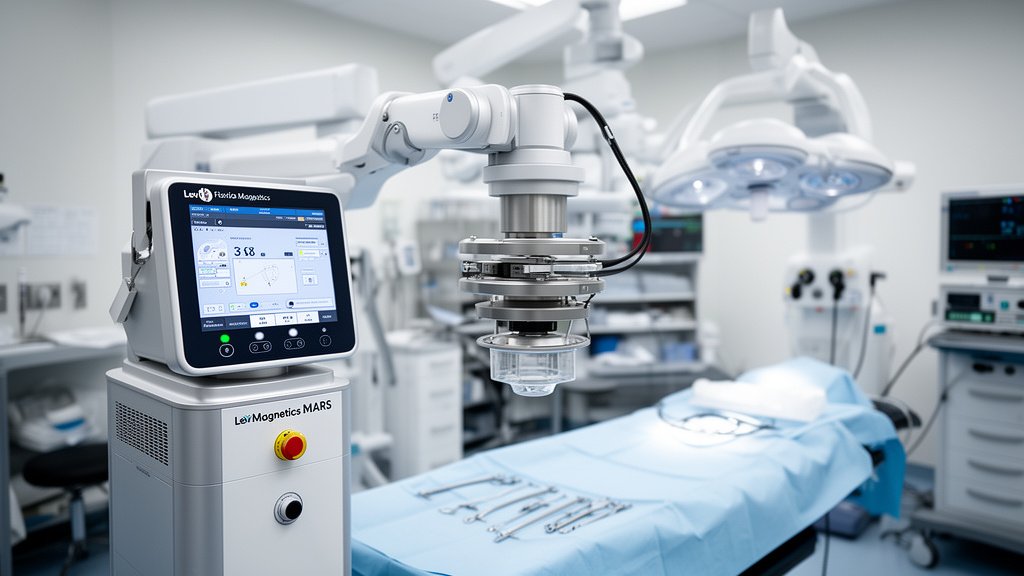
HCA Florida Mercy Hospital in Miami has achieved a significant milestone in regional healthcare by becoming the first facility in the state to deploy the Levita Magnetics Magnetic Assisted Robotic Surgery (MARS) platform. This strategic implementation represents a pivot toward more refined, minimally invasive surgical techniques, potentially altering the landscape for abdominal surgeries in Florida. By leveraging magnetic forces to manipulate surgical instruments, the system promises to reduce the number of physical incisions required for routine procedures, marking a technological leap from traditional laparoscopic methods.
Key Highlights
- State-First Implementation: HCA Florida Mercy Hospital is the inaugural site in Florida to offer the MARS platform, placing the Miami institution at the forefront of robotic-assisted surgical technology.
- Magnetic Mechanics: The system utilizes a specialized magnetic retractor controlled from outside the body, allowing surgeons to manipulate internal tissues without additional access ports.
- Minimally Invasive Evolution: By reducing the total number of incisions needed for procedures like cholecystectomy (gallbladder removal), the platform aims to improve cosmetic outcomes and potentially shorten patient recovery times.
- Strategic HCA Deployment: The adoption by HCA Florida Healthcare highlights a broader network-wide commitment to investing in high-tech, efficiency-driven surgical robotics to enhance patient care standards.
Surgical Innovation: The Rise of Magnetic Assistance
The introduction of the Levita Magnetics MARS platform at HCA Florida Mercy Hospital is not merely a hardware upgrade; it is a fundamental shift in how surgical access is conceptualized. Historically, minimally invasive surgery has relied heavily on multiple access points—trocars inserted into the abdomen to hold cameras and retractors. While effective, each entry point carries a risk of infection, increased postoperative pain, and visible scarring. The MARS system challenges this paradigm by introducing magnetic retraction technology.
Understanding the MARS Technology
At the core of this system is the principle of Magnetic Assisted Robotic Surgery. The technology employs a surgical retractor inside the patient’s abdomen, which is then controlled by a magnetic device positioned outside the body. Because the control mechanism is external, it eliminates the need for one or more of the traditional ports that would otherwise be required to hold the retractor in place.
Surgeons at HCA Florida Mercy are utilizing this to achieve “fewer-incision” surgery. This is particularly relevant for abdominal procedures, such as laparoscopic cholecystectomy, which is among the most common surgeries performed in the United States. By moving the control of tissue retraction to the external surface of the skin, the MARS platform provides the surgeon with a stable, unobstructed view of the surgical site while maintaining necessary tissue tension—a critical component of any laparoscopic operation.
The Clinical Advantage: Less Invasive, Faster Recovery
From a clinical perspective, the primary value proposition of the MARS system lies in patient outcomes. Traditional laparoscopy, while far superior to open surgery, still creates trauma at each port site. By reducing the number of ports, surgeons may be able to significantly reduce the “footprint” of the surgery.
Patient data in broader trials associated with the MARS system suggests that fewer incisions correlate with lower postoperative pain scores and improved recovery times. For the patient, this means potentially less reliance on pain medication, a reduced risk of incisional hernias, and a faster return to daily activities. Furthermore, the cosmetic benefit of having fewer, smaller scars is an increasingly important factor for patients opting for elective or semi-elective abdominal procedures.
Florida’s Strategic Healthcare Shift
The debut of this technology in Miami is part of a larger trend of HCA Florida Healthcare aggressively adopting robotic and AI-assisted surgical platforms. In the competitive Florida healthcare market, where major systems are vying to offer the most advanced technology to attract both patients and top-tier surgical talent, the MARS platform serves as a key differentiator.
Integrating the MARS system is not an isolated decision; it reflects an institutional bet on the future of “Smart Surgery.” As robotic platforms become more sophisticated, the integration of robotics with magnetic control and, eventually, artificial intelligence, will define the next decade of operative medicine. For HCA Florida Mercy, this launch establishes the hospital as a hub for surgical innovation, setting a benchmark that other regional hospitals will likely be pressured to match.
Furthermore, the economics of this technology are compelling. While the upfront investment in robotic platforms is substantial, the long-term efficiencies—such as shorter hospital stays, fewer complications, and higher patient satisfaction—create a virtuous cycle that justifies the expenditure. The HCA Florida Mercy team is now positioned to gather localized data on these efficiencies, which will likely influence future adoption strategies across the broader HCA network in the Southeast.
FAQ: People Also Ask
What specific surgeries is the MARS platform used for?
Currently, the Levita Magnetics MARS platform is primarily utilized for abdominal surgeries, most notably laparoscopic cholecystectomy (gallbladder removal). Its ability to provide stable tissue retraction makes it ideal for procedures requiring clear visualization in the abdominal cavity.
Does the MARS platform replace the surgeon?
No, the MARS platform does not replace the surgeon. It is an assistant device. The surgeon remains in total control, manually guiding the external magnetic controller to manipulate the internal retractor, ensuring that the surgeon’s expertise and judgment drive the procedure.
How does magnetic surgery differ from standard robotic surgery?
Standard robotic surgery (like the da Vinci system) uses robotic arms to manipulate surgical instruments inside the body through ports. The MARS platform is distinct because it uses an external magnetic field to control a retractor inside the body, eliminating the need for a specific robotic arm or port to hold that instrument, thereby reducing the number of total incisions.
Is this technology available throughout all Florida hospitals?
No, it is currently exclusive to HCA Florida Mercy Hospital in Miami as the first site in Florida to implement the technology. While other hospitals may eventually adopt the MARS platform, it is currently a premium, specialized offering at this specific location.