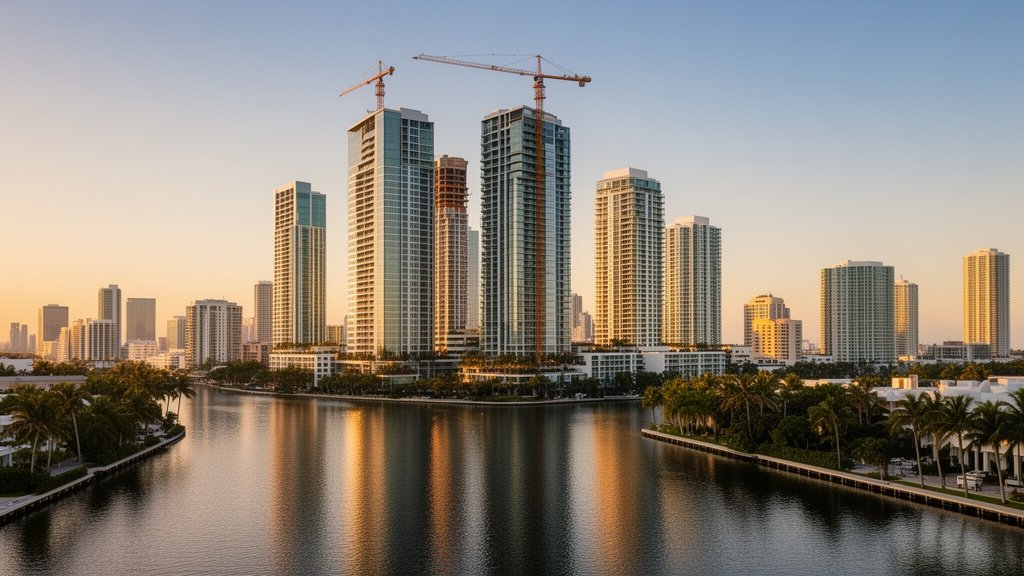
At ‘The Real Deal’s’ recent ‘Welcome to the New Miami’ event, industry leaders gathered to address a defining paradox of the current South Florida housing market: while broader volatility grips the national real estate landscape, the ultra-luxury segment remains in a state of hyper-competitiveness fueled by severe inventory constraints. As high-net-worth individuals continue to consolidate portfolios in Florida, the traditional real estate sales process is increasingly bypassed in favor of discreet, off-market deals designed to secure premium, turn-key properties.
Key Highlights
- Inventory Bottleneck: A chronic shortage of ultra-luxury supply persists, with top-tier properties in high-demand enclaves remaining off the open market.
- The Rise of Private Channels: Buyers are shifting toward off-market, ‘pocket’ listings to bypass bidding wars and preserve privacy.
- Market Resilience: Despite national economic volatility and fluctuating interest rates, the $10 million-plus segment in Miami shows unique resilience due to cash-heavy transactions.
Navigating the ‘New Miami’ Supply Deficit
The narrative surrounding the South Florida luxury real estate market has shifted from the explosive growth seen in the immediate post-pandemic period to a more mature, yet constrained, landscape. During ‘The Real Deal’s’ panel discussions, veteran brokers highlighted that the ‘New Miami’ is not just a destination for seasonal visitors but a permanent capital for wealth, which has fundamentally altered the supply-demand equilibrium.
The Anatomy of a Supply Squeeze
In the ultra-luxury segment—specifically properties valued at $10 million and above—the lack of inventory has reached critical levels. Historically, market cycles operate on a ebb and flow of listings. However, the current cycle is defined by a ‘lock-in effect.’ Sellers who secured low-interest rates or who see their properties as irreplaceable assets are simply not listing. When they do, the competition is fierce.
Brokers noted that this is not merely a shortage of quantity, but a shortage of quality. Buyers are searching for ‘trophy assets’—fully renovated waterfront estates or high-floor penthouses with specific finishes. When these assets do come to market, they rarely stay there long enough to generate public buzz. This has catalyzed a move away from the Multiple Listing Service (MLS) and toward private networks. Networking, reputation, and broker-to-broker relationships have replaced the traditional ‘for sale’ sign as the primary driver of market liquidity. For the savvy investor, the most valuable commodity in South Florida is not just the property, but the information regarding who might be willing to sell, even if they aren’t ‘on the market.’
Migration and the ‘Wealth Effect’
Secondary analysis suggests this trend is deeply tied to the demographic shift occurring in South Florida. The influx of financial institutions and tech firms into the Miami-Dade corridor has created a ‘wealth effect.’ These new residents are not looking for starter homes; they are looking for lifestyle upgrades that demand immediate occupancy. This demand side, coupled with a construction pipeline that faces zoning and development hurdles, ensures that the supply side cannot react quickly enough to stabilize prices.
Even as some economists predict cooling across the broader U.S. housing market, Miami’s luxury tier operates in a vacuum. Because these transactions are predominantly cash-based, they are significantly less sensitive to the Federal Reserve’s interest rate hikes. This isolation from traditional mortgage-rate volatility allows the local market to maintain its upward trajectory, though brokers caution that this creates a two-tiered economy: one where luxury pricing continues to climb, and another where entry-level housing faces pressure from borrowing costs.
The Historical Context: How This Differs from 2008
It is tempting to view market volatility through the lens of the 2008 financial crisis, but current industry data suggests a vastly different reality. Unlike the speculative boom of the mid-2000s, which was built on loose lending standards and over-leverage, the current ‘New Miami’ market is backed by substantial liquid capital. Today’s buyers possess significant equity, and the ‘distressed’ sales that characterized the post-2008 era are notably absent in the ultra-luxury tier. This historical divergence is crucial; it suggests that the floor for luxury prices in South Florida is significantly higher than previous cycles, making a catastrophic price correction unlikely in the near term.
Future Predictions: Vertical vs. Horizontal Living
The coming years will likely see a bifurcation in luxury development. We are witnessing a intense battle for space between horizontal sprawling estates—which are becoming scarcer and thus exponentially more valuable—and the vertical evolution of Miami. Branded residential towers and ultra-luxury condo developments are attempting to replicate the ‘estate’ feel within a high-rise format to capture the overflow of demand. Brokers expect the next phase of the market to be defined by ‘hyper-local’ competition, where micro-neighborhoods (like Bal Harbour vs. Coconut Grove) dictate value more than broad regional trends. The ability of developers to provide experiential living—think private clubs, medical spas, and concierge services within the building—will be the deciding factor for the next wave of ultra-luxury buyers.
FAQ: People Also Ask
1. Why is there a shortage of ultra-luxury homes in Miami?
Significant demand from high-net-worth individuals relocating to South Florida, combined with a lack of available developable land in premium coastal areas, has created an inventory bottleneck that outpaces new construction.
2. What is an ‘off-market’ deal?
An off-market deal, or ‘pocket listing,’ refers to a property that is sold without being publicly listed on the Multiple Listing Service (MLS). These sales are handled through private networks and broker connections to ensure privacy and avoid competitive bidding wars.
3. Is the Miami housing market expected to crash?
Brokers at ‘The Real Deal’ event emphasized that the luxury segment is largely cash-driven and shielded from the interest-rate sensitivity affecting the wider national housing market. Therefore, most experts view the current climate as a price-stabilization period rather than a crash.
4. How are interest rates affecting the ultra-luxury market?
Because the vast majority of ultra-luxury transactions in South Florida are cash-based, higher interest rates have a negligible impact on the purchase power of the primary buyer demographic, unlike the entry-level or mid-market segments.