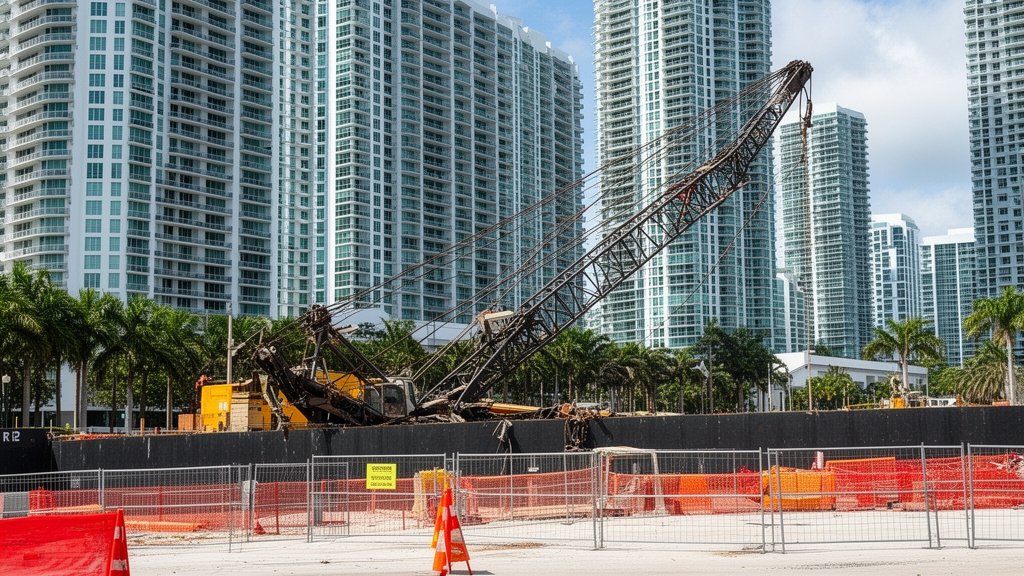
An 85-foot construction crane collapsed in the heart of Miami’s affluent Brickell neighborhood earlier this week, sending shockwaves through the city’s dense business district. The incident, which resulted in the crane crushing a parked vehicle and sparking a significant fire, has left four individuals hospitalized with minor injuries. Local authorities and federal agencies have since descended upon the site to secure the area and launch a comprehensive forensic engineering investigation, as residents and business owners demand answers regarding site safety protocols in South Florida’s rapidly expanding real estate landscape.
Key Highlights
- Incident Scale: An 85-foot crane structural failure occurred at a major construction site in the Brickell neighborhood.
- Casualties: Four individuals, including the crane operator and construction personnel, were transported to local hospitals with non-life-threatening, minor injuries.
- Site Damage: The crane’s collapse caused the total destruction of a stationary vehicle and ignited a localized fire that required rapid response from Miami-Dade Fire Rescue (MDFR).
- Regulatory Action: An immediate stop-work order has been issued as investigators from the Occupational Safety and Health Administration (OSHA) assess potential code violations.
The Anatomy of the Brickell Structural Failure
The incident, which unfolded during standard operating hours, serves as a stark reminder of the complexities involved in vertical construction within narrow urban environments. According to preliminary reports from the scene, the 85-foot crane experienced a catastrophic structural compromise while engaged in material transport. The sheer force of the collapse impacted a parked vehicle below, triggering an immediate conflagration. Firefighters arriving on the scene were met with high-heat flames emanating from the wreckage, complicating the initial extraction and rescue efforts.
For the four hospitalized victims, the outcome could have been significantly worse. Medical professionals on-site reported that the injuries, while requiring immediate hospitalization, were minor given the destructive potential of falling heavy machinery. The proximity of the collapse to high-traffic pedestrian zones in Brickell—a hub for both corporate headquarters and luxury residential towers—has prompted city planners to review traffic management and public safety buffers around active construction sites.
Investigating the Regulatory Landscape
OSHA investigators have officially begun their onsite review, focusing heavily on the crane’s maintenance logs, the operator’s certification, and the site’s adherence to Miami-Dade County’s stringent vertical building codes. When high-rise development occurs in dense areas like Brickell, the margin for error is razor-thin. Investigators are currently analyzing wind speed data from the time of the incident, as well as the mechanical integrity of the crane’s load-bearing components. If negligence is identified, the developer and the contracting firm could face significant litigation and increased scrutiny regarding future permitting processes in Miami.
Urban Density and Public Risk
Beyond the specific mechanics of this collapse, the incident brings the broader debate of “Magic City” urban density to the forefront. Brickell has seen an aggressive influx of capital and vertical growth over the past decade, with dozens of cranes dotting the skyline simultaneously. Urban planning experts are now calling for a re-evaluation of safety zones. Is the current 15-foot buffer zone sufficient? Should public access be restricted further when cranes are moving heavy loads over public rights-of-way? These questions are now central to the ongoing discourse between city officials and major developers.
Economic and Insurance Ripples
Construction insurance premiums in South Florida are already among the highest in the nation, driven by hurricane-related risks and high property values. A high-profile accident of this nature inevitably leads to a hardening of the market. General contractors across Miami-Dade may anticipate a wave of new risk assessment audits from insurers. Beyond insurance, the immediate work stoppage causes significant economic friction, with delays in construction timelines often costing developers hundreds of thousands of dollars per week in interest and operational carrying costs. The ripple effect of this collapse will be felt not just by the victims, but across the balance sheets of multiple stakeholders.
FAQ: People Also Ask
Q: What caused the crane to collapse in Brickell?
A: While an official cause is pending the results of the OSHA investigation, experts are evaluating factors such as mechanical fatigue, operator error, and external environmental factors like wind gusts, which are common in coastal Miami.
Q: Is it safe to drive or walk near construction sites in Brickell?
A: While accidents are statistically rare, city ordinances require safety netting and public warnings. Pedestrians are advised to always adhere to sidewalk closure signs and avoid walking directly beneath active swinging loads.
Q: Who is responsible for the damages caused by the crane collapse?
A: Liability typically rests with the general contractor and the specialized crane operator company. Investigations will determine if the incident was a result of equipment failure or human error, which will dictate the path of potential civil lawsuits and insurance claims.