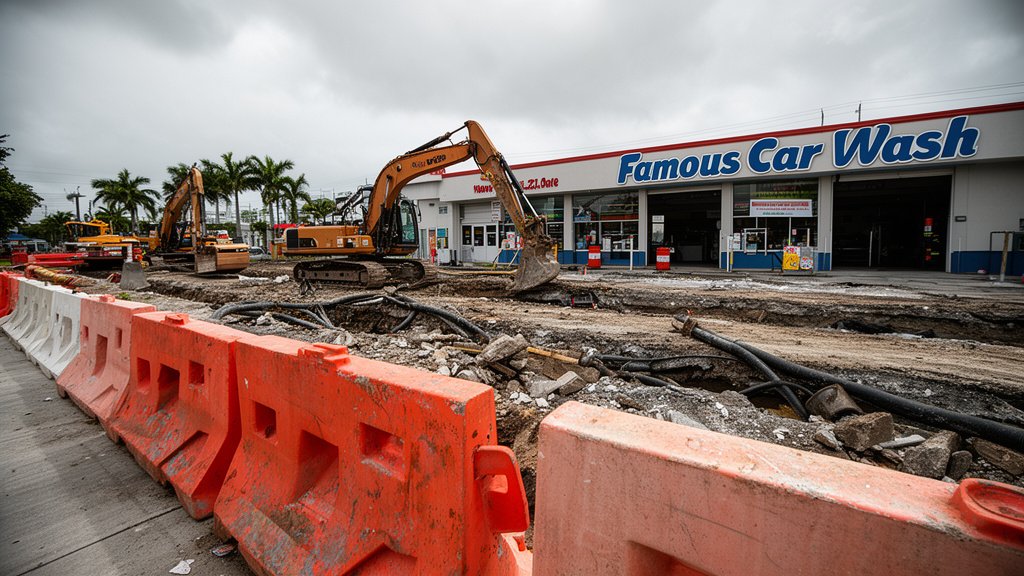
Community advocates and local entrepreneurs are converging on Northwest 22nd Avenue this week, demanding immediate financial compensation and relief for Black-owned businesses crippled by what they describe as mismanagement of vital water and sewer infrastructure upgrades. The focal point of the mobilization is the Famous Car Wash, a site that has become a symbol for the broader struggle of small businesses attempting to operate within the suffocating environment of a long-term construction zone.
Key Highlights
- The Protest Hub: Demonstrators are mobilizing at the Famous Car Wash, representing the dozens of Black-owned businesses currently isolated by the ongoing infrastructure work.
- Core Grievance: Business owners cite the protracted timeline of the water and sewer projects along Northwest 22nd Avenue as the primary driver of plummeting revenues and operational stagnation.
- Strategic Demands: Led by The Black Collective, the group is calling for tangible financial relief packages to offset months of lost foot traffic and supply chain disruption.
- Systemic Issue: This movement highlights a critical intersection between necessary municipal infrastructure updates and the disproportionate economic burden placed on minority-owned business corridors.
The Economic Toll of Infrastructure Stagnation
For months, the landscape along Northwest 22nd Avenue has been dominated by heavy machinery, unyielding orange barricades, and the persistent hum of construction—a sight that, while synonymous with city growth, has become a death knell for the local economy. The ongoing water and sewer infrastructure project, intended to improve long-term utility capacity, has instead created a physical barrier between businesses and their customer base.
The Anatomy of the Financial Bleed
The economic impact of prolonged construction is not merely a matter of inconvenience; it is an existential threat. For businesses such as the Famous Car Wash and surrounding independent retailers, the construction has effectively blocked access points, deterred drive-by patronage, and complicated delivery logistics. Small businesses, which often operate on thin profit margins, lack the capital reserves to weather a multi-month—or in this case, year-long—disruption.
When a street becomes impassable, the “economic leakage” is immediate. Customers who cannot easily navigate to a storefront will find alternatives, often shifting their loyalty to larger corporate entities that are better insulated from localized construction issues. This creates a lasting impact that extends far beyond the duration of the actual building work, as customer habits are difficult to reclaim once broken.
The Role of The Black Collective
The Black Collective has emerged as the driving force behind this call for accountability. By organizing the demonstration at the Famous Car Wash, the group is forcing a public reckoning with the City of Miami regarding its oversight of municipal contracts. Their demands are clear: if the city expects these businesses to endure the “public good” of infrastructure upgrades, the city must also bear the financial burden of the resulting economic displacement.
This advocacy represents a shift in how small business corridors are handling municipal friction. Rather than quietly absorbing losses, stakeholders are leveraging collective bargaining and public visibility to insist that economic development initiatives do not come at the expense of established Black-owned commerce.
Intersection of Development and Displacement
A secondary angle to this crisis is the inherent risk of gentrification and displacement. When Black-owned businesses are forced to close due to insurmountable infrastructure-related revenue loss, the resulting commercial vacancies often open the door for predatory real estate acquisitions. The fear among community organizers is that the “construction zone” will lead to a “commercial vacuum,” which is then filled by developers who do not serve the existing community.
This is not a new narrative in Miami, but the intersection of municipal public works projects and minority business districts brings a unique intensity to the situation. Protesters argue that the city’s planning departments failed to implement adequate mitigation strategies—such as temporary signage, accessible parking alternatives, or financial grant programs—to support businesses during the project’s lifecycle.
Looking Toward Equitable Infrastructure
The path forward requires a reevaluation of how the city of Miami balances infrastructure maintenance with the preservation of local ecosystems. Effective governance should include impact assessments that consider the viability of small businesses before breaking ground. Without such safeguards, the cost of “progress” is essentially subsidized by the very businesses that give the neighborhood its character. As The Black Collective continues to push for relief, their efforts serve as a litmus test for the city’s commitment to equitable economic recovery.
FAQ: People Also Ask
Q: What is the main cause of the protest on Northwest 22nd Avenue?
A: The protest is driven by delayed water and sewer infrastructure projects that have restricted access to Black-owned businesses, causing significant loss of revenue and customer traffic.
Q: Who is organizing the demonstration?
A: The demonstration is being organized by community advocates from The Black Collective, a group focused on economic justice and protecting Black-owned enterprises.
Q: Why is the Famous Car Wash being used as the gathering point?
A: The Famous Car Wash serves as a strategic and symbolic location that has been directly impacted by the construction, representing the struggle of the wider commercial corridor.
Q: What are the protesters demanding?
A: The group is demanding direct financial relief and compensation from the city to mitigate the losses sustained during the prolonged construction period.