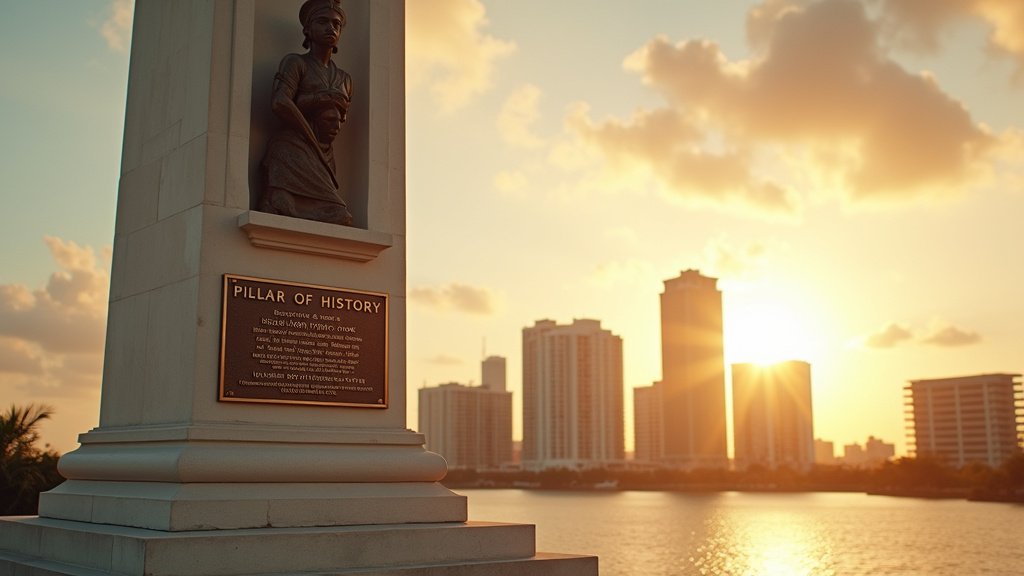
Miami is set to further cement the legacy of its original inhabitants, the Tequesta people, with the upcoming installation of a new bronze plaque on the iconic “Pillar of History” monument atop the Brickell Avenue Bridge. This vital addition, the Tequesta Memorial Plaque, will significantly enhance understanding of Miami’s Indigenous heritage. This initiative, expected to receive City Commission support, aims to provide essential historical context and elucidate the poignant symbolism of the “Tequesta Family” sculpture for the countless individuals who traverse the bridge daily. The Tequesta Memorial Plaque will serve as a beacon of remembrance for Miami’s deep Native American history Florida.
Honoring Miami’s Earliest Inhabitants with the Tequesta Memorial Plaque
The Tequesta were a Native American tribe who called the southeastern coast of Florida home for nearly two millennia, establishing a rich presence around Biscayne Bay and the Miami River long before European colonization. Their lives, deeply intertwined with the abundant natural resources of the region, saw them thrive as skilled hunter-gatherers and fishers. Evidence suggests their presence dates back as far as 500 BCE, and potentially even 7,000 years ago, making them the true first residents of the land that would become modern Miami. The installation of the Tequesta Memorial Plaque will highlight their enduring legacy and the history of the Biscayne Bay tribes.
The tribe’s territory spanned a significant portion of present-day South Florida, extending from near Boca Raton south to the tip of the peninsula and including the Florida Keys. Their main village, also named Tequesta by early Spanish explorers, was situated at the mouth of the Miami River. However, like many Indigenous peoples, the Tequesta faced immense challenges with the arrival of Europeans, succumbing to diseases, settlement battles, and enslavement, leading to their virtual disappearance by the mid-18th century. Despite their decline, archaeological sites like the Miami Circle archaeological site stand as enduring testaments to their complex society and deep connection to the land, a connection the Tequesta Memorial Plaque will help to commemorate.
The Pillar of History: A Monumental Tribute Enhanced by the Tequesta Memorial Plaque
In 1995, during the reconstruction of the Brickell Avenue Bridge, the Florida Department of Transportation commissioned a significant public art installation that would serve as a lasting memorial. The result was the “Pillar of History,” a towering 36-foot bronze monument created by renowned Cuban Master Sculptor Manuel Carbonell. This monumental work is a graphic narration of the Tequesta people’s lives, featuring 158 intricate figures that depict their culture and environment. The addition of the Tequesta Memorial Plaque will further illuminate this significant work and the Tequesta people Miami.
Crowning the column is the “Tequesta Family” sculpture, a 17-foot bronze piece that poignantly captures the tribe’s narrative. It portrays a Tequesta warrior aiming an arrow towards the sky, his wife looking on, and their child shielding his eyes – a symbolic representation of the tribe’s search for their future and the inevitable nature of their eventual extinction. The monument also includes bas-reliefs honoring key Miami pioneers such as Henry Flagler, Dana A. Dorsey, William and Mary Brickell, Marjory Stoneman Douglas, and Julia Tuttle, alongside depictions of Florida’s native fauna. The “Pillar of History” was a pioneering effort by the FDOT to integrate art and engineering into bridge design, creating a landmark that connects Miami’s past with its present, now enhanced by the Tequesta Memorial Plaque.
A New Layer of Understanding for the Tequesta Memorial Plaque
The proposed bronze plaque will build upon the existing monument by offering specific explanations of the “Tequesta Family” sculpture’s symbolism. It will acknowledge Manuel Carbonell’s artistic contribution and underscore the historical significance of the Tequesta people Miami as Miami’s foundational inhabitants. This addition aims to ensure that the nearly 2,500 years of history predating the city’s incorporation are not overlooked by the millions who pass over the bridge each year, making the Tequesta Memorial Plaque an invaluable educational tool. The installation is expected to be formally supported by the City Commission, with the clerk set to transmit a certified copy of the resolution to the FDOT to proceed with the plaque’s installation, thereby honoring Miami Indigenous heritage.
Broader Trends in Indigenous Recognition, Including the Tequesta Memorial Plaque
Miami’s enhanced memorialization of the Tequesta aligns with a broader movement across the region to recognize and honor Indigenous heritage. In recent years, Miami-Dade County has taken steps to acknowledge its Indigenous roots, notably by designating October 9th as Miccosukee Day and the second Monday of October as Indigenous Peoples’ Day, shifting focus from Columbus Day to the contributions of native nations. The Tequesta Memorial Plaque is a key part of this ongoing effort to recognize the Tequesta people Miami.
However, the journey to fully preserve and interpret sites of historical significance remains complex. Developers’ projects in areas like Brickell have unearthed vast amounts of Tequesta artifacts, leading to critical discussions and actions regarding their preservation, display, and long-term care. While institutions like HistoryMiami Museum express interest in curating these finds, questions about funding and accessibility persist, underscoring the ongoing challenges in balancing development with historical stewardship. The news about the plaque is a positive development in this ongoing narrative of acknowledging and honoring Miami’s deep indigenous past, with the Tequesta Memorial Plaque at its forefront.
Acknowledging a Deeper History with the Tequesta Memorial Plaque
The forthcoming plaque on the Brickell Avenue Bridge represents more than just an addition to public art; it is a significant step in weaving the narrative of the Tequesta into the fabric of Miami’s identity. By providing explicit context for Carbonell’s “Tequesta Family” sculpture, the city is actively choosing to honor its earliest stewards and acknowledge the deep historical roots upon which its vibrant present is built. This initiative, centered around the Tequesta Memorial Plaque, serves as a crucial reminder that the modern Miami stands on land with a history stretching back thousands of years, a history now being brought to greater prominence for all to see. The Tequesta Memorial Plaque will ensure that the story of the Biscayne Bay tribes and the Native American history Florida is not forgotten. This landmark addition, the Tequesta Memorial Plaque, reinforces the importance of the Pillar of History monument and Manuel Carbonell sculpture in telling Miami Indigenous heritage.