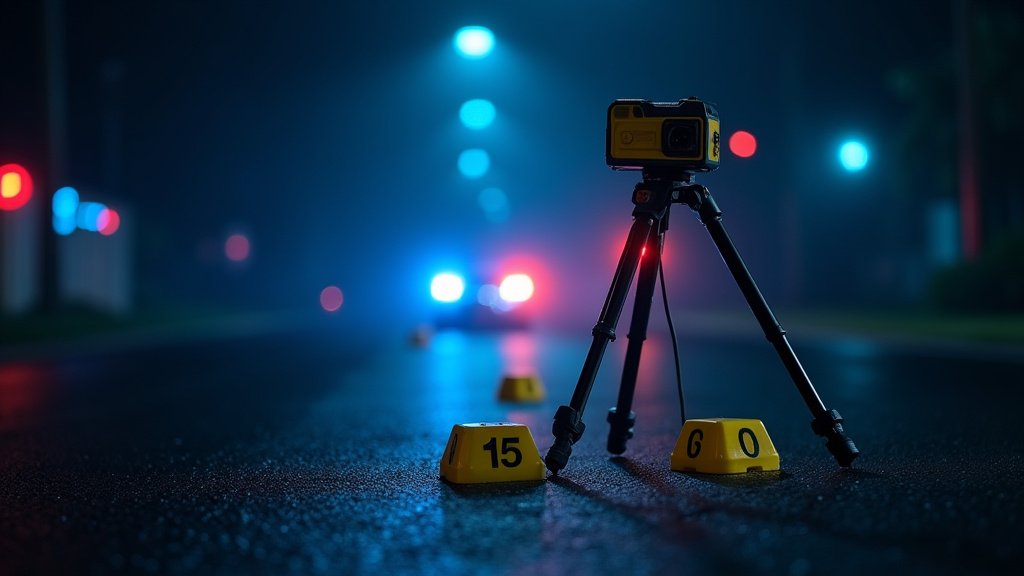
Early Friday morning, a violent and fatal collision occurred in Doral, Florida, resulting in a significant police presence and a complete shutdown of the surrounding area. The incident, which took place near the intersection of 33rd Street and 107th Avenue, was reported at approximately 2:30 a.m. Preliminary visual evidence from the scene indicates a high-velocity event, with the wreckage of the vehicle scattered across a wide debris field, suggesting the car impacted multiple objects before coming to a final, tragic rest against a tree. As the sun rose over Miami-Dade County, investigators from the Traffic Homicide Unit began the complex, somber task of documenting the scene to determine the precise circumstances that led to the loss of life.
Key Highlights
- A single-vehicle crash occurred in Doral at 2:30 a.m. Friday, claiming at least one life and resulting in a total road closure for investigation.
- The vehicle sustained catastrophic damage, breaking apart after impacting multiple obstacles before striking a tree, leaving a wide debris field.
- The Miami-Dade Sheriff’s Office Traffic Homicide Unit is leading the investigation, a standard procedure for fatalities of this nature.
- Motorists are being advised to avoid the 33rd Street and 107th Avenue corridor, as evidence markers and police containment lines remain active at the scene.
The Anatomy of a High-Impact Investigation
When a collision of this magnitude occurs, the immediate response is a highly codified, multi-agency operation. The presence of the Traffic Homicide Unit signifies that authorities are treating the event not merely as an accident, but as a critical incident requiring a forensic deep dive. This is not simply about removing the vehicle; it is about reconstructing the final seconds of that vehicle’s trajectory. In incidents involving significant structural damage—where a vehicle is found in pieces—investigators rely on a precise methodology to piece together the mechanical and human factors that contributed to the tragedy.
Forensic Reconstruction and Evidence Collection
The scene at 33rd Street and 107th Avenue serves as a time capsule of the crash’s final moments. Investigators utilize high-precision lasers and photogrammetry to map every piece of debris. In modern traffic homicide investigations, the debris field is a roadmap. The distribution of parts—from the front bumper to the rear chassis—allows engineers and detectives to calculate the speed, the angle of impact, and even the vehicle’s yaw (rotation) during the collision. When a vehicle slams into a tree after hitting multiple objects, as was reported in this Doral incident, the force of energy transfer is extreme. Documenting the skid marks, the gouges in the pavement, and the structural integrity of the roadside obstacles provides the raw data needed to simulate the crash digitally.
The Role of Vehicle Data Recorders
Beyond the physical scene, investigators will almost certainly pull data from the vehicle’s Event Data Recorder (EDR), often referred to as the ‘black box.’ Modern passenger vehicles are equipped with sophisticated sensors that log throttle position, braking input, steering angle, and seatbelt status in the milliseconds leading up to an impact. While authorities have not yet released information regarding the vehicle’s make or model, the EDR data will be the primary instrument in confirming whether the crash was a result of driver error, a medical episode, or a catastrophic mechanical failure. This digital footprint is vital for providing closure to the families of the deceased and for understanding whether roadway design played a role in the outcome.
Urban Infrastructure and Doral’s Growing Pains
While the investigation into this specific tragedy remains in its infancy, the crash inevitably invites a broader conversation about Doral’s rapid expansion and the pressures it places on local infrastructure. Doral has transformed over the last decade from a suburban enclave into a bustling commercial and industrial hub. This growth brings increased traffic volume, higher speeds, and a complex mix of heavy commercial vehicles and passenger cars.
The Challenge of High-Speed Corridors
As Doral develops, the tension between maintaining traffic flow and ensuring pedestrian and driver safety becomes increasingly palpable. The intersection of 33rd Street and 107th Avenue is a major thoroughfare. When infrastructure design lags behind population growth, corridors can become dangerous, particularly during the late-night or early-morning hours when visibility is low and traffic volume is minimal, often leading to increased speeds. Local urban planners and city officials are frequently tasked with the difficult job of retrofitting older roadway designs with traffic-calming measures that do not impede commercial logistics while protecting the safety of the commuting public.
Psychosocial Impact on the Community
Fatal crashes like the one witnessed early Friday have a profound ripple effect on the local community. For residents, seeing a crime scene of this scale—yellow tape, flashing lights, and the physical destruction of a vehicle—is a jarring reminder of the fragility of safety. It sparks a heightened sense of vigilance, often leading to calls for increased patrols or infrastructure upgrades. The trauma of such events is not contained to the victims’ families; it affects the local law enforcement officers tasked with the investigation, as well as the commuters who navigate these streets daily. The community’s response typically involves a mix of grief, frustration, and a desire for accountability, pressing officials to ensure that such occurrences are anomalies rather than trends.
Future Implications for Public Safety
As the investigation into this Doral tragedy concludes, the findings will likely trigger a review of the intersection’s safety protocols. If investigators determine that speed was a primary factor, we may see calls for enhanced traffic enforcement or physical changes to the roadway, such as improved lighting or lane reconfiguration. The goal of every traffic homicide investigation is twofold: to identify the cause of death and to identify preventative measures to ensure it does not happen again.
The Evolution of Traffic Enforcement
Technological advancements in traffic management, such as AI-driven surveillance and automated speed detection, are becoming standard tools in major cities across Florida. Should this intersection be identified as a recurring ‘hot spot’ for high-impact collisions, it is probable that the city will move to implement ‘Smart City’ solutions. These might include adaptive traffic signals that change based on real-time traffic density, or increased camera coverage that acts as both a deterrent and a monitoring tool for traffic law enforcement.
FAQ: People Also Ask
Q: What is the current status of the intersection at 33rd Street and 107th Avenue?
A: As of the latest reports, the area remains under investigation and closed to traffic. Authorities have cordoned off the scene to allow the Traffic Homicide Unit to complete its forensic documentation. Drivers are urged to seek alternate routes.
Q: Why does a single-vehicle crash require a homicide unit?
A: In many jurisdictions, the ‘Traffic Homicide Unit’ is simply the specialized division of the police department responsible for investigating all fatal traffic accidents, regardless of whether criminal activity is suspected. The term refers to the nature of the event—a fatal investigation—rather than an assumption of foul play.
Q: Have the identities of the victims been released?
A: No. As of now, the Miami-Dade Sheriff’s Office has not released the identities of those involved, as notification of next-of-kin is the priority and typically takes precedence before public disclosure.