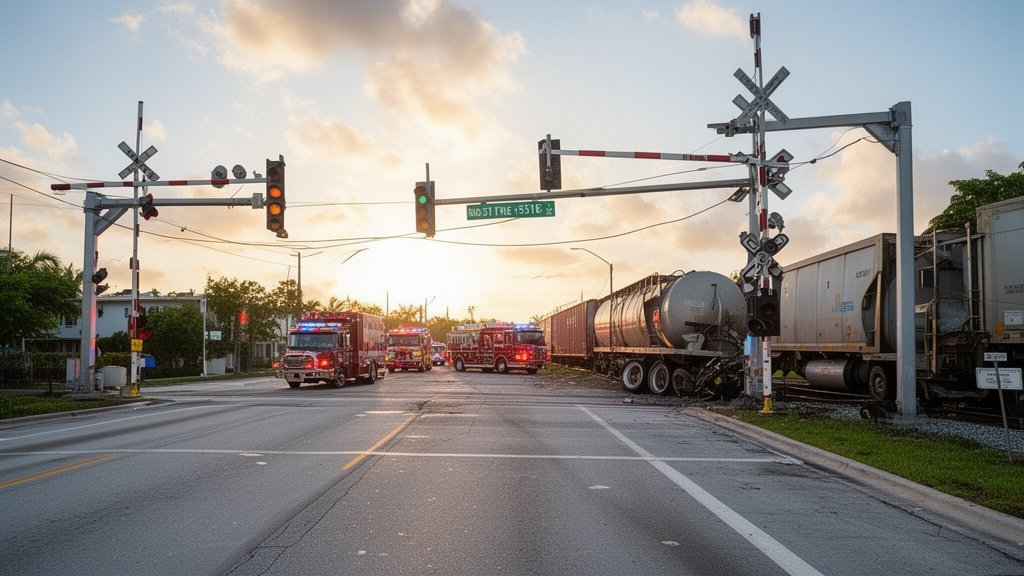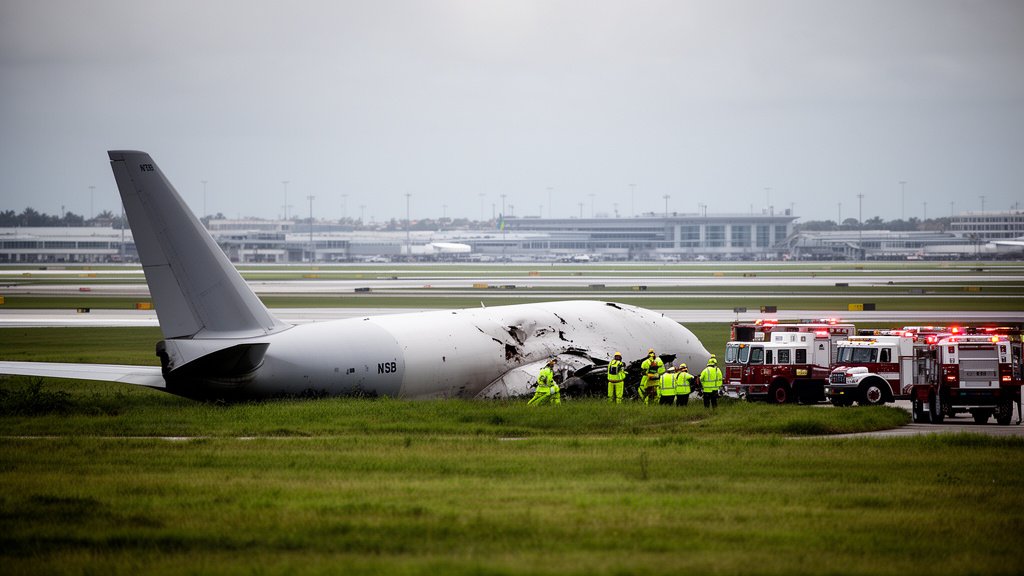
The aviation industry is reeling following a catastrophic incident on Sunday afternoon, when an Amazon-contracted cargo plane overran a runway at Miami International Airport (MIA), resulting in a collision with ground vehicles and at least five fatalities. As first responders continue to secure the scene, investigators from the National Transportation Safety Board (NTSB) have launched a comprehensive inquiry to determine the sequence of events that transformed a routine cargo operation into a localized disaster.
Key Highlights
- Incident Summary: An Amazon cargo jet overran the designated runway at Miami International Airport on Sunday afternoon.
- Fatalities: Current reports confirm at least five fatalities, involving the aircraft crew and occupants of vehicles struck during the runway excursion.
- Ongoing Investigation: The NTSB and local emergency services are on-site, securing the wreckage and analyzing data flight recorders (black boxes) to establish a timeline.
- Operational Context: Federal authorities are evaluating all variables, including mechanical performance, environmental conditions at the time of the landing, and potential human factors.
Anatomy of a Runway Incursion: Analyzing the Miami Cargo Incident
The Sequence of the Disaster
The tranquility of a typical Sunday afternoon at one of the nation’s busiest logistical hubs was shattered when the cargo aircraft, operating under the Amazon Air network, failed to come to a stop within the standard landing distance of the runway. Aviation experts describe runway overruns as complex events where kinetic energy, surface friction, and braking capability intersect. According to initial reports, the aircraft proceeded past the end of the runway, striking vehicles in a service or perimeter area. The intensity of the impact and the subsequent fire necessitated an immediate and coordinated response from Miami-Dade Fire Rescue, who faced the dual challenge of extinguishing a blaze fueled by aviation fuel while attempting a high-stakes search-and-rescue operation.
NTSB Protocols and Investigative Rigor
The National Transportation Safety Board (NTSB) has deployed a “Go Team” to the site. Their mandate is not merely to identify the cause but to reconstruct the physics of the crash. The investigation will focus on several critical vectors: the aircraft’s maintenance history, the status of the braking systems, the weight and balance of the cargo load, and the specific communication logs between the flight deck and Miami Air Traffic Control. Recovering the cockpit voice recorder (CVR) and the flight data recorder (FDR) is the immediate priority. These devices hold the granular data—altitude, speed, pitch, and hydraulic pressure—that will either confirm or refute hypotheses regarding mechanical failure or pilot action.
The Logistics Web: Amazon and Air Cargo Dynamics
Amazon Air, the e-commerce giant’s proprietary air cargo division, has rapidly expanded its footprint, relying on a fleet of leased aircraft to meet the demand for rapid delivery. This incident raises broader questions regarding the oversight of third-party operators and the intense operational tempo required to sustain modern supply chains. While there is no evidence to suggest that speed-of-service demands played a direct role in this specific crash, industry analysts often point to the high cycle rate of cargo planes—which often fly multiple, short-duration legs per day—as a stressor on airframe longevity and maintenance intervals. The NTSB will almost certainly scrutinize the specific maintenance protocols of the operator to see if any discrepancies existed prior to the fatal flight.
Airport Infrastructure and Runway Safety Areas (RSAs)
The design of Miami International Airport, like all major international terminals, includes Runway Safety Areas (RSAs). These are designated surfaces surrounding the runway, cleared and graded to reduce the risk of damage to airplanes in the event of an undershoot, overshoot, or excursion. The fact that the aircraft struck vehicles suggests it traveled significantly beyond the paved runway and into an area not designed for heavy commercial aircraft. Investigators will evaluate whether the RSA was compliant with current FAA standards and whether the placement of the vehicles involved—likely airport support equipment or perimeter security units—was within established safety parameters for distance from the active runway end.
The Mechanics of Braking and Performance
Landing a cargo jet is an exercise in precise mathematics. Pilots must factor in the weight of the aircraft, the remaining fuel, runway conditions (wet vs. dry), and wind vectors. Miami’s climate often introduces sudden, localized rain showers, which can change the coefficient of friction on a runway surface instantly. If the aircraft’s anti-skid system failed, or if the pilots encountered a “hydroplaning” scenario, the ability to decelerate effectively would be severely compromised. The NTSB’s mechanical engineers will likely disassemble the braking mechanisms and inspect the landing gear tires for signs of wear or failure that could have contributed to this tragic outcome.
Future Implications for Aviation Safety
This incident will likely serve as a catalyst for a national review of cargo airport safety. When a commercial airliner crashes, it is often a matter of public attention; however, cargo crashes are sometimes overlooked in the broader safety discourse. By investigating this accident, the NTSB is not only seeking accountability for the five lives lost but is also working to prevent recurrence. Findings from this investigation will likely trickle down into new FAA directives, potentially influencing everything from how vehicles are staged near active runways to how pilots are trained to abort landings (go-arounds) when landing parameters are not met within the first third of the runway.
FAQ: People Also Ask
Q: What is the primary role of the NTSB in a crash like this?
A: The NTSB is an independent federal agency charged by Congress with investigating every civil aviation accident in the United States. Their role is to determine the probable cause of the accident and issue safety recommendations to prevent similar events in the future. They do not assign blame or enforce laws; they identify safety gaps.
Q: How do authorities determine the cause of a runway overrun?
A: Investigators analyze multiple streams of data, including “black box” flight data recorders, radar tracks from air traffic control, weather data at the time of touchdown, and physical wreckage patterns. They also interview flight crew, maintenance staff, and air traffic controllers to build a holistic picture.
Q: Does Amazon own the planes involved in these crashes?
A: Amazon typically contracts with third-party carriers to operate its fleet of aircraft. These carriers are responsible for the day-to-day maintenance, crewing, and operation of the planes, though they operate under Amazon’s brand and logistics network. The NTSB investigation will focus on the carrier responsible for the specific flight.
Q: How common are runway excursions at major airports?
A: While runway excursions are among the most common types of aviation incidents, fatal ones involving ground collisions are rare. Most excursions result in minor damage and are categorized as incidents rather than catastrophic accidents. A fatal event like the one in Miami is treated as a major emergency requiring an extensive NTSB investigation.
Q: What will happen to the airport operations at MIA following the crash?
A: While the site of the crash will remain closed during the investigation, the rest of the airport will likely return to normal operations as quickly as possible. However, the specific runway involved will remain shut down for days, or even weeks, until the wreckage is removed and the safety of the pavement and infrastructure can be verified.