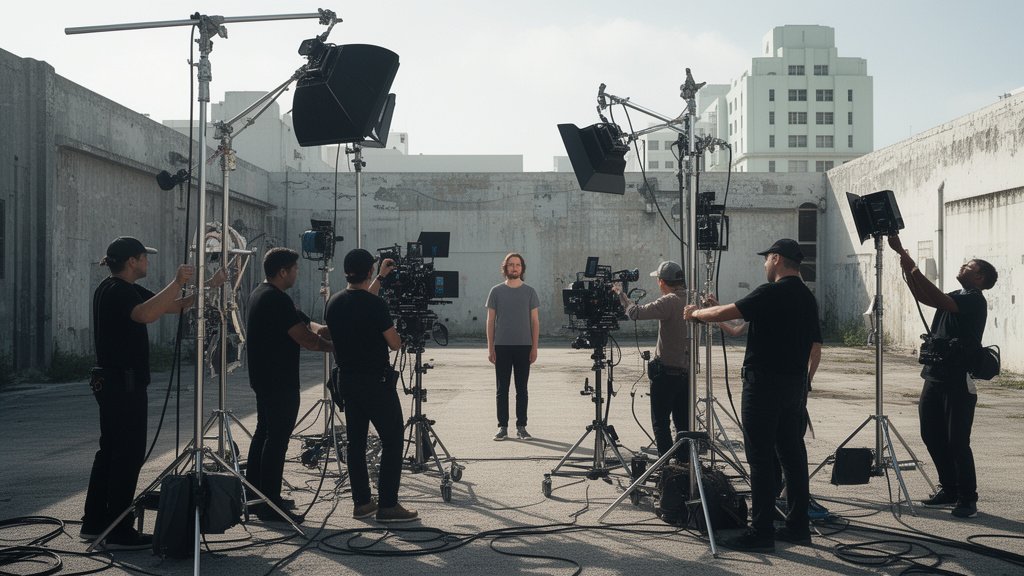
An urgent casting call has surfaced in Miami, Florida, for non-union talent to serve as stand-ins and body doubles for an undisclosed major rap artist’s upcoming music video. The production, slated for this Saturday, August 29, 2026, requires individuals who mirror the artist’s stature and physical build, signaling a high-budget creative undertaking in one of the world’s most vibrant urban production hubs. This development marks another significant instance of Miami serving as the backdrop for high-octane hip-hop visual storytelling, underscoring the city’s enduring role as a central pillar in the global music industry.
Key Highlights
- Event: Music video shoot for a major, yet-to-be-disclosed, hip-hop superstar.
- Date: Saturday, August 29, 2026.
- Roles: Non-union stand-ins and body doubles required.
- Location: Miami, Florida, an active hub for high-budget music video production.
- Focus: The casting call emphasizes the need for physical likeness, essential for efficient lighting tests and complex camera blocking.
The Anatomy of a High-Budget Music Video Shoot
When a top-tier rap artist prepares for a music video, the process is akin to orchestrating a miniature feature film. The current casting call in Miami serves as a microcosm of the intense logistics involved in modern music video production. For the uninitiated, the role of a stand-in or body double is rarely just about “looking the part.” It is a functional, highly technical necessity that allows the director of photography (DP) to set complex lighting cues and frame shots without requiring the artist to stand motionless under hot studio lights for hours.
The Necessity of Precision in Music Video Logistics
The requirement for specific physical builds—often height, skin tone, and body type—is vital for the integrity of the shoot. In professional film production, a stand-in allows the crew to dial in the exposure, lens focus, and camera movement, often referred to as “blocking.” This ensures that when the artist arrives on set, they can step into the frame and perform immediately, maximizing the limited time often afforded to major celebrities. In the context of a Miami shoot, where humidity and heat can make long days grueling, having dedicated stand-ins is not just an aesthetic choice; it is an operational imperative to keep the production on schedule.
Why Miami Remains the Capital of Visual Rap Aesthetics
Miami has long held a monopoly on the visual identity of hip-hop. The city’s unique architectural landscape—ranging from Art Deco aesthetics in South Beach to the raw, urban texture of industrial neighborhoods—offers a diverse palette for directors. Furthermore, the proximity to luxury maritime and automotive hubs allows production teams to quickly source the high-end vehicles and yachts that have become synonymous with rap music visual culture. This upcoming August 29th shoot is likely capitalizing on this convergence of resources, leveraging the city’s visual brand to elevate the artist’s storytelling.
The Dynamics of Non-Union Productions in Florida
The call for “non-union” talent provides insight into the production’s structure. While union productions (under SAG-AFTRA) operate under strictly defined rules regarding hours, pay, and safety, non-union sets offer more flexibility for productions to operate quickly and efficiently, though they must still adhere to local Florida labor laws. For many in the freelance production world, these gigs are an entry point into the high-stakes industry of entertainment, offering a glimpse into how a multimillion-dollar vision is translated onto the screen.
The Economics of Music Video Tourism
There is a broader economic ripple effect when a major artist chooses to film in a city like Miami. From hiring local catering companies, security details, and equipment rental houses to utilizing local casting agencies, a major shoot acts as a localized economic stimulus. The industry has evolved from the MTV-era videos of the 1990s to the high-definition, color-graded cinematic spectacles seen on streaming platforms today. This evolution demands more equipment, more personnel, and more time, all of which benefit the local economy where the production is anchored.
FAQ: People Also Ask
Q: What is the primary role of a body double in a music video?
A: A body double is used for shots where the artist’s face may not be visible or is obscured, allowing the production to film dangerous, time-consuming, or distant shots without exhausting the primary talent.
Q: Why does the casting call specify “non-union” talent?
A: Non-union calls refer to productions not governed by specific collective bargaining agreements like those of SAG-AFTRA. This allows producers to source local talent directly without needing to go through the union clearance process, which is often used for lower-budget or fast-turnaround independent productions.
Q: Is it common for major artists to keep video shoots secret?
A: Absolutely. To maintain creative control, prevent leaks of unreleased music, and manage fan traffic (which can disrupt production and pose security risks), most high-budget music videos are filmed under strict non-disclosure agreements and heightened security.
Q: How does the August date in Miami affect the shoot?
A: August in Miami is peak summer, characterized by high temperatures and humidity. This necessitates early call times and late-night shoots to avoid the peak heat of midday, impacting the scheduling of exterior scenes significantly.