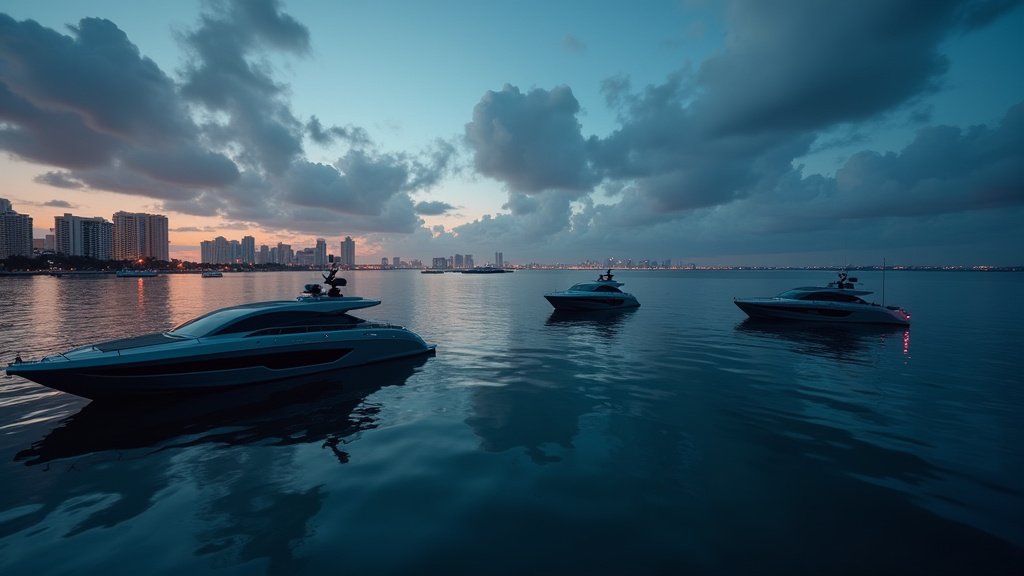
Miami, FL – The City of Miami is moving closer to enacting significant restrictions on overnight boat anchoring in Biscayne Bay, a move aimed at addressing growing concerns over environmental pollution, public safety, and waterway congestion. The proposed ordinance, set for review by the Miami City Commission, aligns with new state legislation empowering local governments to regulate vessel anchoring and will potentially affect hundreds of boaters who live aboard or anchor for extended periods offshore.
Background: A Growing Concern in Biscayne Bay
The proliferation of unregulated vessel living and long-term anchoring in Biscayne Bay has become a pressing issue for Miami officials. This trend has been linked to substantial environmental harm, including the direct discharge of trash and human waste into city waterways. The increased presence of anchored vessels also strains city resources, requiring additional expenditure for monitoring and maintenance. Furthermore, unrestricted anchoring has contributed to a rise in derelict and abandoned vessels, posing navigational hazards and requiring costly removal.
New State Legislation Empowers Local Governments
In response to these challenges, the Florida Legislature recently passed and Governor Ron DeSantis signed House Bill 481 (HB 481). This landmark legislation grants counties with populations exceeding 1.5 million, including Miami-Dade, enhanced authority to regulate overnight boat anchoring. The new state law, effective immediately, reduces the allowable anchoring period in designated areas from 45 days to 30 days within any six-month period, specifically between sunset and sunrise. It also increases the buffer zone around public mooring fields from 100 to 300 feet. This legislation allows for the establishment of “Anchoring Limitation Areas” (ALAs) to manage crowded or environmentally sensitive zones.
Miami’s Proposed Ordinance: Key Provisions
The Miami City Commission is considering an ordinance that would formally establish an Overnight Anchoring Limitation Area within the city’s jurisdiction of Biscayne Bay. Under the proposed city rules, vessels would be prohibited from remaining anchored in designated city waterways for more than 30 nights within a six-month period, specifically between one-half hour after sunset and one-half hour before sunrise. The ordinance also stipulates that boats must anchor at least 300 feet away from any public mooring field.
Exemptions and Enforcement
While the ordinance aims to restrict long-term anchoring, several exceptions are included to address legitimate needs. Commercial and recreational fishing vessels actively engaged in fishing, government boats, and vessels seeking shelter from severe weather conditions would be exempt. Additionally, exceptions are made for vessels involved in permitted marine construction, installation, or maintenance work.
Violators of the proposed ordinance could face substantial penalties, with fines potentially reaching up to $500 per day. Enforcement will be carried out by the city’s Police Department and Code Compliance Department, which may issue written warnings or civil citations.
Specific Areas Targeted
Florida’s HB 481 explicitly designates several high-traffic areas within Biscayne Bay as “anchoring limitation areas.” These include the waters surrounding Palm Island, Hibiscus Island, Star Island, and the Venetian and Sunset Islands. In these specific zones, overnight anchoring would be prohibited altogether, with the previously mentioned exceptions. Prior state legislation already prohibited overnight anchoring in certain sections of Biscayne Bay, such as between Rivo Alto and Di Lido Islands, and San Marino and San Marco Islands.
Impact on Boaters and Stakeholders
The trending news of these stricter regulations is generating discussion among various stakeholders. Supporters of the ordinance, including city officials like Miami Beach City Commissioner David Suarez, argue that the new rules are necessary to combat issues such as “boat squatters,” abandoned vessels, and environmental degradation. Suarez emphasized that many anchored boats are non-functional and contribute to pollution and hazards.
Conversely, some boaters and liveaboard residents feel unfairly targeted. They argue that existing laws against pollution and derelict vessels should be enforced rather than imposing broad restrictions that impact responsible boaters. Some boaters who previously lived on their vessels in Miami Beach have already relocated due to the increasing restrictions. They contend that anchoring is a right and that limiting options pushes them out, while also pointing out that the underlying issues of derelict boats might simply be displaced to other areas.
Broader Context and Future Implications
This Miami initiative is part of a larger effort in Florida to manage its waterways more effectively. The state has seen a significant increase in boat ownership, leading to heightened competition for anchoring and mooring spaces. The new laws and local ordinances aim to strike a balance between preserving public access to waterways, protecting the environment, and addressing the challenges posed by long-term vessel occupation and neglect. The Miami-Dade County Department of Regulatory and Economic Resources has identified “hot spots” in Biscayne Bay and is exploring the establishment of ALAs to minimize impacts on sensitive ecosystems like seagrasses.
As the Miami City Commission moves forward with its proposed ordinance, the focus will be on implementing these new regulations effectively while navigating the concerns of the boating community. The success of these measures will likely depend on clear communication, consistent enforcement, and the availability of adequate mooring or marina facilities for those affected.
This developing news is a significant shift in Miami’s approach to waterway management, reflecting a broader trend across Florida’s coastal communities grappling with similar challenges.