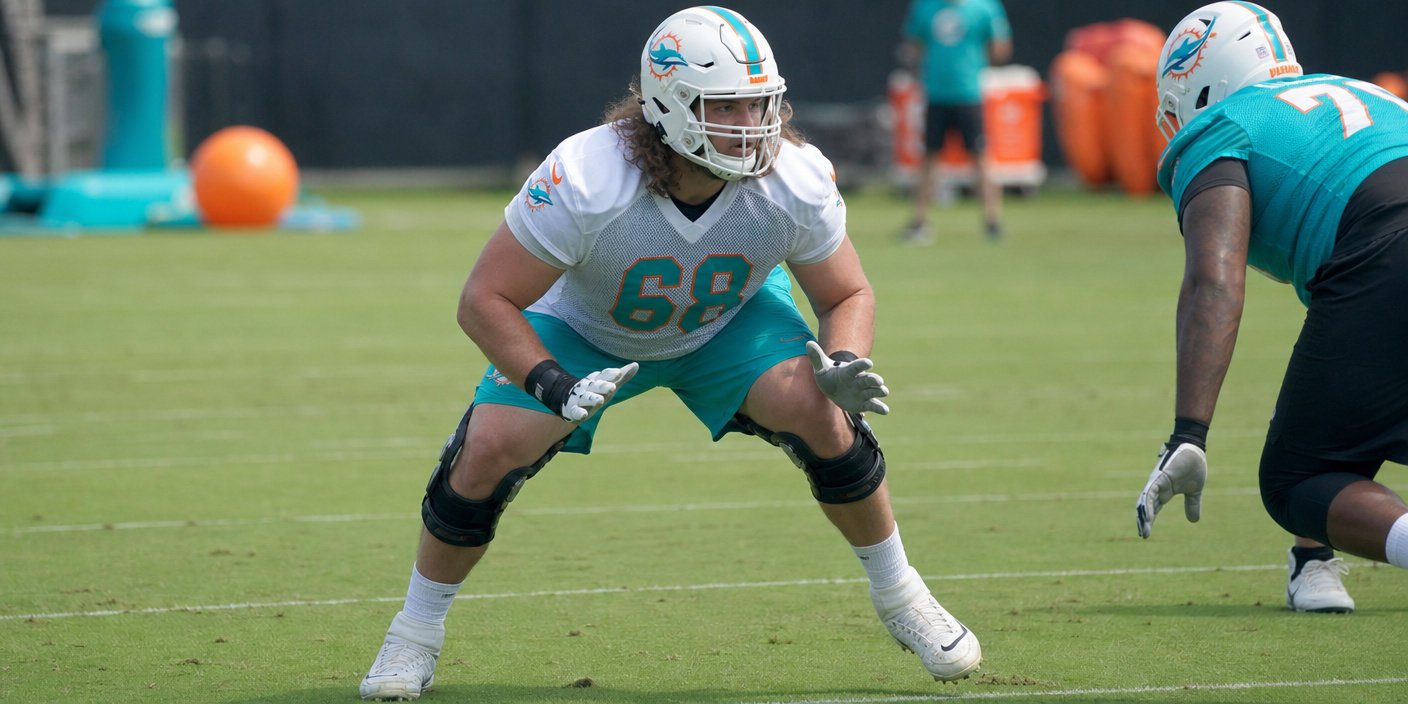
The Miami Dolphins have reinforced their offensive line unit, executing a strategic trade to acquire rookie tackle Caedan Wallace from the New England Patriots. This move aims to solidify depth at the tackle position as Miami enters the upcoming season with a renewed focus on protecting their franchise quarterback and maintaining the integrity of their high-powered offensive scheme. The acquisition underscores the Dolphins’ commitment to addressing injury vulnerabilities that have historically plagued their front five, ensuring that coaching staff have reliable options as the regular season schedule intensifies.
Key Highlights:
- Acquisition of 2024 third-round draft pick and versatile offensive tackle Caedan Wallace.
- Direct bolster to Miami Dolphins’ offensive line depth, focusing on pass protection and run-blocking stability.
- Trade finalized with the New England Patriots, signaling a shift in roster management strategy for both AFC East franchises.
- Strategic alignment aimed at ensuring long-term durability and development for the Dolphins’ offensive front.
Strengthening the Foundation: The Strategy Behind the Wallace Acquisition
In the modern NFL, the offensive line is frequently the difference between a championship contender and a team that struggles to find rhythm. The acquisition of Caedan Wallace by the Miami Dolphins is not merely a depth move; it is a calculated investment in the sustainability of their offensive output. By securing a player with the pedigree and physical tools of Wallace, the Dolphins front office is proactively managing the inevitable attrition that occurs over an 17-game season.
Scouting Report: The Caedan Wallace Profile
Caedan Wallace enters the Dolphins’ facility with a reputation as a technically sound and physically imposing tackle. Drafted out of Penn State in the third round of the 2024 NFL Draft, Wallace showcased immense potential as a pass protector during his collegiate career. His ability to anchor against power rushers while maintaining the lateral quickness necessary to handle speed off the edge makes him a high-upside developmental prospect.
Standing at a prototypical size for an NFL tackle, Wallace utilizes a wide base and aggressive hand placement to disrupt opposing pass rushers. His time in the Big Ten provided him with experience against elite competition, refining his ability to diagnose defensive fronts and execute complex blocking assignments. For the Dolphins, who rely heavily on precise timing and quick release windows, having a tackle capable of executing these technical requirements is paramount. The coaching staff is expected to prioritize Wallace’s development in zone-blocking schemes, where his mobility can be leveraged to create lanes in the running game.
Tactical Implications for the Dolphins’ Offense
The Dolphins’ offensive identity is built on speed, precision, and explosive playmaking. However, these elements cannot materialize if the quarterback is under constant duress. By adding Wallace to the roster, the team creates a more competitive environment in the trenches. Competition breeds excellence, and the presence of a high-draft-pick talent like Wallace forces incumbent players to elevate their performance levels.
Furthermore, this move provides the Dolphins with significant tactical flexibility. In the event of injury—a reality the team has faced frequently in recent years—Wallace offers a plug-and-play solution that does not sacrifice the structural integrity of the offensive line. This reliability is crucial for the coaching staff when game-planning against diverse defensive fronts. The ability to rotate linemen without a significant drop-off in production allows the Dolphins to maintain their aggressive offensive tempo regardless of who is on the field.
The AFC East Trade Landscape
Trade activity within the AFC East is always scrutinized, given the high level of familiarity and competition between the Dolphins, Patriots, Bills, and Jets. Trading a third-round selection like Wallace indicates that both organizations have shifted their long-term priorities. For New England, this transaction may be part of a broader organizational restructuring, potentially prioritizing draft capital or alternative roster needs. For Miami, it is a statement of intent: they are in a win-now window and are willing to utilize the trade market to ensure they have the necessary personnel to compete for the division title.
This trade also highlights the evolving nature of front-office philosophies in the AFC East. General managers are increasingly willing to move recent draft picks if the value proposition aligns with immediate team needs. The Dolphins’ willingness to pull the trigger on this trade demonstrates a focus on current roster optimization rather than purely relying on internal development cycles.
Long-Term Developmental Trajectory
While the immediate focus is on the upcoming season, the acquisition of Caedan Wallace is also a forward-looking decision. Offensive tackles often require significant time to transition to the professional level, adjusting to the speed and complexity of NFL defenses. By integrating Wallace into their system now, the Dolphins are accelerating his learning curve. The team’s strength and conditioning program, combined with specialized positional coaching, will play a critical role in unlocking Wallace’s ceiling. Over the next few seasons, the Dolphins will look to cultivate his raw talent, potentially grooming him for a starting role as his grasp of the professional game deepens.
FAQ: People Also Ask
1. What does the trade for Caedan Wallace mean for the Dolphins’ depth chart?
It significantly deepens the tackle rotation. By adding a player with Wallace’s physical profile, the Dolphins gain a versatile piece capable of filling multiple roles across the offensive line, providing a safety net against injuries and enhancing competitive depth.
2. Why was Caedan Wallace considered a valuable asset in this trade?
Wallace was a 2024 third-round pick with impressive collegiate tape at Penn State. His technical foundations, combined with his size and athletic ability, make him a projectable starter in the NFL, which holds high intrinsic value for teams looking to secure their offensive front.
3. How does this trade impact the Patriots?
For the Patriots, the trade represents a strategic reallocation of assets. Moving a high-draft pick suggests a shift in their roster-building priorities, allowing the organization to capitalize on current market value to address other pressing needs within their team structure.