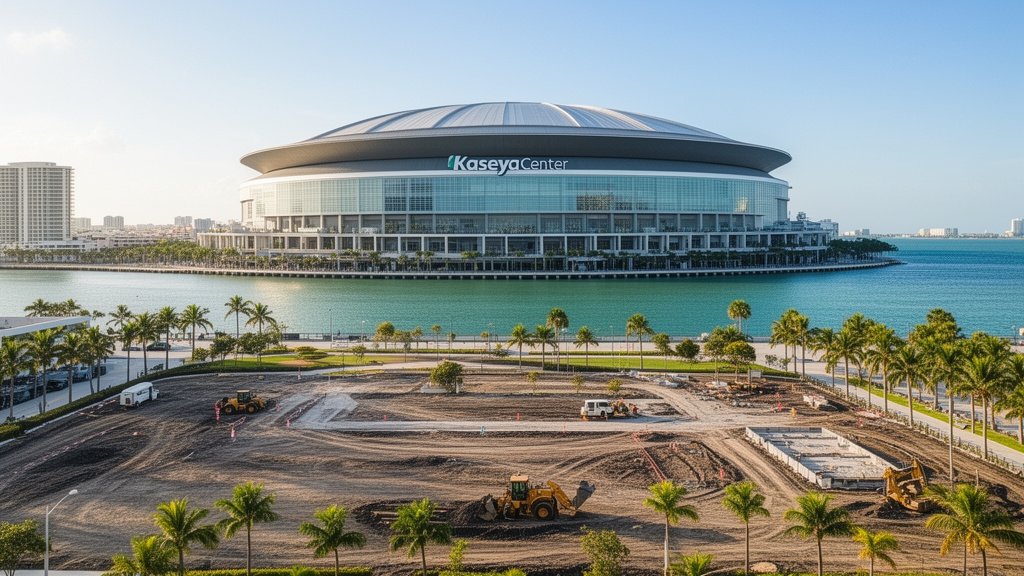
A high-profile marketing partnership involving Grand Theft Auto VI and the Kaseya Center rooftop has generated nearly $1 million, a critical financial injection earmarked specifically to accelerate the development of Parcel B, a waterfront public space in downtown Miami that has sat in limbo for years. For residents of downtown Miami and followers of urban development, this transaction represents a rare convergence of global entertainment marketing and local municipal infrastructure improvement, effectively turning digital anticipation into physical green space.
Virtual Assets, Real-World Impact: The GTA VI-Parcel B Connection
The funding agreement, approved by the Miami-Dade County Commission, allows for prominent advertising signage atop the Kaseya Center, home of the NBA’s Miami Heat. With Rockstar Games, the developer of the Grand Theft Auto franchise, utilizing the arena’s rooftop as a canvas for the highly anticipated Grand Theft Auto VI, the revenue generated from this prime real estate is being redirected into the long-awaited Parcel B project. This initiative marks a pivot in how the county manages underutilized land, moving from traditional budget allocations to creative public-private revenue streams.
The Deal: How Marketing Becomes Infrastructure
The mechanics of the deal are straightforward yet significant. Miami-Dade County, which owns the land beneath and surrounding the Kaseya Center, holds the rights to commercialize the facility’s exterior for advertising. By leasing the rooftop space to high-visibility clients like the publishers of Grand Theft Auto VI, the county bypasses typical taxpayer-funded limitations. The nearly $1 million in generated funds is legally designated for the development, landscaping, and final construction phases of Parcel B. This specific allocation ensures that the capital is not absorbed into the general municipal fund but remains strictly tied to the park’s realization. It is an example of modern urban asset optimization, where a city’s architectural landmarks provide the necessary capital to build its own recreational future.
Parcel B: A History of Delays and Hopes
For nearly a quarter of a century, Parcel B has been a source of local frustration. When the original arena was constructed and the master plan for the waterfront district was drafted in the late 1990s, the park was promised as a centerpiece of the downtown revitalization effort. However, economic downturns, shifting administrative priorities, and changing arena contracts repeatedly stalled the project. Often described as a “dead zone” between the bustle of the arena and the open water of Biscayne Bay, the parcel remained little more than a service area for years. Local advocacy groups have lobbied relentlessly for its conversion into a green space that offers public access to the waterfront. This infusion of funding from the GTA VI campaign is the first major move in years that guarantees the project will move beyond the conceptual design phase and into tangible construction.
Economic Ripples: Gaming Giants and Urban Planning
The choice of Grand Theft Auto VI for this advertising partnership is poetic, given that the game series—particularly its “Vice City” setting—is a stylized, satirical love letter to Miami itself. The synergy between the game’s marketing department and the county planners is palpable. By allowing a product that is inextricably linked to the cultural identity of Miami to fund its infrastructure, the county is capitalizing on the massive “GTA effect.” This secondary angle of the story highlights a shift in modern urban governance: city administrators are increasingly looking to major technology and media entities not just for taxes, but for active participation in the physical, public-facing environment of the city. If this partnership model proves successful, it could set a precedent for future downtown developments, where cultural exports fund public goods.
Future Predictions: The New Normal for City Parks
Looking ahead, the question remains whether this is a one-off anomaly or a blueprint for the future. As cities struggle with aging infrastructure and constrained budgets, public-private partnerships that leverage “lifestyle advertising” may become commonplace. The success of this project could encourage further development of surrounding waterfront lots, potentially sparking a wider renewal of the downtown Miami periphery. Furthermore, the park, once completed, will likely serve as a focal point for tourism, given its proximity to the Kaseya Center and its high-profile funding origin. It is not difficult to imagine “GTA-themed” or video-game-inspired community events being held in the park, further blending the lines between the digital world and local civic engagement.
FAQ: People Also Ask
What exactly is Parcel B and where is it located?
Parcel B is a strip of waterfront land located directly behind the Kaseya Center (home of the Miami Heat) in downtown Miami. It has historically been unused for public recreation, despite long-standing agreements to transform it into a park.
Why was Grand Theft Auto VI involved in this funding?
Rockstar Games, the developer of Grand Theft Auto VI, leased the Kaseya Center rooftop for a major marketing campaign. The revenue from this commercial lease was specifically directed by Miami-Dade County officials to fund the construction and landscaping of Parcel B.
Does this set a precedent for corporate-funded public parks?
While public-private partnerships are common in urban development, this specific deal highlights a trend of using high-value, temporary media campaigns to fund delayed municipal projects. It serves as a test case for whether “cultural advertising” can reliably support long-term urban infrastructure.
How much money was raised, and is it enough for the whole park?
The deal secured nearly $1 million. While this is a significant injection of capital that jumpstarts the development, it may serve as an initial tranche of funding. County officials have indicated this is a major step forward, though additional resources may be required for ongoing maintenance or future expansions of the park area.