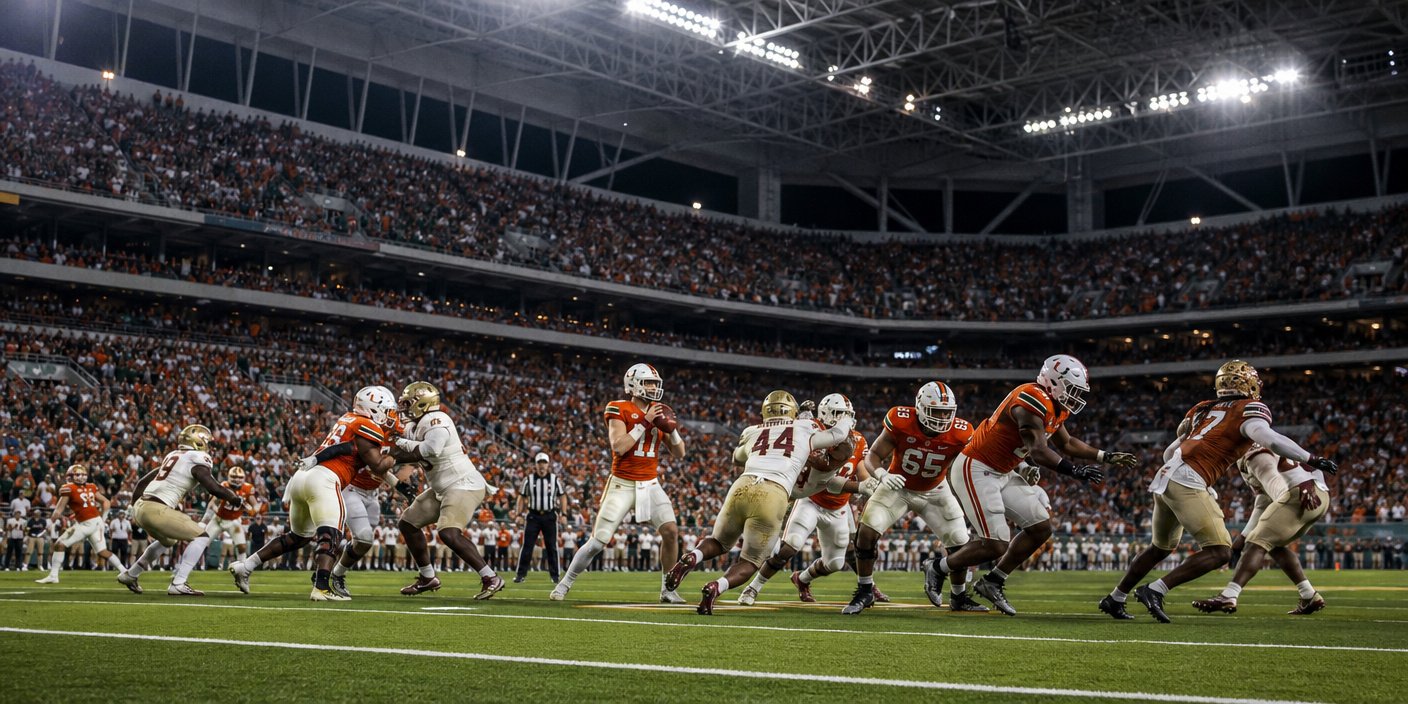
The atmosphere at Hard Rock Stadium crackled with the kind of electric intensity reserved only for college football’s fiercest rivalries. In a contest that lived up to the storied history between the two programs, the No. 3 Miami Hurricanes secured a hard-fought 43-35 victory over the Florida State Seminoles. The game, which extended into a grueling double-overtime period, showcased the grit of a Miami squad that refused to blink, keeping their season trajectory on an upward incline while delivering a masterclass in situational football.
Key Highlights
- Final Score: The Miami Hurricanes defeated the Florida State Seminoles 43-35 in a tense double-overtime thriller at Hard Rock Stadium.
- Offensive Engine: Quarterback Darian Mensah was the catalyst for the Hurricanes, racking up an impressive 326 passing yards and three touchdowns throughout the high-stakes matchup.
- Clutch Finish: The game was ultimately decided in double overtime, with Malachi Toney securing the final scoring pass to put the Hurricanes ahead.
- Defensive Lockdown: Bryce Fitzgerald delivered the decisive blow of the contest, recording a game-ending interception that silenced the Seminoles’ final threat.
Anatomy of a Thriller: Miami’s Hard Rock Heroics
The Miami-Florida State rivalry has historically been defined by volatility and high-stakes drama, and this latest chapter at Hard Rock Stadium was no exception. For onlookers and analysts alike, the game served as a microcosm of the modern college football experience—marked by momentum shifts, strategic adjustments, and individual brilliance under extreme pressure. As the clock wound down in regulation and shifted into the overtime format, the crowd witnessed a collision of wills where one mistake could have derailed a championship-caliber season.
The Quarterback Duel and Offensive Execution
Central to the Hurricanes’ success was the performance of Darian Mensah. Coming into the game, expectations were high for the young signal-caller, but his execution exceeded even the most optimistic forecasts. With 326 yards through the air, Mensah demonstrated a poise that belies his experience level. His ability to navigate the pocket, even when facing aggressive pass-rush schemes designed to disrupt his rhythm, was the anchor of the Miami offense.
However, it was not merely the yardage that impressed; it was the distribution. Mensah’s three touchdowns were spread throughout the game, providing crucial scoring responses whenever Florida State threatened to seize control. The final scoring pass to Malachi Toney in the second overtime period was a surgical strike—a testament to the chemistry developed between the receiver and quarterback over the course of the season. Toney’s ability to locate soft spots in the coverage allowed him to come down with the catch that effectively broke the deadlock and put the burden of response squarely on Florida State’s shoulders.
The Defensive Stand
While the offense provided the points, the defense provided the survival. Football games that extend into double overtime often become attrition contests where the defense is pushed to its absolute limit, both physically and mentally. As the Seminoles looked to answer Miami’s final scoring drive, the pressure mounted in the stadium. Bryce Fitzgerald, throughout the night, had been a disruptive force, reading the Seminoles’ offensive patterns and positioning himself to negate big-play opportunities.
His game-ending interception was the culmination of this defensive diligence. In a situation where a pass completion could have extended the game or shifted the advantage back to the visitors, Fitzgerald read the quarterback’s eyes, anticipated the trajectory, and secured the ball to finalize the victory. It was a play that punctuated the Hurricanes’ commitment to defensive discipline, proving that while their offense can put up points, their defense has the capability to seal victories in the most harrowing conditions.
Strategic Context and Future Implications
From a broader perspective, this win is significant not just for the rivalry bragging rights, but for the implications regarding the College Football Playoff (CFP). For No. 3 Miami, surviving an opponent that had nothing to lose—a common narrative in rivalry games—demonstrates the championship mettle required for a deep post-season run. Coaches and analysts often point to “grind-it-out” wins like these as the ones that define a team’s character.
Additionally, the game highlighted the evolution of overtime rules in college football. The transition from regulation to overtime periods requires a different tactical mindset; teams must balance the aggression needed to score with the defensive caution required to prevent an immediate loss. Miami’s ability to handle the specific demands of the second overtime period speaks to the depth of their coaching and the composure of their veteran leadership.
FAQ: People Also Ask
Q: Where was the Miami Hurricanes vs. Florida State game played?
A: The game was played at Hard Rock Stadium, the home field of the Miami Hurricanes, providing a significant home-field advantage for the team during this double-overtime matchup.
Q: How many passing yards did Darian Mensah record?
A: Darian Mensah delivered an outstanding performance, throwing for a total of 326 yards and three touchdowns to lead the Hurricanes’ offensive effort.
Q: Who caught the game-winning touchdown for Miami?
A: The final touchdown pass, which occurred in the second overtime period to help seal the 43-35 victory, was caught by Malachi Toney.
Q: How did the game end?
A: The game concluded in the second overtime when Miami defensive player Bryce Fitzgerald intercepted a pass from the Florida State quarterback, effectively ending the threat and securing the win for the Hurricanes.
Q: What is the significance of this win for Miami?
A: Beyond the historic rivalry implications, this victory is crucial for Miami’s standing in the College Football Playoff race, reinforcing their position as a top-tier contender and proving their ability to perform under high-pressure, late-game scenarios.