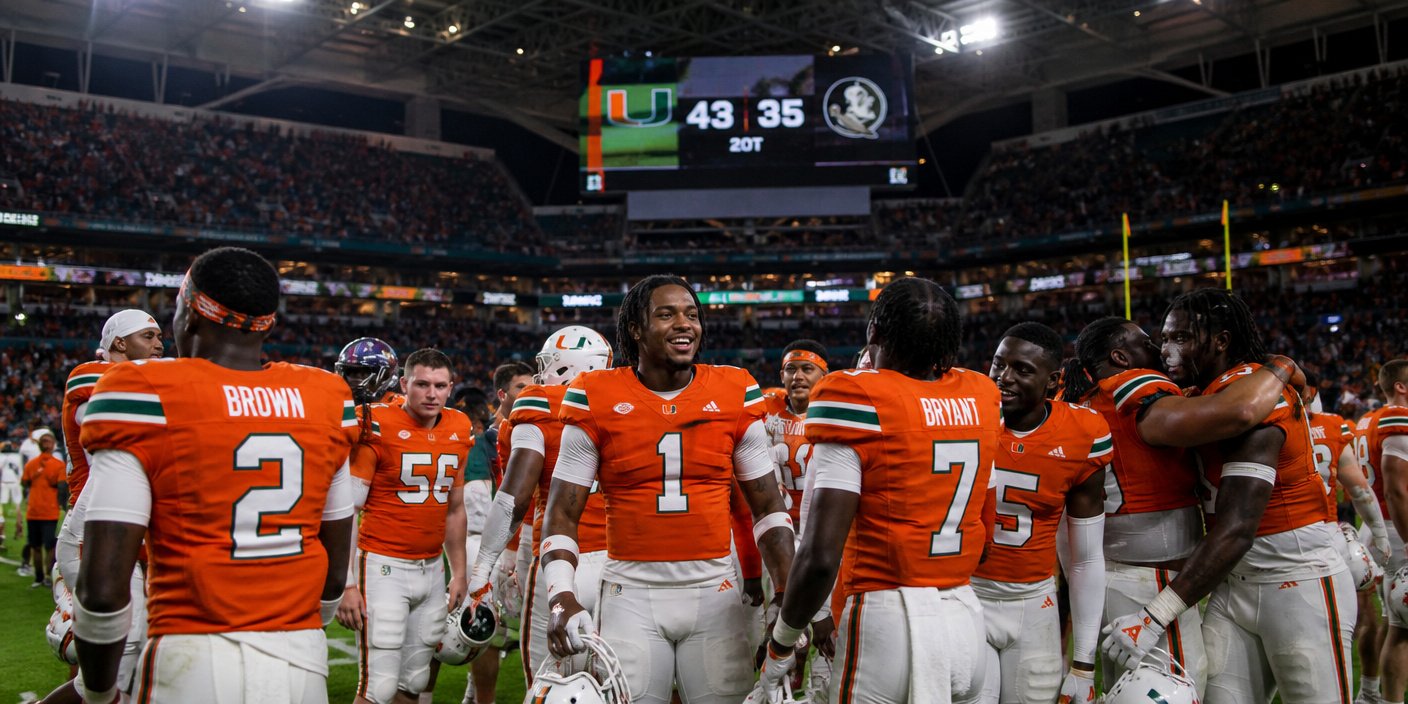
The No. 3 Miami Hurricanes cemented their status as legitimate national championship contenders on Saturday, overcoming the Florida State Seminoles in a heart-stopping 43-35 double-overtime victory. This clash, defined by back-and-forth momentum and high-stakes execution, serves as a pivotal moment in the 2024 season, effectively placing Miami at the doorstep of the No. 1 national ranking as the College Football Playoff picture begins to crystallize.
Key Highlights
- Final Score: Miami Hurricanes 43, Florida State Seminoles 35 (2OT).
- Clutch Performance: The Hurricanes’ offense successfully executed critical drives in the pressure-cooker environment of double overtime to secure the win.
- Rankings Impact: With this victory, Miami strengthens its resume for the top seed, capitalizing on a week of significant volatility across the college football landscape.
The Anatomy of the 305-Seminole Marathon
The narrative surrounding this matchup was one of contrasting trajectories. While the Hurricanes entered the contest as heavy favorites with aspirations of securing a playoff bye, Florida State arrived looking to salvage a season defined by missed opportunities and unexpected struggles. The result, however, was far from the blowout many analysts predicted. The 43-35 scoreline reflects a game where both teams traded blows until the final moments of the second overtime period.
Tactical Precision Under Pressure
In the modern era of college football, few environments are as unforgiving as a rivalry game pushed into overtime. Miami’s offensive strategy, which has been praised for its verticality and quick-strike capability throughout the season, was forced to adapt to a gritty, defensive-minded Florida State game plan. The Hurricanes were tested in the red zone repeatedly, a critical area that has historically been the litmus test for championship-caliber squads.
The overtime period saw Miami’s quarterback manage the pocket with remarkable composure. Rather than forcing desperate plays, the offensive scheme leveraged short, high-percentage passes to sustain drives against a fatigued Florida State secondary. The resilience shown by the Miami unit during these high-leverage possessions demonstrates the psychological maturity that head coach Mario Cristobal has been attempting to instill since his arrival. By converting on crucial third and fourth-down situations, Miami showcased the kind of situational football that is required to survive the gauntlet of the playoffs.
The Florida State Resistance
To their credit, Florida State played perhaps their most inspired football of the season. The Seminoles utilized a blend of aggressive blitz packages and disciplined coverage to frustrate the Miami rhythm. While the final outcome did not favor the Seminoles, their ability to push a top-three ranked opponent to double overtime suggests that the talent disparity often discussed by pundits was bridged, at least for four quarters and two additional frames, by superior effort and schematic discipline on defense. The struggle for Miami here highlights a recurring theme in top-tier college football: when a historic rival plays with nothing to lose, the records and rankings often become secondary to pure emotional output.
Playoff Implications and the Road to No. 1
This win is more than just a notch in the conference standings; it is a declaration of intent. With the current landscape of college football seeing unexpected losses among the top ten teams, the door is wide open for Miami to ascend to the top ranking. The voters prioritize strength of schedule and the ability to win close games—a metric in which Miami has now proven their competence.
Looking ahead, the Hurricanes must now reconcile this physical and emotional toll with the need for consistency. Surviving an emotional rivalry game often leads to a ‘hangover’ effect the following week, a challenge that the coaching staff will need to manage meticulously. As the season progresses, Miami’s path to the ACC Championship is now clearer, provided they can avoid the pitfalls that have derailed other top-ranked programs in recent weeks.
Secondary Angles: A Shift in Power Dynamics
1. The ACC Landscape: The conference is currently defined by Miami’s dominance, yet this game proves that the parity within the ACC remains competitive. This victory keeps Miami in the driver’s seat for an automatic bid, but the margin for error remains razor-thin.
2. The ‘New’ Miami Identity: Under the current administration, the Hurricanes are pivoting away from the volatility of previous years. This game served as a stress test for that new culture—winning when things aren’t perfect is the trademark of a dynasty, and this overtime victory checks that box.
3. Recruiting Capital: A win in this fashion, especially in a rivalry game, provides immense momentum for recruiting cycles. Demonstrating the ability to win in overtime and perform under the bright lights of national primetime coverage creates a tangible marketing advantage for the program when courting high-value recruits in Florida and beyond.
FAQ: People Also Ask
Q: How does this win affect Miami’s standing in the College Football Playoff rankings?
A: While the official rankings are released weekly, this victory significantly bolsters Miami’s resume. By winning a high-stakes, double-overtime game, they prove their resilience to the committee, which is a key qualitative factor in separating top teams.
Q: What changed in the game strategy during the double overtime?
A: The game shifted toward a conservative, high-percentage approach. Both teams prioritized minimizing turnovers and leaning on their most reliable personnel to execute in tight spaces, leading to a focus on power running and short-to-intermediate passing routes.
Q: Is this the biggest win of the season for Miami?
A: It is certainly the most gut-check win. While there may be statistically more impressive wins, the ability to overcome an intense rivalry atmosphere and win in double overtime provides the ‘toughness’ narrative that coaches and playoff committees value highly.
Q: Why was the game so close given the disparity in rankings?
A: Rivalry games often negate statistical advantages. Florida State’s familiarity with Miami’s scheme, combined with the emotional intensity of the rivalry, allowed them to neutralize Miami’s offensive speed and force the game into a grind-it-out format.