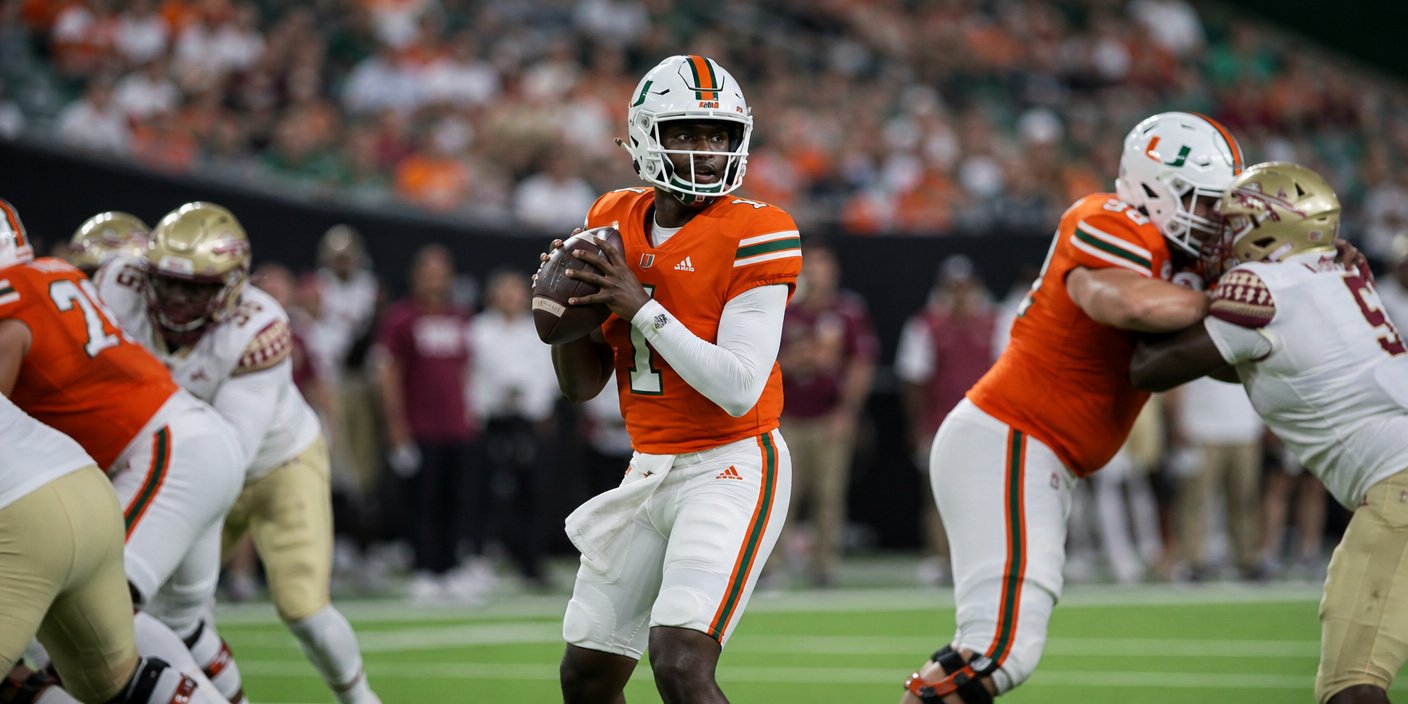
The atmosphere at Hard Rock Stadium was nothing short of electric this past Saturday night as the No. 3 Miami Hurricanes engaged in a tactical and emotional tug-of-war with their fiercest rival, the Florida State Seminoles. With a final score of 43-35 in double-overtime, the Hurricanes not only secured a crucial victory but also maintained their unblemished 6-0 start to the season. This game was a testament to the resilience of Mario Cristobal’s squad, showcasing the high-octane offensive capabilities and the defensive fortitude required to navigate the pressures of a top-tier college football schedule.
The Storm Rises: Analysis of the 43-35 Thriller
The Anatomy of an Overtime Classic
The game began with an intensity that only a Miami-Florida State rivalry can produce. Both teams entered the matchup with vastly different narratives—Miami looking to confirm its status as a legit National Championship contender, and Florida State fighting for pride and momentum. The regulation period saw both teams trading blows, with Miami’s offense, led by standout quarterback Cam Ward, struggling at times to contain the Seminoles’ defensive adjustments. The back-and-forth scoring ultimately led to a deadlock that pushed the game into the high-stress environment of overtime.
In the first overtime session, both teams demonstrated clinical efficiency. The tactical shift during the second overtime, however, was where the game was decided. Miami’s ability to convert critical third downs and execute in the red zone proved to be the differentiator. The Hurricanes’ defense, which had been bending throughout the night, tightened their coverage when it mattered most, forcing FSU into difficult throws and ensuring that Miami had the final edge in the scoring column. The 43-35 result, while razor-thin, reflects a game defined by composure under pressure.
Strategic Coaching and Player Execution
Mario Cristobal’s management of the clock and personnel rotations in the final minutes of regulation was a masterclass in risk management. By trusting his veteran starters to make the big plays, Cristobal minimized turnover risks that often plague young, undefeated teams in high-stakes environments. Cam Ward’s performance was arguably the anchor of the evening. His ability to extend plays outside the pocket kept Florida State’s pass rush guessing, and his accuracy on intermediate routes allowed the Hurricanes to sustain long, clock-draining drives.
Conversely, Florida State deserves credit for a resilient defensive effort that kept them in the game far longer than many analysts predicted. The Seminoles’ scheme prioritized stuffing the run, which forced Miami to beat them through the air. For long stretches, this strategy worked, leading to the chaotic, high-scoring affair that left the Hard Rock Stadium crowd on the edge of their seats until the final whistle.
Historical Context and Rivalry Dynamics
The Miami-Florida State rivalry has historically served as a bellwether for the ACC. Decades ago, these games determined National Champions. Seeing this game go into double-overtime serves as a massive injection of relevance back into the storied matchup. For Miami, the 6-0 start is the best they have seen in recent memory, and it signals a potential shift in the power dynamic of the Atlantic Coast Conference. Winning this specific game—a game historically prone to upsets and heartbreak for the Hurricanes—validates the culture shift Cristobal has been attempting to instill since his arrival.
The CFP Implications and Future Outlook
With this victory, Miami firmly positions itself as a favorite for a spot in the 12-team College Football Playoff. The committee looks for “quality wins” and the ability to win close, high-pressure games. Surviving an overtime thriller against a historic rival provides exactly the kind of metrics the committee values. However, the path forward remains difficult. The Hurricanes must avoid the “trap game” scenarios that often follow emotional, high-energy rivalry victories. If Miami can maintain the discipline shown in this overtime win, they are not just contenders for an ACC title; they are legitimate threats to run the table and enter the postseason undefeated.
Tactical Takeaways: Why the 43-35 Scoreline Matters
The offensive output of 43 points highlights Miami’s dangerous ceiling, but the 35 points allowed should serve as a wake-up call for the defensive coordinator. While the victory is what counts in the standings, the defensive lapses—particularly the inability to stop FSU in open space—will need to be addressed in the film room this week. Championship teams are often defined by their ability to win in different ways; this week, Miami proved they can win a shootout. Next week, they may need to prove they can win a defensive slugfest. The ability to pivot strategy mid-game is what will truly define their ceiling this season.
FAQ: People Also Ask
1. What was the final score of the Miami vs. Florida State game?
The No. 3 Miami Hurricanes defeated the Florida State Seminoles with a final score of 43-35 in double-overtime.
2. What is Miami’s current record after the victory?
Following the win at Hard Rock Stadium, the Miami Hurricanes have improved their season record to 6-0.
3. Why was this game significant for Miami?
Beyond the rivalry stakes, the win keeps Miami undefeated and strengthens their argument for a high seed in the College Football Playoff, proving they can perform under extreme pressure.
4. Who are the key entities mentioned in the match coverage?
Key entities include the Miami Hurricanes (ACC), the Florida State Seminoles, quarterback Cam Ward, Head Coach Mario Cristobal, and the venue, Hard Rock Stadium.