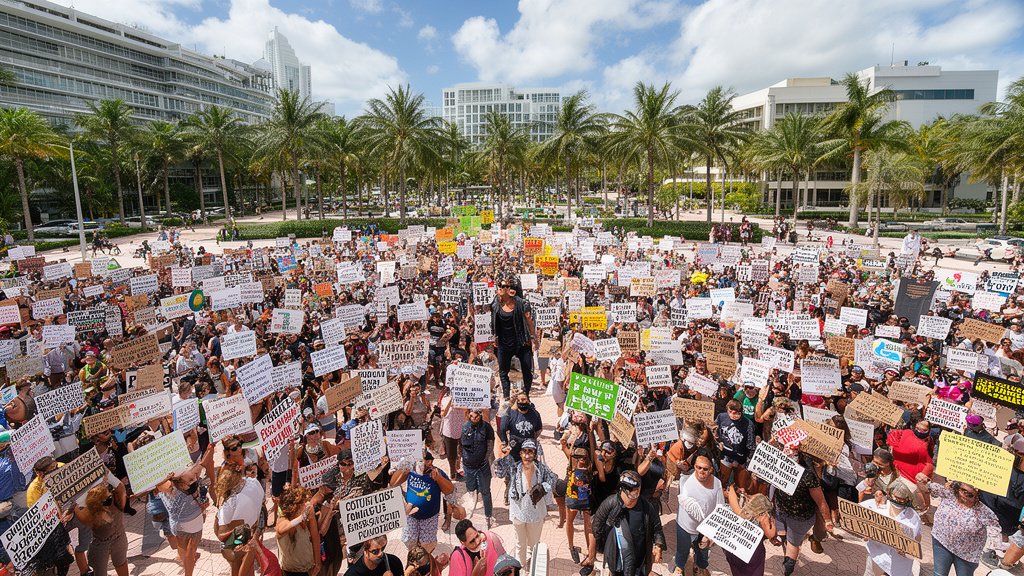
Thousands of demonstrators mobilized across South Florida on October 17, participating in the nationwide “No Kings” day of action. This coordinated wave of protests, unfolding in major hubs from Miami to West Palm Beach, served as a stark political barometer for the region, highlighting widespread public anxiety regarding the boundaries of executive power and the erosion of democratic checks and balances just weeks before the critical midterm elections. As participants filled public squares and lined busy thoroughfares, the movement sought to translate broad constitutional concerns into tangible voter energy, signaling that the debate over the limits of authority would be a deciding factor for the electorate.
Key Highlights
- Mass Mobilization: Thousands of protesters participated in organized events across South Florida, focusing on major urban centers to maximize visibility.
- Core Ideology: The “No Kings” movement centers on the foundational American principle that no individual, regardless of office, is above the law or the Constitution.
- Strategic Timing: The protests were deliberately scheduled ahead of midterm elections to influence voter turnout and frame the national discourse around judicial and executive accountability.
- Cross-Coalition Support: The events were supported by a diverse array of advocacy groups, labor unions, and local grassroots organizations aiming to protect institutional democracy.
The Surge for Accountability: A New Political Litmus Test
The “No Kings” day of action was more than a singular event; it represented a strategic escalation in political communication. By coalescing around the theme of anti-monarchical governance, organizers tapped into a deep, historical vein of American political thought. The imagery and rhetoric utilized during the South Florida demonstrations—ranging from hand-painted signs evoking revolutionary-era warnings to speeches invoking the Founding Fathers—were designed to bridge the gap between abstract constitutional theory and the immediate, lived reality of the American voter.
The Anatomy of the South Florida Demonstrations
In cities like Miami, Fort Lauderdale, and West Palm Beach, the rallies were marked by high attendance and a noticeably disciplined message. Unlike localized protests that often splinter into disparate demands, the South Florida contingency remained tightly focused on the “No Kings” narrative. Local organizers emphasized the importance of executive transparency and judicial independence, two pillars they argue have been weakened by recent political polarization.
Security and logistical planning for these events were significant, with law enforcement monitoring traffic impacts in downtown corridors. Despite the political intensity, the events remained peaceful, providing a controlled environment for activists to mobilize undecided voters and energize the base. The geographic spread of these protests—spanning the entire South Florida peninsula—demonstrates the logistical maturity of the organizers, who leveraged digital networks to ensure simultaneous impact across disparate counties.
Philosophical Roots and Political Implications
The “No Kings” slogan itself is a direct rejection of unitary executive theories, which suggest that the President possesses near-absolute authority over the executive branch, effectively insulating the office from congressional or judicial oversight. By centering their dissent on this concept, protesters are effectively framing the midterm elections as a referendum on the nature of American governance. For the average voter in South Florida, this turns a complex legal debate into a clear-cut question of power dynamics: Do citizens consent to a system where the executive branch operates without accountability?
Midterm Calculus and Voter Turnout
Historical precedent suggests that midterms are often referendums on the sitting administration. However, the “No Kings” movement is attempting to shift this dynamic. Instead of focusing solely on economic inflation or localized cultural issues, these protesters are forcing a conversation about systemic integrity. Analysts observe that this strategy is risky; while it energizes the progressive base, its effectiveness with moderate, independent voters remains to be seen. In South Florida, where the electorate is increasingly fractured and polarized, capturing the “middle” is essential for any political movement to find lasting success.
Exploring Secondary Angles
1. The Digital-Physical Hybridity: The efficiency of these protests relied heavily on social media coordination. The movement highlights how modern grassroots efforts have transcended traditional organizing methods, using rapid-response digital alerts to turn out thousands on a single calendar day. This suggests a permanent shift in how political messaging is disseminated and how physical presence is orchestrated in the digital age.
2. Historical Context of Executive Protest: Comparing this to historical protests against executive overreach (such as the Watergate era or the opposition to the Alien and Sedition Acts) reveals a recurring American anxiety about centralized authority. The “No Kings” movement is the latest iteration of this historic tension, reflecting a cyclical struggle to balance the need for effective governance with the necessity of constitutional constraints.
3. Economic and Logistical Challenges: Organizing a statewide event of this magnitude involves significant resource allocation. The infrastructure required to manage crowd control, sound systems, and outreach programs in South Florida’s high-cost urban environments underscores the financial backing behind these advocacy groups. This raises questions about the long-term sustainability of such high-visibility campaigns in an era of donor-fatigue.
FAQ: People Also Ask
Q: What is the primary objective of the ‘No Kings’ day of action?
A: The movement aims to protest against presidential overreach and emphasize the doctrine that no leader or public official is above the law, directly linking this sentiment to the importance of voting in the midterm elections.
Q: How does this protest impact the midterm elections?
A: By focusing on constitutional integrity and executive accountability, organizers hope to motivate voter turnout and shape the national discourse, forcing candidates to address the issue of government authority and checks and balances.
Q: Is the ‘No Kings’ movement a bipartisan initiative?
A: While the movement is generally aligned with progressive advocacy groups, it frames its argument through the lens of constitutional principles—specifically the Founding Fathers’ intent to prevent tyranny—which organizers argue should appeal to all voters regardless of party affiliation.
Q: Why was South Florida a key location for these demonstrations?
A: As a major, politically diverse, and densely populated region, South Florida serves as a crucial battleground for voter engagement and media attention, making it an essential venue for amplifying the movement’s message ahead of the polls.