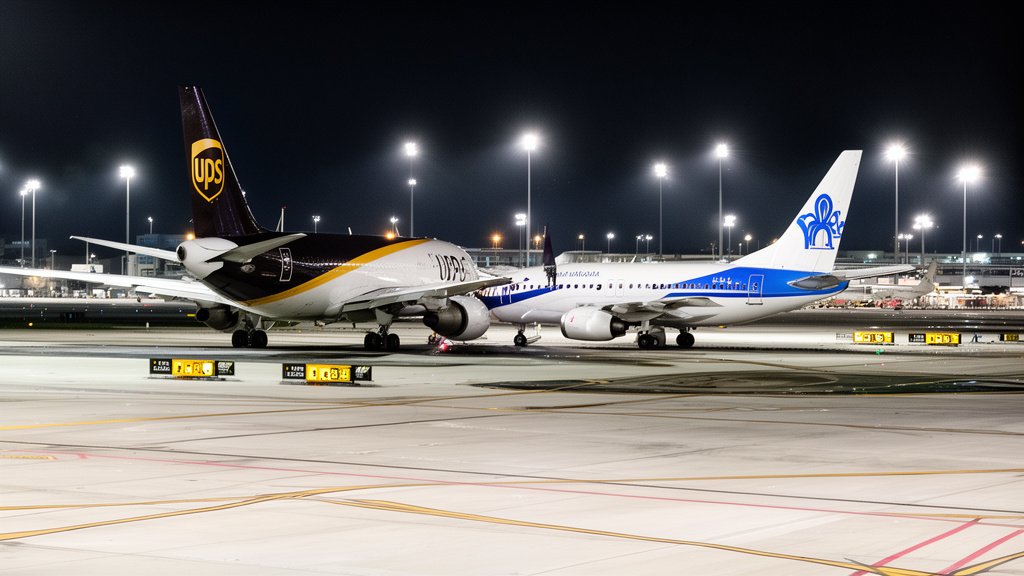
On a busy Saturday night at Miami International Airport (MIA), routine ground operations took a dangerous turn when a UPS cargo aircraft and a Copa Airlines passenger jet collided on the taxiway. The incident, which disrupted operations at one of the nation’s busiest international gateways, involved the wingtip of a Copa Boeing 737 striking the nose of a UPS Boeing 767. While the collision resulted in only minor injuries to two individuals, it has prompted an immediate investigation by the Federal Aviation Administration (FAA) and raised questions regarding ground safety protocols at high-traffic airports.
Key Highlights
- The Collision: A Copa Airlines Boeing 737 and a UPS Boeing 767 cargo plane collided on an airport taxiway at Miami International Airport on Saturday night.
- Specific Impact: The wingtip of the Copa Airlines 737 struck the nose of the UPS 767, causing structural damage to both aircraft.
- Injuries: Two people reported minor injuries; medical assistance was provided at the scene.
- Investigation: The FAA has officially launched an investigation to determine the contributing factors, including ground control communications and adherence to taxiway safety procedures.
- Operational Impact: The incident resulted in temporary taxiway closures, impacting airport ground traffic and leading to potential scheduling delays for associated flights.
Understanding the Taxiway Collision at MIA
The Miami International Airport (MIA) serves as a critical nexus for both domestic passenger travel and international cargo logistics. When a taxiway incident occurs, the ripple effects are felt throughout the entire national aviation system. The collision involving the UPS Boeing 767—a heavy freighter—and the Copa Airlines Boeing 737—a narrow-body passenger jet—occurred under conditions currently under scrutiny by aviation authorities.
Anatomy of a Taxiway Incident
Taxiway incidents, while less publicized than mid-air emergencies, are a significant focus for the FAA and the National Transportation Safety Board (NTSB). At major airports like MIA, the complexity of ground movement is immense. Pilots and air traffic controllers (ATC) must coordinate maneuvers across an intricate web of tarmac lanes. In this instance, the proximity of the two aircraft suggests a potential breach in separation standards. A wingtip-to-nose contact indicates that at least one of the aircraft was likely navigating a designated taxi route that brought it into the path of the other.
Investigators are currently examining the cockpit voice recorders and ground radar data to determine if the error stemmed from a communication breakdown between the flight crews and ground control, or if a mechanical issue influenced the pathing of either aircraft. The specific geometry of the Boeing 767 nose and the Boeing 737 wingtip suggests the aircraft were moving at low speeds, which likely prevented a more catastrophic outcome.
The Critical Role of MIA in Global Logistics
Miami International Airport is not merely a passenger hub; it is the primary gateway for Latin American and Caribbean air cargo in the United States. UPS operates a massive hub at MIA, managing thousands of tons of freight weekly. The collision of a freighter of this magnitude underscores the logistical fragility of the modern supply chain. When a major cargo carrier like UPS suffers an aircraft-on-ground (AOG) event, the delay can cause logistical bottlenecks that extend far beyond the runway. While passenger flights are often prioritized during recovery, the cargo backlog can impact delivery windows for businesses and consumers across the region.
FAA Safety Investigations and Protocol
Following the collision, the FAA has taken the lead in the investigation, standard procedure for surface incidents at commercial airports. The investigation will focus on several pillars:
1. Ground Traffic Management: Reviewing the taxi clearances given to both the Copa and UPS crews.
2. Pilot Compliance: Evaluating whether both crews were following the specific visual and radio-based instructions provided by ground control.
3. Environmental Factors: Assessing if visibility, taxiway lighting, or signage played a role in the navigation error.
4. Equipment Functionality: Checking if the aircraft communication and transponder equipment were operating correctly at the time of the maneuver.
The findings will eventually be compiled into a report that the FAA uses to update airport safety procedures. Historically, such incidents often lead to changes in ground signaling, the installation of enhanced taxiway lighting, or stricter runway/taxiway intersection protocols.
Operational Disruption and Recovery
While the FAA investigation continues, the immediate aftermath required the rapid deployment of emergency services and the temporary closure of the affected taxiway. Ground crews worked through the night to move the damaged aircraft, a process that requires precision to prevent further structural damage to the fuselage and control surfaces. Copa Airlines, a major international carrier with a significant footprint in Panama and across the Americas, had to coordinate the re-accommodation of passengers, while UPS faced the arduous task of rearranging cargo loads to minimize the impact on its delivery network.
As the aviation industry continues to grapple with increasing air traffic volume, events like this serve as a stark reminder of the complexity of airport operations. The safety protocols in place are designed to manage these risks, but the human factor remains a persistent variable. The upcoming FAA report will be essential in clarifying exactly how this collision occurred and what steps can be taken to prevent future ground incidents of this nature.
FAQ: People Also Ask
What happens to the aircraft after a taxiway collision?
After the immediate scene is secured, both aircraft are typically grounded for a comprehensive structural assessment by engineering teams. The FAA and NTSB must conduct an inspection before the aircraft can be repaired or returned to service. The aircraft are often towed to a maintenance hangar to determine if the damage—such as the wingtip or nose section compromise—is repairable or requires significant parts replacement.
Are taxiway collisions common at major airports?
While rare in terms of total flight operations, taxiway collisions do occur, especially at high-volume hubs like Miami, JFK, or O’Hare. The FAA tracks these incidents as part of their Runway Safety Program, which aims to reduce the frequency and severity of surface incursions and ground collisions through technology, training, and infrastructure improvements.
Can passengers still travel on the involved Copa Airlines jet?
No. Any aircraft involved in a physical collision, regardless of how minor the impact appears, must be taken out of service immediately. It cannot carry passengers until a certified airworthiness inspection confirms it is safe for flight. Passengers booked on that specific aircraft must be rebooked, causing delays in flight schedules.
How does this affect UPS cargo deliveries?
UPS has a highly integrated logistics network. When a freighter is grounded due to a collision, the company typically swaps in backup aircraft from their fleet to maintain delivery schedules. However, a primary aircraft being out of commission can cause localized delays in the short term, particularly for time-sensitive cargo shipments routed through the Miami hub.