The National Transportation Safety Board (NTSB) has provided a critical update regarding the high-profile Amazon cargo plane crash at Miami International Airport (MIA), shedding new light on the final, chaotic seconds of the flight. Investigators confirmed that the pilots engaged in a last-ditch effort to abort the landing—a maneuver known in aviation parlance as a ‘go-around’—before the aircraft ultimately overran the runway. This finding adds a layer of complexity to the ongoing federal investigation, moving the focus toward understanding the precise timing of the pilot inputs versus the physical capabilities of the heavy cargo jet.
The Final Seconds: A Technical Breakdown
According to data recovered from the aircraft’s Flight Data Recorder (FDR), the flight crew attempted to initiate a go-around maneuver while the aircraft was already in the final stages of its approach. For a heavy aircraft like the Boeing 767, which serves as the backbone of many air cargo fleets, a go-around is not a decision made lightly. It requires an immediate and substantial increase in engine thrust, retraction of landing gear, and a recalibration of flight surfaces to ascend safely.
The NTSB analysis indicates that while the pilots moved the thrust levers to initiate this abort, the aircraft had already reached a state where the kinetic energy of the landing attempt likely superseded the available runway length. The investigation is currently dissecting the synchronization of these inputs: did the pilots identify the instability early enough, or was the decision to abort triggered by a specific, late-breaking realization of an unsafe landing configuration? The distinction is vital. If the decision was made after the aircraft touched down—a ‘rejected landing’ rather than a ‘go-around’—the physics of stopping the aircraft change drastically, and the runway requirements increase exponentially.
The Complexity of Heavy Cargo Operations
To understand the magnitude of this event, one must look at the unique operational profile of Amazon Air and its contracted operators. Unlike passenger flights, which often operate into major hubs with longer, specialized runways, cargo operations often run on tighter schedules and face unique load-balancing challenges. Heavy cargo planes are unforgiving machines; a fully loaded 767 carries significant weight, which directly impacts its braking performance and its ability to execute a last-minute climb-out.
Industry analysts often point to ‘get-there-itis’ or the pressure of delivery schedules as a potential, though unproven, stressor in cargo operations. However, in this specific case, the NTSB is focused on the hard data: speed, wind shear conditions at the time of arrival, and the mechanical responsiveness of the aircraft. By examining the interplay between the crew’s manual control inputs and the automated flight systems, the NTSB aims to determine if the abort was an appropriate reaction to an evolving emergency or a result of an unstable approach that went uncorrected for too long.
Infrastructure and MIA’s Unique Environment
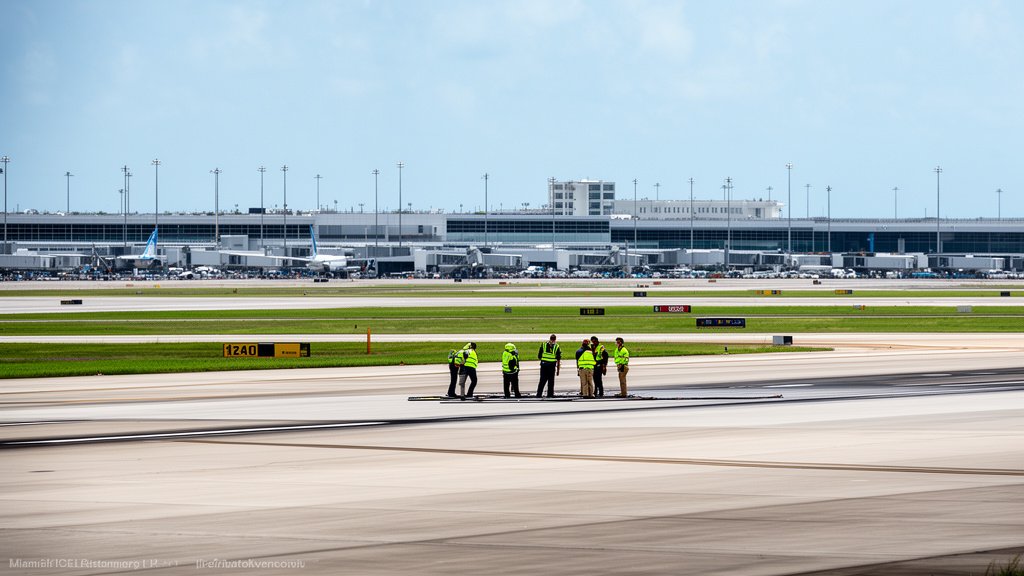
Miami International Airport presents a specific set of challenges for heavy cargo operations. Located in a densely populated urban area, the airport’s runways are surrounded by infrastructure, leaving little room for error when an aircraft overruns the pavement. The NTSB’s investigation will likely encompass the runway surface conditions at the time of the incident, including any evidence of standing water or runway contamination, which can significantly alter braking friction coefficients.
This incident has sparked renewed debate regarding runway safety areas (RSAs). While MIA meets current regulatory standards, the NTSB often uses such investigations to push for infrastructure upgrades, such as Engineered Material Arresting Systems (EMAS)—crushable concrete beds designed to safely stop aircraft that overrun the runway. The question of whether such a system could have mitigated the outcome of this specific Amazon cargo crash will undoubtedly be a central theme in the final NTSB report.
The Future of the Investigation
As the NTSB continues its deep dive, the final report will likely focus on three pillars: pilot training, flight path management, and aircraft maintenance. The ‘last-ditch’ effort mentioned by investigators suggests that the flight crew was aware of the impending danger, which naturally leads to questions about the approach profile. Was the aircraft on the correct glide path? Did it suffer from a sudden microburst or wind shear that pushed it off course?
Furthermore, the investigation will look into the specific operator’s protocols for ‘stabilized approach criteria.’ Most major airlines and cargo carriers require a ‘go-around’ to be initiated if certain criteria (speed, altitude, and configuration) are not met by a specific ‘gate,’ typically 500 or 1,000 feet above the ground. If the crew attempted an abort lower than these standard gates, the NTSB will examine why those protocols were bypassed. This thorough scrutiny serves a larger purpose: ensuring that lessons learned from this incident are disseminated across the aviation industry, preventing similar occurrences in the future.
Conclusion
The revelation that the pilots attempted to abort the landing adds a layer of humanity to the cold technical data of the NTSB investigation. It shifts the narrative from a simple mechanical failure to a complex event involving split-second decision-making under duress. As investigators synthesize the FDR data with cockpit voice recordings and external radar information, the aviation community awaits the final determination of whether this was a heroic attempt to save the flight or a reaction to a preventable approach error.