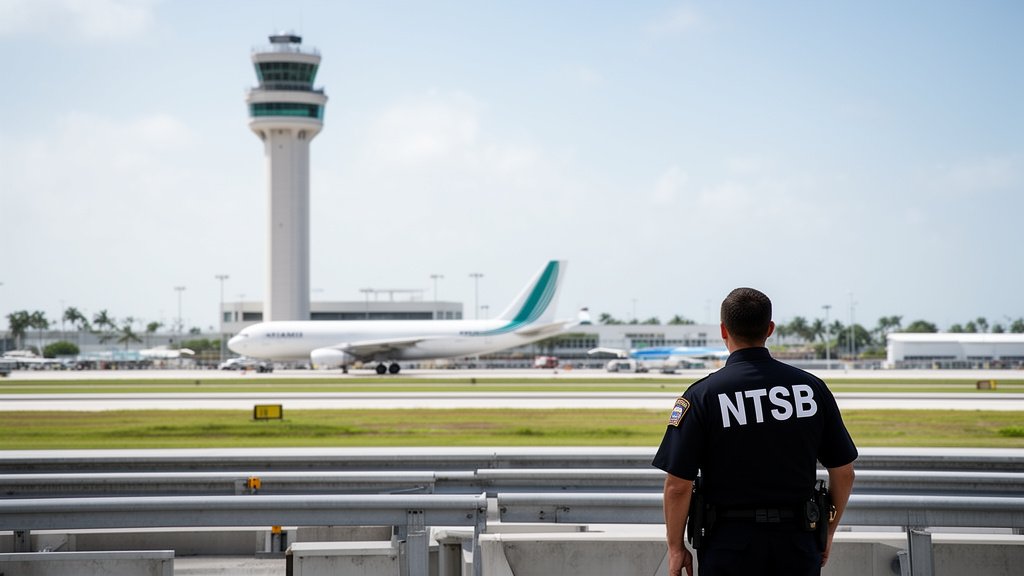
The National Transportation Safety Board (NTSB) has unveiled critical new details surrounding a high-stakes cargo plane incident at Miami International Airport, confirming that the flight crew executed a desperate, last-ditch effort to abort their landing sequence in the final moments before the crash. This revelation adds significant technical weight to the ongoing investigation, shifting the focus toward the complex interplay between pilot decision-making, aircraft response, and organizational safety culture.
Key Highlights
- Final Attempt: NTSB data indicates the flight crew attempted a “go-around” maneuver significantly late in the landing approach, an action that signifies a critical assessment of the plane’s flight path stability.
- Prior Warning Signs: Investigation documentation has surfaced revealing that former pilots for the cargo operator had previously filed safety reports and expressed specific concerns regarding operational standards prior to the incident.
- Ongoing Docket: The NTSB continues to analyze flight data recorder (FDR) and cockpit voice recorder (CVR) information to determine why the abort maneuver was initiated so close to the tarmac.
- Regulatory Scrutiny: The intersection of these mechanical flight findings and reported internal safety complaints is now a focal point for federal investigators assessing whether systemic failures contributed to the event.
Unraveling the Critical Moments of the Flight
The NTSB’s recent release of investigative docket materials provides a sobering window into the final minutes of the flight. For aviation experts, the term “go-around” represents a standard, albeit high-stress, procedure where pilots discontinue a landing and climb back to a safe altitude. However, the timing of this specific attempt at Miami International Airport has become the central focus of the investigation. The data suggests that the crew recognized instability in the aircraft’s approach trajectory, compelling them to reject the landing.
The Mechanics of the Abort
When pilots initiate an aborted landing, they are balancing speed, altitude, and aircraft configuration. The critical nature of this incident lies in the proximity to the runway. The NTSB is currently evaluating whether the aircraft’s performance limitations at that altitude and speed were sufficient to execute the maneuver safely. Investigators are cross-referencing the FDR data with manual inputs provided by the pilots to determine if the aircraft responded as commanded or if mechanical factors hindered the plane’s ability to gain lift during the critical climbing phase.
This specific segment of the investigation is crucial for determining if the crash was the result of a “loss of control” (LOC) event that began in the air or a mechanical failure that occurred during the attempted go-around. By analyzing the vertical speed and pitch data against the throttle settings, the NTSB aims to establish a precise timeline of the pilots’ intervention versus the plane’s automated safety response systems.
The Shadow of Prior Safety Allegations
Perhaps the most contentious aspect of the NTSB’s report involves the emergence of past safety concerns raised by former pilots employed by the cargo operator. In the world of commercial aviation, safety reporting systems—often called Aviation Safety Action Programs (ASAP)—are designed to allow crew members to report hazards without fear of retribution. The NTSB is now investigating whether these prior warnings were adequately addressed by the airline’s management and, if not, whether that inaction created a permissive culture where safety risks were normalized.
The Cultural and Systemic Implications
The emergence of these documents suggests a potential gap between frontline pilot observations and top-level operational decision-making. Aviation industry analysts point out that cargo operations often function under different economic pressures than passenger airlines, with demanding schedules that can sometimes strain maintenance and training resources. The investigation is now tasked with determining if the specific issues raised by previous pilots—such as maintenance delays, fatigue, or standardized operating procedure (SOP) deviations—had any causal or contributory link to the conditions present during the Miami incident.
If the investigation confirms that systemic safety issues were ignored, it could lead to significant regulatory overhauls for cargo operators. The FAA and NTSB typically issue safety recommendations following such findings, which could mandate new training requirements, tighter oversight of internal safety reporting mechanisms, or changes to how cargo pilots handle emergency abort procedures.
Future Implications for Aviation Safety
The outcome of this investigation will likely reverberate through the air cargo industry. As global supply chains become increasingly reliant on rapid air transport, the pressure on operators is immense. However, the Miami incident serves as a stark reminder that safety margins cannot be eroded by operational pace. The NTSB’s final report will not only determine the “probable cause” of this specific crash but will also likely serve as a benchmark for how similar incidents are investigated in the future.
Technological and Training Adjustments
Beyond the investigation of this specific event, the industry is closely watching for new recommendations regarding “go-around” training. Many modern cockpits are highly automated, and experts argue that pilots must remain proficient in manual handling, particularly for instances where the flight management system may be unable to compensate for rapid environmental changes or mechanical anomalies. Increased simulator training, specifically focused on late-stage aborted landings, could be a primary recommendation arising from the board’s findings. Ultimately, the industry must decide if current training regimes are robust enough to prepare flight crews for the high-pressure decision-making required in the final seconds before touchdown.
FAQ: People Also Ask
What is an aborted landing or ‘go-around’?
A go-around is a safe, standard procedure where pilots stop the landing process and climb back to a safe altitude to re-approach or divert to another airport. It is a normal part of flight operations, though the timing of when it is initiated is critical to safety.
Why are the prior pilot safety concerns significant to the NTSB?
The NTSB investigates not just the immediate cause of a crash but also contributing factors. If pilots previously reported safety issues (such as maintenance or scheduling) that went unaddressed, investigators look to see if those issues created a chain of events or a culture that directly contributed to this incident.
Does this investigation impact Amazon’s overall flight operations?
While the aircraft was operating for Amazon, these flights are typically contracted out to third-party air cargo carriers. The NTSB’s investigation focuses on the operator of the aircraft, the crew, and the maintenance history, though it raises questions about the oversight of contract cargo operations.
How long will the NTSB investigation take?
Complex aviation crash investigations can take 12 to 24 months to finalize. The NTSB will issue preliminary reports, followed by an analysis of the evidence, and finally, a report detailing the probable cause and safety recommendations.