As the warm Atlantic currents accelerate, Miami-Dade County’s world-famous beaches are facing an unprecedented challenge: massive, foul-smelling influxes of sargassum. Researchers from the University of South Florida (USF) are now at the forefront of a critical scientific push to understand, track, and ultimately mitigate the record-high accumulations of this brown macroalgae. While sargassum is a natural part of the marine ecosystem, the current volume—driven by a combination of climate-induced warming and shifting nutrient patterns—has overwhelmed local beach maintenance resources, forcing scientists and city officials to seek long-term solutions for a problem that threatens both the regional tourism economy and local marine health.
Key Highlights
- Record-Breaking Volume: USF’s Optical Oceanography Lab reports that the Great Atlantic Sargassum Belt (GASB) has reached historical mass levels, with seasonal trends showing earlier and heavier arrival times in Miami-Dade.
- The Dual Catalyst: Experts identify two primary drivers: rising sea surface temperatures (SST) in the Atlantic and increased nutrient availability—specifically nitrogen and phosphorus—flowing from major river systems into the ocean.
- Economic and Logistical Strain: Miami-Dade County municipalities are grappling with the soaring costs of mechanical beach cleanup and the challenge of processing organic waste that can release toxic hydrogen sulfide as it decomposes.
- Scientific Mitigation: Researchers are evaluating real-time satellite tracking, beach barrier efficacy, and the potential for harvesting the biomass for commercial use as fertilizer or biofuel.
The Great Atlantic Sargassum Belt: A New Ocean Reality
For years, the phenomenon known as the Great Atlantic Sargassum Belt (GASB) has been the subject of intense study by the University of South Florida. This massive, free-floating seaweed accumulation stretches thousands of miles across the Atlantic, from the coast of West Africa to the Caribbean and the Gulf of Mexico. Unlike the historic Sargasso Sea, which is geographically fixed, the GASB has emerged as a distinct, climate-driven feature of the modern ocean.
Dr. Chuanmin Hu and his team at the USF Optical Oceanography Lab have been pivotal in mapping these blooms. Their satellite data indicates that the seaweed thrives in the high-nutrient, warmer waters that have become standard in the Atlantic over the last decade. When these rafts of seaweed encounter the specific hydrodynamic conditions off the Florida coast, they are pushed onshore by prevailing winds and currents. This is not merely a seasonal nuisance; it is a fundamental shift in oceanographic behavior that coastal communities must adapt to permanently.
The Mechanics of the Surge
Why are the piles on Miami Beach reaching record highs? The answer lies in a “perfect storm” of environmental factors. Firstly, global sea surface temperatures have seen consistent, statistically significant increases. Warmer water acts as a catalyst for growth, allowing sargassum to double its biomass in shorter timeframes than in cooler years. Secondly, nutrient loading is a significant, man-made contributor. Large-scale deforestation and agricultural runoff in the Amazon and Congo basins result in massive amounts of nitrogen and phosphorus entering the ocean. These nutrients act as fertilizer for the seaweed, fueling the massive expansion of the GASB. When this nutrient-rich water meets the warming Atlantic, the result is the massive “Golden Tides” currently washing up on Miami’s shorelines.
Secondary Angles: Understanding the Impact
1. The Economic Toll on Tourism
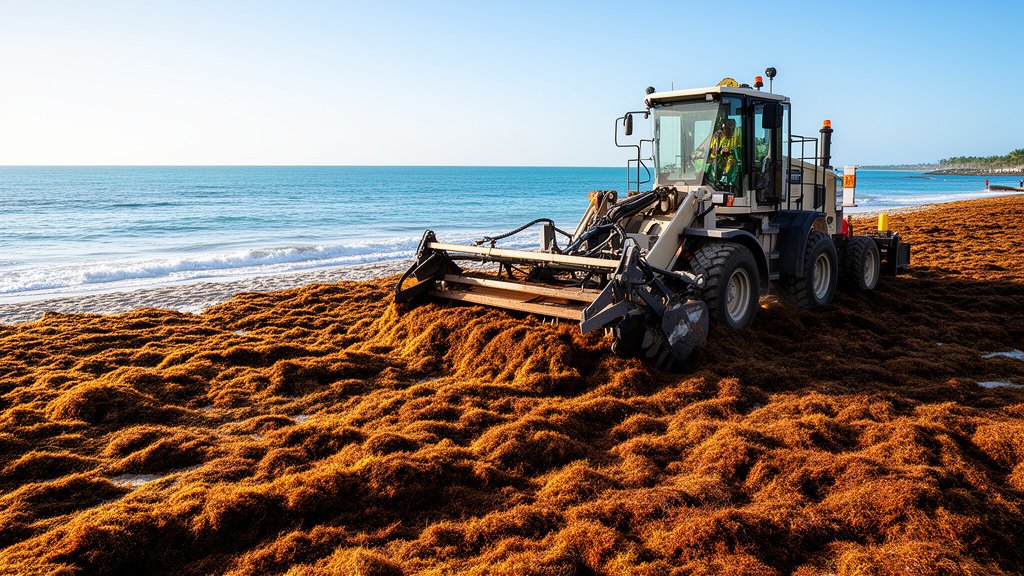
Miami-Dade’s economy is inextricably linked to its pristine beaches. The presence of massive, decomposing piles of sargassum presents a clear and present danger to the hospitality sector. When seaweed is allowed to sit, it releases hydrogen sulfide, creating a pungent, “rotten egg” odor that can drive away tourists and impact property values. The cost of daily mechanical removal—using heavy machinery to rake, collect, and truck away tons of wet, heavy, and corrosive organic material—places an immense financial burden on municipal budgets, diverting funds from other critical infrastructure projects.
2. Ecological Consequences for Local Biodiversity
While sargassum is a habitat for crabs and small fish in the open ocean, it becomes a disaster when it washes ashore in excess. The decay process consumes dissolved oxygen in the water column, creating localized hypoxic zones that can kill marine life trapped in the shallow surf. Furthermore, the thick mats of seaweed present a physical barrier to nesting sea turtles. Hatchlings, already struggling against natural predators, often become entangled in the dense, leathery mounds of algae, hindering their journey from the nest to the ocean. Researchers are tasked with finding a balance: clearing beaches to protect tourism while minimizing disturbance to critical nesting habitats.
3. The Future of Mitigation and Harvesting
Beyond simple removal, the scientific community is exploring the concept of the “Blue Economy.” If the sargassum is coming regardless of intervention, could it be a resource? USF researchers and partners are investigating the feasibility of large-scale harvesting at sea before the algae reaches the coastline. This would prevent the decay cycle on the beach and potentially yield biomass for agricultural compost, livestock feed, or even biofuels. However, the logistical hurdle of harvesting millions of tons of wet, salty biomass remains the primary barrier to commercial-scale viability.
FAQ: People Also Ask
Q: Is the sargassum on Miami Beach harmful to human health?
A: While generally not toxic to the touch, the primary issue arises during decomposition. As sargassum rots, it releases hydrogen sulfide gas, which can cause respiratory irritation, particularly for those with asthma or other underlying health conditions. It is advised to avoid areas with strong, sulfurous odors.
Q: Why can’t the city just stop the sargassum from washing up?
A: The ocean is a vast, dynamic system. There is currently no proven, large-scale technology that can act as a “barrier” to stop seaweed without also severely impacting marine traffic and local marine life, such as manatees and turtles. Currently, the most effective mitigation remains rapid collection and removal once the seaweed lands.
Q: How does the University of South Florida predict these surges?
A: The USF Optical Oceanography Lab utilizes NASA and ESA satellite imagery. By analyzing the color of the ocean—specifically the distinct spectral signature of the chlorophyll within the seaweed—researchers can track the size and trajectory of the Great Atlantic Sargassum Belt weeks before it reaches Florida’s coastline, providing municipal managers with critical lead time.
Q: How long will the seaweed season last this year?
A: While peak season typically runs from March through August, the warming of the Atlantic has expanded these windows. Residents and visitors should expect intermittent arrivals throughout the late summer months, depending on wind patterns and the intensity of the current year’s bloom.