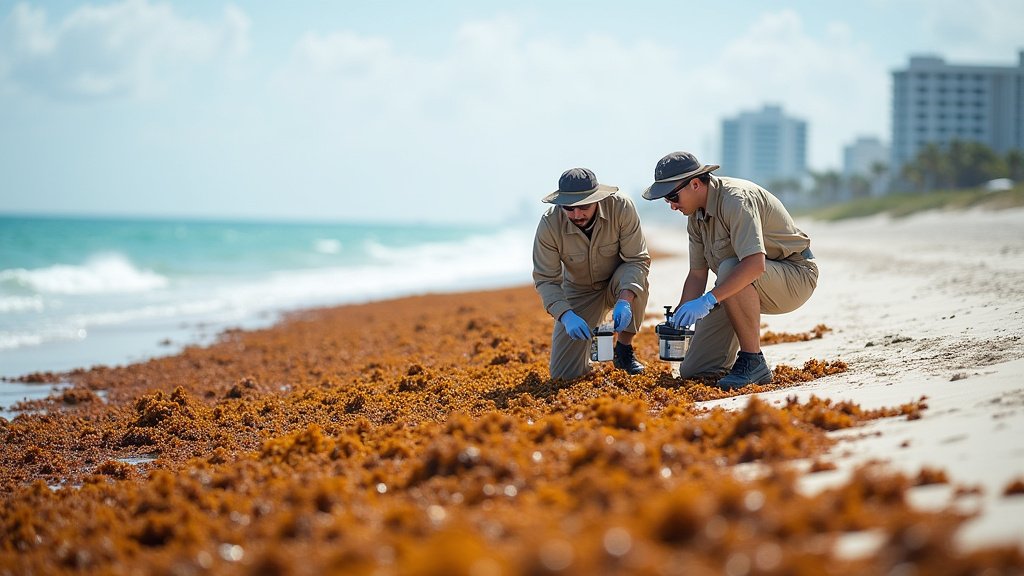
Miami Beach’s pristine white sands have faced a recurring, formidable adversary in recent years: the relentless, seasonal inundation of sargassum seaweed. While the phenomenon is natural, the scale of the accumulation has reached unprecedented levels, disrupting tourism, testing municipal resources, and forcing the University of South Florida (USF) into a critical position as the primary scientific authority on this “Great Atlantic Sargassum Belt.” As local governments scramble to mitigate the impact of this sprawling brown tide, the race is on to understand the drivers of this phenomenon and move beyond reactive clean-up strategies toward proactive management.
Key Highlights
- USF’s Leading Role: Researchers at the University of South Florida’s Optical Oceanography Lab are the global leaders in tracking the Great Atlantic Sargassum Belt (GASB), using advanced satellite imagery to predict influxes.
- Environmental Drivers: The surge is primarily attributed to increased nutrient runoff—specifically nitrogen and phosphorus—from major river systems like the Amazon and Congo, coupled with rising ocean temperatures.
- Economic Tension: The accumulation of sargassum poses a significant threat to Miami-Dade’s tourism-reliant economy, with removal costs often reaching millions of dollars annually for beach maintenance.
- The Predictive Shift: Scientists are moving from reactive cleanup models to an early-warning system that utilizes satellite data to alert municipal authorities weeks before the seaweed hits the shore.
Decoding the Great Atlantic Sargassum Belt
To understand why Miami Beach faces this challenge, one must look far beyond the Florida coastline. The phenomenon known as the Great Atlantic Sargassum Belt (GASB) is a massive, drifting ecosystem of floating seaweed that stretches from West Africa to the Gulf of Mexico. Dr. Chuanmin Hu, a professor at the University of South Florida, and his team at the Optical Oceanography Lab have been instrumental in defining this belt. Their research indicates that the belt has not only become a permanent feature of the Atlantic but is also expanding in both volume and duration.
The Science Behind the Surge
Sargassum has always existed in the ocean; it provides a vital habitat for marine life, including sea turtles, fish, and birds. However, the current crisis is a matter of scale. USF research highlights a critical convergence of factors. First, the introduction of nutrients—nitrogen and phosphorus—from agricultural run-off flowing into the Atlantic from the Amazon and Congo river systems has acted as “fertilizer” for the seaweed. When these nutrient-rich waters meet the warming surface temperatures of the tropical Atlantic, the seaweed experiences explosive growth.
Environmental Triggers: Why Now?
The relationship between climate change and sargassum is becoming increasingly clear. As sea surface temperatures rise, the biological metabolic rates of sargassum increase, allowing for faster reproduction and biomass accumulation. The USF team has observed that the “seasonality” of this influx is shifting. What was once a short-lived occurrence in late spring is now extending into the autumn months, creating a persistent environmental burden for coastal management teams.
Innovation as the Frontline Defense
Facing this challenge requires a pivot from traditional “beach raking” methods. While mechanical removal is necessary to keep Miami Beach operational, it is expensive and environmentally taxing, as it often removes sand and disrupts local turtle nesting grounds. USF researchers are advocating for smarter, data-driven interventions.
Satellite Monitoring: The Early Warning System
The most significant advancement in this field is the use of satellite imagery to map the density and trajectory of sargassum mats while they are still in deep water. By synthesizing data from instruments like the MODIS sensor on NASA satellites, the USF lab can issue alerts to local authorities. This “early warning system” allows Miami-Dade officials to prepare cleanup crews and deploy equipment in anticipation of an arrival, rather than scrambling after the seaweed has already begun to rot on the shore. This is the difference between a minor maintenance task and an emergency environmental hazard response.
Challenges in Clean-up and Mitigation
Even with warnings, the physical removal remains a complex engineering challenge. Large-scale harvesting at sea is technically difficult and energetically expensive. Furthermore, once the sargassum reaches the shallow, highly populated waters of Miami Beach, it traps organic matter and debris. USF is currently investigating the chemical composition of the decaying seaweed, as it can release hydrogen sulfide and ammonia, which present health risks to beachgoers. The goal is to develop sustainable collection methods that can extract the sargassum before it reaches the intertidal zone, where it decomposes and causes the most damage.
The Future of Coastal Management in Florida
As Miami looks to the future, the integration of scientific research into municipal policy is no longer optional—it is a necessity for economic survival. The economic reality is stark: Miami Beach relies on its reputation as a premier luxury destination. Persistent mounds of decaying, foul-smelling seaweed are antithetical to this image. Consequently, the collaboration between academic institutions like USF and city planners is creating a new framework for “climate-resilient coastal management.”
Economic Implications for Miami Beach
The financial burden of sargassum cleanup is a significant line item in local budgets. Beyond the direct costs of trucks and labor, there is the indirect impact of decreased tourism revenue. Local officials are leveraging USF’s data to advocate for state and federal funding, arguing that sargassum is not merely a local nuisance, but a regional climate-driven catastrophe that requires a national-level response.
Long-term Ecological Perspectives
While we focus on the removal, the scientific community reminds us to keep the long-term ecological balance in mind. Sargassum is a natural part of the ocean’s carbon cycle. The researchers at USF are quick to note that we cannot—and should not—eliminate sargassum from the ocean entirely. The task is to manage the interaction between human coastal use and this massive, shifting natural phenomenon. This includes exploring ways to repurpose the collected seaweed, perhaps for agricultural fertilizer or biofuel, turning a waste management crisis into a circular economy opportunity.
FAQ: People Also Ask
Q: What is the primary cause of the record-breaking sargassum levels on Miami Beach?
A: According to University of South Florida researchers, the primary drivers are increased nutrient runoff (nitrogen and phosphorus) from major international river systems like the Amazon and Congo, combined with rising sea surface temperatures that accelerate the seaweed’s growth.
Q: Can we stop the sargassum from reaching the beach?
A: Currently, there is no way to “stop” the sargassum, as it is a large-scale, open-ocean phenomenon. However, researchers are using satellite monitoring to provide early warnings, allowing cities to implement preemptive cleanup strategies and minimize the accumulation on the shore.
Q: Is the sargassum seaweed toxic to humans?
A: The sargassum itself is not inherently toxic, but as it rots on the beach, it can release hydrogen sulfide gas, which can cause respiratory issues and eye irritation, especially for individuals with underlying health conditions. Officials often issue warnings during high-accumulation events.
Q: Does USF research suggest this will get worse in the coming years?
A: Dr. Chuanmin Hu and his team at USF suggest that the conditions fueling the Great Atlantic Sargassum Belt—specifically climate change and nutrient loading—are ongoing global trends, meaning that coastal communities should prepare for continued, and potentially intense, seasonal sargassum arrivals.