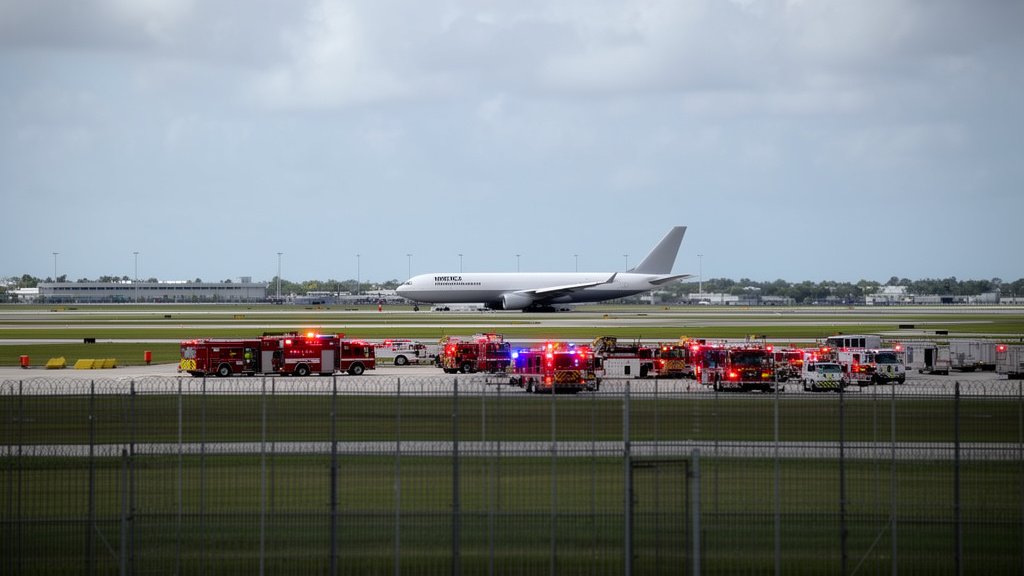
A catastrophic incident unfolded at Miami International Airport (MIA) on Sunday afternoon, when an Amazon cargo aircraft failed to stop on the runway, overrunning the tarmac and colliding with nearby ground vehicles. Emergency services were immediately dispatched to the site, where flames consumed the wreckage. Authorities have officially confirmed that at least five individuals lost their lives in the crash, with several others sustained injuries and requiring urgent medical transport. The airport grounds remain cordoned off as recovery teams and aviation investigators begin the grueling process of securing the area.
Key Highlights
- Fatal Incident: Five deaths confirmed following a runway overrun by an Amazon cargo jet at MIA.
- Ground Collision: The aircraft struck nearby vehicles after exceeding the runway threshold, causing a significant fire.
- Emergency Response: Local fire and rescue crews were deployed immediately, managing the blaze and establishing a perimeter.
- Ongoing Investigation: The Federal Aviation Administration (FAA) and National Transportation Safety Board (NTSB) are expected to lead the investigation into the crash causes.
Anatomy of a Runway Disaster: Understanding the MIA Incident
The aviation community and the logistics sector are reeling from the events of Sunday afternoon at Miami International Airport. While initial reports confirm the tragic loss of five lives, the precise cause of the runway overrun—a technical term used when an aircraft fails to decelerate or stop within the designated pavement—remains the primary subject of inquiry. Runway excursions are statistically rare but carry the highest risk profile in aviation due to the proximity of obstacles, fueling stations, and ground support equipment often found near major runway thresholds.
The Sequence of Events
Preliminary information suggests the cargo plane was in the final stages of its landing procedure when the anomaly occurred. Witnesses described the aircraft failing to decelerate at the expected rate before exiting the paved surface of the runway. Upon leaving the tarmac, the aircraft struck ground vehicles positioned in the vicinity, which likely contributed to the severity of the fire. The immediate eruption into flames created a chaotic scene, requiring massive resources from the Miami-Dade Fire Rescue to contain. For investigators, the primary focus will be the integration of telemetry data, pilot communication, and potential mechanical failure, specifically targeting the brake and spoiler systems.
The Role of Amazon Air and Cargo Operations
Amazon Air (often referred to as Prime Air) has seen an explosive growth trajectory over the past decade, shifting from a third-party logistics client to an entity operating a massive fleet of leased and owned cargo aircraft. As a central hub for Latin American trade, Miami International Airport serves as a critical node in this network. The operational tempo at MIA is relentless, and this incident raises critical questions regarding the safety protocols required for high-volume cargo operators. Unlike passenger flights, cargo operations often run on tighter, demand-driven schedules, and investigators will inevitably look into whether flight crew fatigue or maintenance scheduling played a role in the lead-up to the event.
NTSB Investigation Pathways
In any aviation accident involving fatalities, the National Transportation Safety Board (NTSB) assumes the role of lead investigator. They will be looking for the “Black Box” (Flight Data Recorder and Cockpit Voice Recorder). These devices are essential for reconstructing the final minutes of the flight. The investigation will also cross-reference the weather data from Sunday afternoon, specifically looking for “hydroplaning” conditions or sudden wind shear, which are known variables that can compromise the braking efficiency of a heavy cargo jet.
Secondary Angles: Safety, Logistics, and Policy
Beyond the immediate tragedy, this incident invites deeper analysis into three critical areas:
1. Aviation Safety Technology: The aviation industry has long debated the efficacy of Engineered Materials Arrestor Systems (EMAS)—crushable concrete beds installed at the end of runways to stop aircraft that overrun. This incident will likely spark a renewed push for the mandatory installation of EMAS at airports that serve high volumes of heavy cargo traffic.
2. The Logistics Supply Chain: As a major logistics hub, the temporary closure of any runway at MIA creates a ripple effect across the global supply chain. With the rise of e-commerce, the reliance on air cargo has reached unprecedented levels. This event may force a re-evaluation of how close ground-based support vehicles are permitted to operate near active runway boundaries.
3. Historical Precedents: Historically, cargo aviation safety records are often compared against passenger aviation. While cargo jets are generally older airframes, they are subjected to rigorous maintenance cycles. However, the pilot-to-cargo ratio and the nature of cargo loads (which can shift during deceleration) present unique challenges that will be heavily scrutinized in the coming months.
FAQ: People Also Ask
1. What is a runway overrun?
A runway overrun occurs when an aircraft is unable to come to a complete stop before reaching the end of the runway, continuing onto the adjacent grass or ground area. This can be caused by mechanical failure, pilot error, poor weather conditions, or runway surface friction issues.
2. Is Miami International Airport open?
Operations at Miami International Airport have been significantly impacted. While authorities work to clear the wreckage and conduct the initial forensic sweep, certain runways may remain closed, causing delays and cancellations. Travelers are advised to check their flight status directly with their airlines.
3. How long will the investigation take?
Investigations into major aviation accidents conducted by the NTSB are thorough. While preliminary findings are often released within weeks, a full, comprehensive report detailing the probable cause of the crash can take anywhere from 12 to 24 months to complete.
4. What will happen to the debris?
The site remains an active crime scene and investigation zone. The NTSB will document the wreckage in situ before removing parts to a secure hangar for a more detailed technical teardown and forensic analysis.