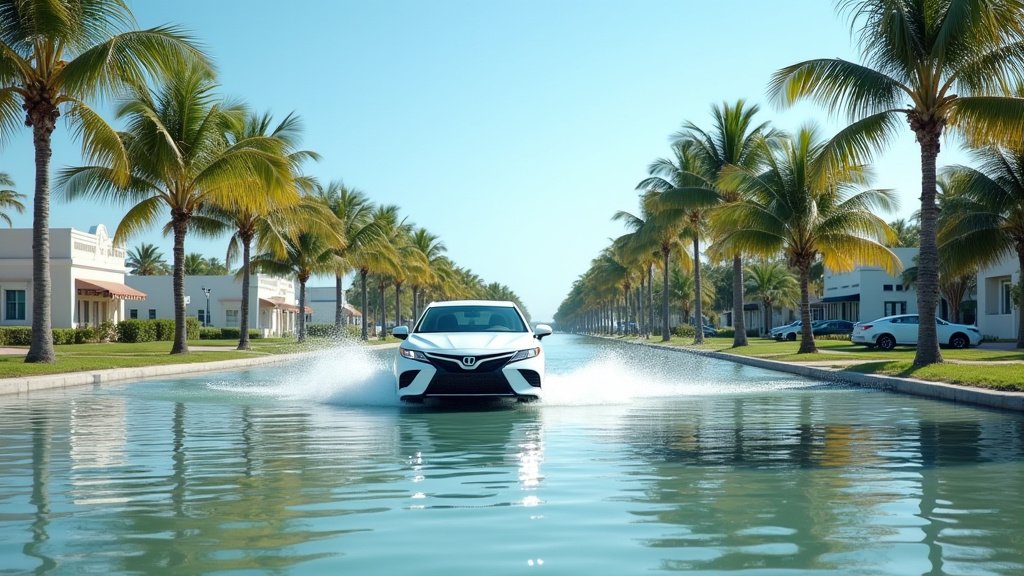
South Florida is grappling with the acute impacts of severe king tide flooding, as residents and municipal authorities scramble to manage water levels that are currently peaking across the coast. From the high-traffic corridors of Miami Beach to the coastal streets of Fort Lauderdale and Hollywood Beach, the phenomenon—known technically as perigean spring tides—has turned streets into waterways, forcing drivers to navigate flooded roadways and triggering localized transit delays. The National Weather Service (NWS) has issued persistent coastal flood advisories, underscoring the urgency of the situation as tide gauges register levels significantly above mean higher high water.
Key Highlights
- Widespread Impact: Severe coastal flooding is confirmed across Broward and Miami-Dade counties, with acute issues reported in Hollywood Beach, Fort Lauderdale, and Miami Beach.
- Critical Infrastructure Warning: Local authorities have cautioned residents about the heightened risk of vehicle damage, specifically warning against driving through salt water which accelerates corrosion and mechanical failure.
- NWS Advisories: The National Weather Service continues to monitor tide gauges, advising property owners to secure outdoor belongings and prepare for “sunny day flooding” that can occur even without rainfall.
- Scientific Context: These tides are the result of the moon’s closest approach to Earth (perigee) aligning with a new or full moon, amplifying gravitational pull.
The Rising Tide: Understanding the Seasonal Surge
The current flooding event is not an isolated incident but part of an escalating seasonal pattern that defines life in South Florida. King tides, or perigean spring tides, occur when the gravitational pull of the moon and the sun align, effectively ‘stacking’ their influence on Earth’s oceans. While these tides are a natural phenomenon, the combination of sea-level rise and aging drainage infrastructure has transformed what was once a manageable inconvenience into a significant urban crisis.
The Physics of Perigean Tides
In South Florida, the geography is uniquely vulnerable. The region sits on a porous limestone foundation, which complicates traditional water management. Unlike other coastal areas where water can simply be dammed or pumped, here, the water often rises from beneath the ground through storm drains and groundwater seepage. This “sunny day flooding”—so called because it frequently occurs on clear, cloudless days—bypasses traditional flood-control systems. Residents are finding that their local streets are submerged not because of a storm, but because the ocean has nowhere else to go. The NWS and local meteorological experts emphasize that this is a predictable cycle, yet one that is becoming increasingly volatile due to global sea-level rise contributing to higher baseline tides.
Targeted Areas: From Miami Beach to Fort Lauderdale
The impact on the tri-county area is non-uniform but severe in specific high-risk zones. In Miami Beach, where the city has invested heavily in pump stations and raised roadways, the current event is testing the limits of these adaptive measures. Residents in South of Fifth and Mid-Beach have reported water pooling at intersections, causing significant rerouting of daily traffic. Moving north, Hollywood Beach presents a distinct challenge. The area’s proximity to the Intracoastal Waterway means that when the ocean pushes in, the pressure is felt almost simultaneously on both sides of the barrier island. Fort Lauderdale is seeing similar trends, particularly in Las Olas and the low-lying neighborhoods adjacent to the New River, where king tides regularly crest over sea walls.
Infrastructure Vulnerabilities and Economic Impact
The economic cost of these events is often underestimated. While immediate damage to vehicles—often caused by saltwater entering the undercarriage and shorting out sensitive electronic control units (ECUs)—is the most visible headline, the cumulative effect on property value and municipal maintenance is profound. Saltwater is inherently corrosive; it accelerates the degradation of concrete, steel reinforcement in bridges, and underground utility pipes. Municipalities are currently spending millions of dollars annually to upgrade pump systems and elevate roads. However, for the average resident, the immediate concern is the financial hit of vehicle repairs or the potential for water intrusion into ground-floor garages. Insurance companies have begun to adjust risk models for these specific areas, leading to rising premiums that correlate with the frequency of these tidal inundations.
Long-term Resilience: Adaptation and Planning
As the reality of these tides sets in, the conversation in South Florida has shifted from ‘flood control’ to ‘flood adaptation.’ This means living with a higher water table. Urban planners are now looking at ‘living shorelines’—using mangroves and native vegetation to break the energy of incoming tides—rather than relying solely on sea walls. There is also a move toward ‘resilient architecture,’ where building codes are being rewritten to require ground-floor mechanical systems to be elevated or flood-proofed. The goal is to create a ‘sponge city’ model where urban spaces are designed to absorb and drain water more efficiently. While these infrastructure projects take years to complete, they represent the only viable path forward for major hubs like Miami and Fort Lauderdale to maintain their economic vitality in the face of changing tidal realities.
FAQ: People Also Ask
Q: What should I do if my car is exposed to floodwater?
A: If your vehicle has been driven through salt water, it is highly recommended to have the undercarriage washed thoroughly at a professional facility to prevent long-term corrosion. If the water was high enough to reach the engine or floorboards, do not start the vehicle; have it towed to a mechanic to assess potential electrical damage.
Q: Why does flooding happen on clear, sunny days?
A: This is due to the astronomical alignment of the sun and moon. When the moon is at perigee (closest to Earth) and in a new or full phase, the gravitational pull is strongest. This forces water levels up independent of local weather, hence the term “sunny day flooding.”
Q: Is this flooding related to climate change?
A: While king tides are a natural celestial event, climate change acts as a force multiplier. Sea-level rise has raised the baseline ‘zero’ level of the ocean, meaning that today’s king tides reach higher elevations and stay on land longer than they did in previous decades.
Q: How long will these king tides last?
A: King tide events typically last for several days, peaking during the specific tidal cycle. Residents should monitor local NWS coastal flood advisories for the exact duration of the current warning period, as tides can fluctuate based on wind direction and barometric pressure.