Miami Beach city commissioners are preparing for a critical vote scheduled for next week regarding a new bond measure intended to fund sea-level rise mitigation infrastructure, following a recent report on escalating storm surge risks. The decision represents a pivotal moment for the municipality, which must decide whether to significantly increase its financial commitment to climate-resilient infrastructure to protect property and public safety.
Key Highlights
- Urgent Bond Vote: Commissioners will vote next week on a substantial bond measure dedicated to funding critical climate adaptation projects.
- Data-Driven Urgency: The proposal follows a fresh, authoritative report detailing heightened storm surge vulnerability along the barrier island’s coastlines.
- Economic Stakes: The infrastructure investment is framed as essential to stabilizing the local real estate market and managing long-term flood insurance costs.
- Infrastructure Focus: Planned projects include expanded pump station capacity, road elevation, and enhanced drainage systems as part of the broader ‘Miami Beach Rising Above’ initiative.
Securing the Horizon: The Architecture of Resilience
The upcoming legislative session for the Miami Beach City Commission is not merely administrative; it is a defensive maneuver against the accelerating realities of Atlantic coastal geography. At the heart of the debate is the proposed allocation of funds to upgrade the city’s aging subterranean network. The city’s ‘Miami Beach Rising Above’ initiative, which has served as the operational backbone for climate strategy since its inception, is now pushing for a new financial injection via a municipal bond measure.
This decision comes on the heels of a diagnostic report by climate analysts which highlighted a startling increase in storm surge frequency—a phenomenon exacerbated by the porous, limestone-based foundation upon which the city sits. This geology makes traditional sea walls insufficient, necessitating the current, multi-pronged approach of road elevation, high-capacity pump installation, and the implementation of backflow preventers. The bond, if approved, would provide the capital necessary to accelerate these projects, which are otherwise phased over long, multi-year timelines.
The Engineering of Survival
When we analyze the technical scope of the proposed infrastructure, we are looking at a complex hydraulic engineering puzzle. The city’s low elevation means that gravitational drainage is effectively obsolete during high-tide events. The proposed bond money is earmarked specifically for the ‘industrial-scale’ hardening of the city. This involves three critical components:
1. Elevation of Public Rights-of-Way: Increasing street levels to create natural barriers and prevent saltwater intrusion during nuisance flooding.
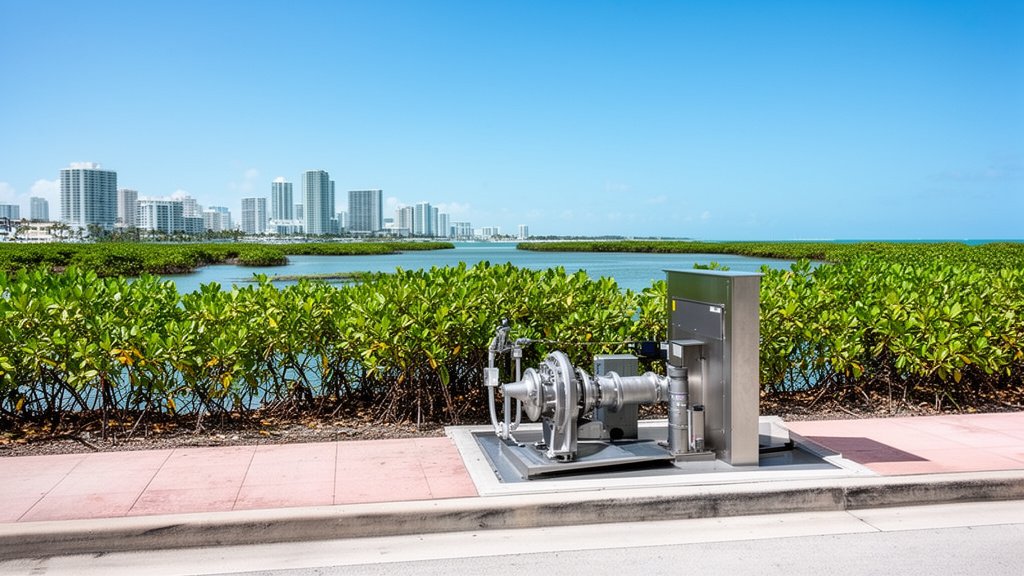
2. Smart-Pump Networks: Scaling up the existing pump station grid, which uses real-time sensor data to optimize water extraction and management before, during, and after storm events.
3. Living Shorelines: Utilizing mangroves and natural vegetation as the ‘first line of defense’ to dissipate wave energy, a strategy favored by environmental consultants for its dual benefit of erosion control and habitat restoration.
Economic Impacts and Property Value
Beyond the raw engineering, the Commission is navigating a treacherous economic landscape. The stability of the Miami Beach real estate market—and by extension, the city’s tax base—is inextricably linked to its perceived climate safety. A failed bond measure could signal to the insurance markets that the city is failing to mitigate risk, potentially driving premiums even higher or causing insurers to exit the market entirely. Conversely, successful funding sends a stabilizing message to institutional investors and homeowners alike: that the city is not merely reacting to the crisis, but proactively managing its survivability. This infrastructure project is, in effect, an economic insurance policy, costing millions today to prevent billions in asset devaluation tomorrow.
Historical Context: The 2018 Precedent
To understand the magnitude of this vote, one must look back at the 2018 General Obligation (G.O.) Bond success, where voters approved $439 million for various municipal improvements, including critical stormwater upgrades. That vote cemented the public’s understanding that climate adaptation is a permanent, non-negotiable line item in the municipal budget. However, that funding is now largely committed or exhausted. The current proposal acts as a ‘Phase II’ of this strategy. The lessons learned between 2018 and the present—specifically regarding the rapid pace of sea-level rise observed by the U.S. Army Corps of Engineers—have pushed the City Commission to move faster than initially anticipated.
Future Predictions: The Adaptation Plateau
Looking toward the next decade, the question is not just about funding, but about the ‘adaptation plateau.’ Engineers generally agree that current strategies, while effective, have an expiration date. Eventually, the city will face the ‘retreat or adapt’ threshold. While the upcoming vote focuses on the short-to-medium-term physical hardening, the discourse in committee meetings is increasingly shifting toward long-term policy adjustments, such as restrictive building codes and strategic zoning changes. For now, however, the commission is focused on the immediate mandate: keeping the water out. The vote next week is a litmus test for whether the political will of the Commission aligns with the technical necessities of climate-resilient infrastructure.
FAQ: People Also Ask
Q: What exactly will the bond measure fund?
A: The bond is specifically targeted at sea-level rise mitigation, primarily funding the expansion of the pump station network, elevating public roads, and reinforcing drainage systems to combat storm surges.
Q: How does this affect my property taxes?
A: Municipal bonds are typically repaid through property tax assessments. While the exact impact depends on the final bond amount and the city’s debt service schedule, residents should anticipate a potential adjustment in their annual millage rates.
Q: Is this bond part of the ‘Miami Beach Rising Above’ initiative?
A: Yes. This bond measure is a financial instrument designed to provide the necessary capital to execute the goals outlined under the ‘Miami Beach Rising Above’ strategic plan.
Q: How soon will work begin if the vote passes?
A: Upon approval, the city will move to bond issuance, followed by procurement and contract bidding. Residents can expect site-specific engineering and construction to commence within 12 to 18 months following the successful authorization of funds.