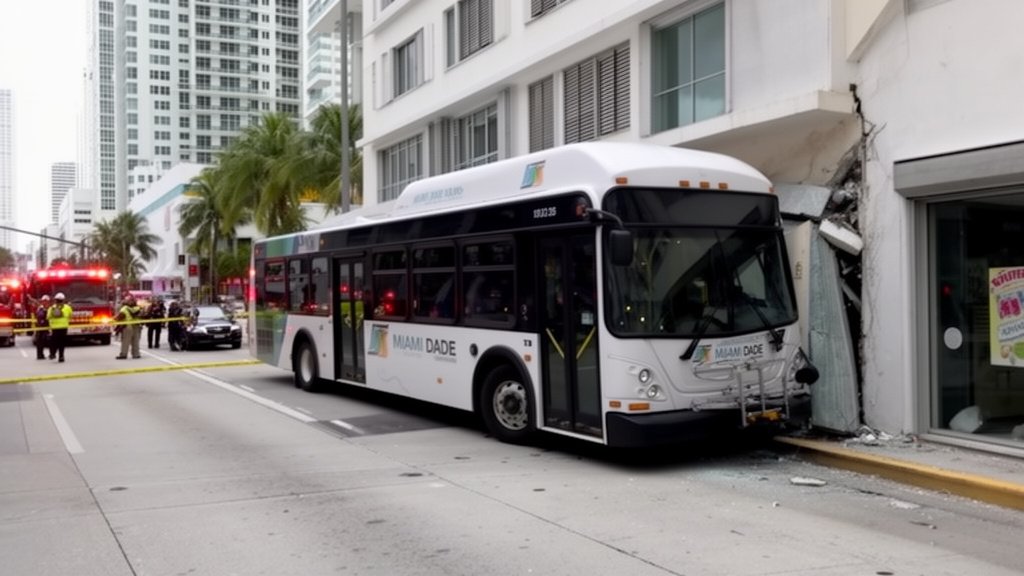
A harrowing scene unfolded on the busy streets of Miami Beach as a Miami-Dade Transit bus veered off the road and collided with a commercial structure, an incident now under intense scrutiny following the release of critical surveillance footage. The crash, which occurred on the 1000 block of Washington Avenue, has drawn immediate attention from municipal authorities and transportation experts alike, raising urgent questions about mechanical maintenance, driver oversight, and urban transit safety in high-density corridors.
Key Highlights
- Surveillance footage released by the Miami Beach Police Department shows the bus departing from its lane and mounting the curb before striking the building.
- Emergency response teams secured the site within minutes, assessing injuries to passengers and pedestrians on the sidewalk.
- A multi-agency investigation is currently underway to determine whether the collision was caused by mechanical failure or human error.
- Structural engineers have been deployed to assess the integrity of the affected commercial property to ensure the safety of the surrounding area.
Anatomy of the Incident and Ongoing Forensic Investigation
The incident, which took place in one of Miami Beach’s most recognizable high-traffic zones, serves as a sobering reminder of the complexities involved in managing public transit within a bustling tourist environment. According to the preliminary reports and the released video evidence, the bus was operating along its scheduled route when it abruptly veered from the roadway. The video, captured by nearby street-level surveillance cameras, shows the vehicle traveling at a moderate speed before the trajectory shifted significantly, ultimately resulting in a high-impact collision with the structural facade of a business.
Following the crash, Miami-Dade Transit (MDT) and local police officials immediately launched a comprehensive investigation. Forensic teams have spent the subsequent hours documenting skid marks, reviewing onboard telematics, and inspecting the physical condition of the bus—specifically focusing on the braking and steering systems. In the context of large-scale transit operations, such investigations are multifaceted. They require not only an analysis of the driver’s log and recent performance history but also an exhaustive review of the vehicle’s maintenance schedule. These buses, which are heavy-duty machines navigating dense urban environments, are subject to rigorous preventative maintenance protocols. Any deviation or failure in these systems is scrutinized with extreme care to prevent recurrence.
The Intersection of Public Transit and Urban Infrastructure
Beyond the immediate cause of the accident, the incident highlights the broader challenge of integrating heavy mass-transit vehicles into the narrow, pedestrian-heavy streets of Miami Beach. Urban planners have long debated the balance between accessibility—providing essential bus routes for commuters and tourists—and the inherent risks posed by large vehicles in tight corridors.
Washington Avenue, a hub of commerce and tourism, presents a unique challenge for transit operators. With narrow lanes, frequent stops, and high volumes of foot traffic, the margin for error is razor-thin. This crash serves as a critical data point for the Miami-Dade Department of Transportation and Public Works as they reassess route safety. The structural impact on the building, which sustained significant cosmetic and potentially structural damage, raises questions about the financial and economic ripple effects for small businesses. Commercial property damage claims, business interruption, and the long-term cost of municipal liability are all factors that will emerge as the investigation concludes. City officials are likely to use this event as a case study for future infrastructure safety enhancements, including the potential installation of protective bollards or refined traffic flow management near storefronts.
Technology as a Preventative Measure: The Future of Transit
The incident has reignited the conversation regarding the implementation of advanced safety technologies in public fleets. Modern transit buses are increasingly being equipped with Advanced Driver Assistance Systems (ADAS), including automatic emergency braking (AEB), lane-departure warnings, and obstacle detection sensors. While it is unclear at this stage to what extent these technologies were integrated into the involved vehicle, the industry standard is shifting rapidly.
Integrating AI-driven safety protocols could potentially mitigate human error, which remains the leading cause of traffic accidents globally. As the National Transportation Safety Board (NTSB) and local authorities continue their review, the push for mandatory upgrades across the aging public transit fleet may gain political momentum. This is not merely a matter of vehicle maintenance; it is a matter of integrating smart-city technology into our existing transit frameworks. The ability for buses to communicate with smart traffic signals, pedestrian detection systems, and even centralized fleet management centers in real-time is the next frontier in preventing accidents of this nature.
FAQ: People Also Ask
Q: Were there any fatalities reported in the Miami Beach bus crash?
A: As of the latest updates from the Miami Beach Police Department, no fatalities were reported. Emergency responders treated several individuals for minor injuries on the scene, and some were transported to local hospitals for further evaluation.
Q: Is Washington Avenue currently closed to traffic?
A: While local authorities have cleared the primary crash site, there may be intermittent lane closures or restrictions as structural engineers continue their assessments of the damaged building. Commuters are advised to check local transit apps for route detours.
Q: How does the investigation process work for a city-owned transit vehicle?
A: Because the incident involves a government-operated vehicle, the investigation is handled with high priority. It involves both internal affairs reviews by Miami-Dade Transit to ensure protocol compliance and an independent forensic investigation by local law enforcement to determine if criminal negligence or mechanical failure occurred.
Q: Will the bus route be permanently changed following this event?
A: Transit route adjustments are usually rare unless specific structural or safety hazards are identified that cannot be mitigated. Currently, there is no official word on a permanent route change, but the city will likely complete a safety audit of the corridor before finalizing any operational decisions.