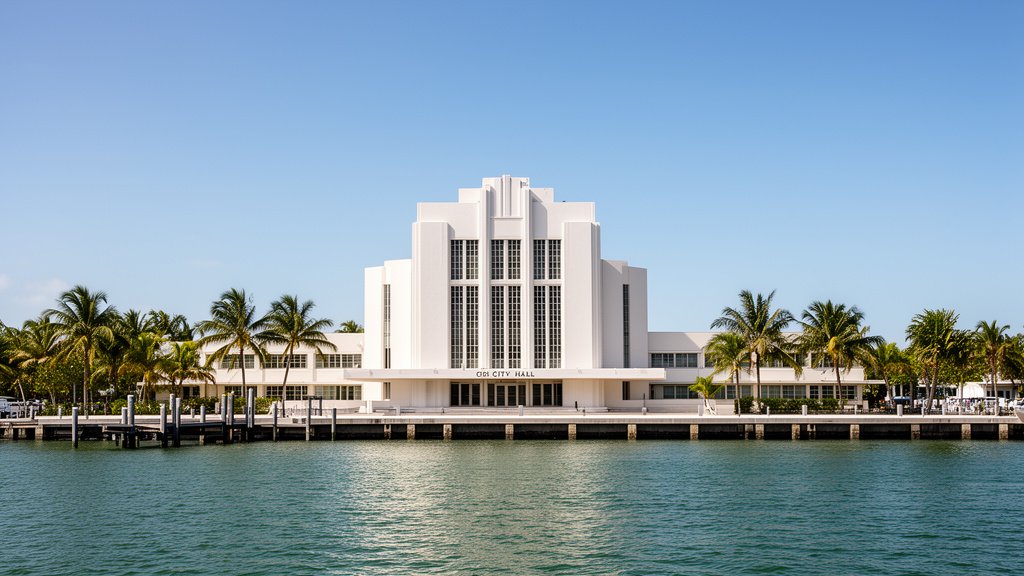
The gleaming facade of Miami City Hall at Dinner Key, once the beating heart of international travel as the Pan American Airways seaplane terminal, now stands at a perilous crossroads. For residents of Coconut Grove, the structure is more than just a seat of municipal government; it is a profound testament to the era when Miami became the ‘Air Gate to the Americas.’ However, a combination of chronic budget neglect, the escalating threat of sea-level rise, and the relentless pressure of urban modernization has left this National Register of Historic Places site in a state of precarious vulnerability. As preservationists and city planners clash over the building’s future, the question remains: Can Miami afford to lose the very landmark that launched its transformation into a global city?
The Birthplace of Trans-Atlantic Aviation
To understand the significance of Dinner Key, one must look back to 1934, when the Pan American Airways seaplane terminal was completed. Designed by the renowned architectural firm Delano and Aldrich, the building served as the primary nexus for travel between the United States, the Caribbean, and South America. During the 1930s and 1940s, this site was not merely a dock; it was a sophisticated international gateway, processing diplomats, celebrities, and travelers who arrived via the iconic Pan Am Clipper flying boats. The terminal’s distinct Art Deco architecture and the vast, open-water runway of Biscayne Bay defined the region’s early aviation identity. When the city converted the structure into City Hall in 1954, it preserved the exterior but repurposed the interior for governance. This dual identity—as a historic aviation monument and an active government hub—has created a unique, yet complicated, mandate for maintenance. The site remains a tangible link to a pivotal moment in American history, representing the moment Miami pivoted from a quiet coastal town to an international logistics powerhouse.
The Rising Tide of Climate Challenges
Perhaps the most existential threat facing the Dinner Key complex is not political, but environmental. Coconut Grove, the historic neighborhood housing the terminal, is particularly susceptible to the effects of sea-level rise. As tidal flooding becomes increasingly frequent and severe during ‘King Tide’ events, the low-lying elevation of the Dinner Key marina and the surrounding parkland poses a direct risk to the structural integrity of the site. Saltwater intrusion and high water tables have accelerated the deterioration of the building’s foundation, necessitating costly and complex retrofitting efforts that go beyond standard facility management. Climate experts point to the site as a ‘canary in the coal mine’ for historic preservation in South Florida. If a landmark as significant as City Hall cannot be protected from the encroaching Atlantic, it signals a bleak outlook for thousands of other historic properties across the coastal region that lack the governmental prioritization of a seat of power.
Architectural Integrity vs. Fiscal Neglect
Beyond the physical impact of climate change, the building suffers from a cycle of deferred maintenance that has plagued many municipal structures in Miami-Dade County. Despite its status on the National Register of Historic Places, the facility requires specialized restoration to maintain its architectural character. Critics of current city policies argue that the aesthetic and historic value of the building is often sidelined in favor of cheaper, more immediate infrastructure fixes. The delicate balancing act of modernizing a 1934 terminal to meet 21st-century building codes and ADA compliance requirements while respecting its historic fabric is an expensive, arduous task. This fiscal strain has resulted in peeling facades, outdated utility systems, and security concerns, leading community advocates to demand a comprehensive preservation master plan. The tension lies in the city’s dual role as both an owner and a steward; by failing to properly fund the maintenance of City Hall, the city is effectively allowing its own history to erode.
The Path Forward for Coconut Grove
Preservationists are now mobilizing to ensure that the Dinner Key site remains a cornerstone of the community. Several proposals have been floated to create a public-private partnership or a dedicated historic trust to oversee the site’s long-term rehabilitation. By leveraging historical tax credits and seeking state-level heritage grants, advocates believe that the site could be stabilized without placing the entire burden on the municipal taxpayer. The goal is to transform the site into a resilient landmark that serves as both a functional government building and an educational center for aviation history. Integrating the site into a broader ‘climate adaptation’ corridor, which includes sea walls, permeable landscaping, and raised infrastructure, could provide the necessary protection for the building while enhancing the public park space. The survival of Dinner Key is not just a matter of nostalgia; it is a critical test of Miami’s ability to value its past while engineering a sustainable future.
FAQ: People Also Ask
Q: Why is Miami City Hall at Dinner Key considered historically significant?
A: It is the former Pan American Airways seaplane terminal, completed in 1934. It was the crucial ‘Air Gate to the Americas,’ facilitating early international commercial aviation and connecting the U.S. to the Caribbean and South America. Its Art Deco architecture and role in early aviation history earned it a spot on the National Register of Historic Places.
Q: How does sea-level rise specifically threaten the building?
A: The building is located in a low-lying coastal area in Coconut Grove. Increased tidal flooding (King Tides) and rising water tables subject the foundation to saltwater intrusion and accelerated erosion. This environment necessitates expensive, specialized infrastructure retrofitting to prevent structural damage that standard repairs cannot address.
Q: Is the building currently in danger of being demolished?
A: While there is no immediate plan for demolition, preservationists warn that ‘demolition by neglect’—a process where a building is allowed to decay until it becomes unsafe and restoration is deemed fiscally unfeasible—is the primary risk. Chronic deferred maintenance remains the most significant threat to its longevity.