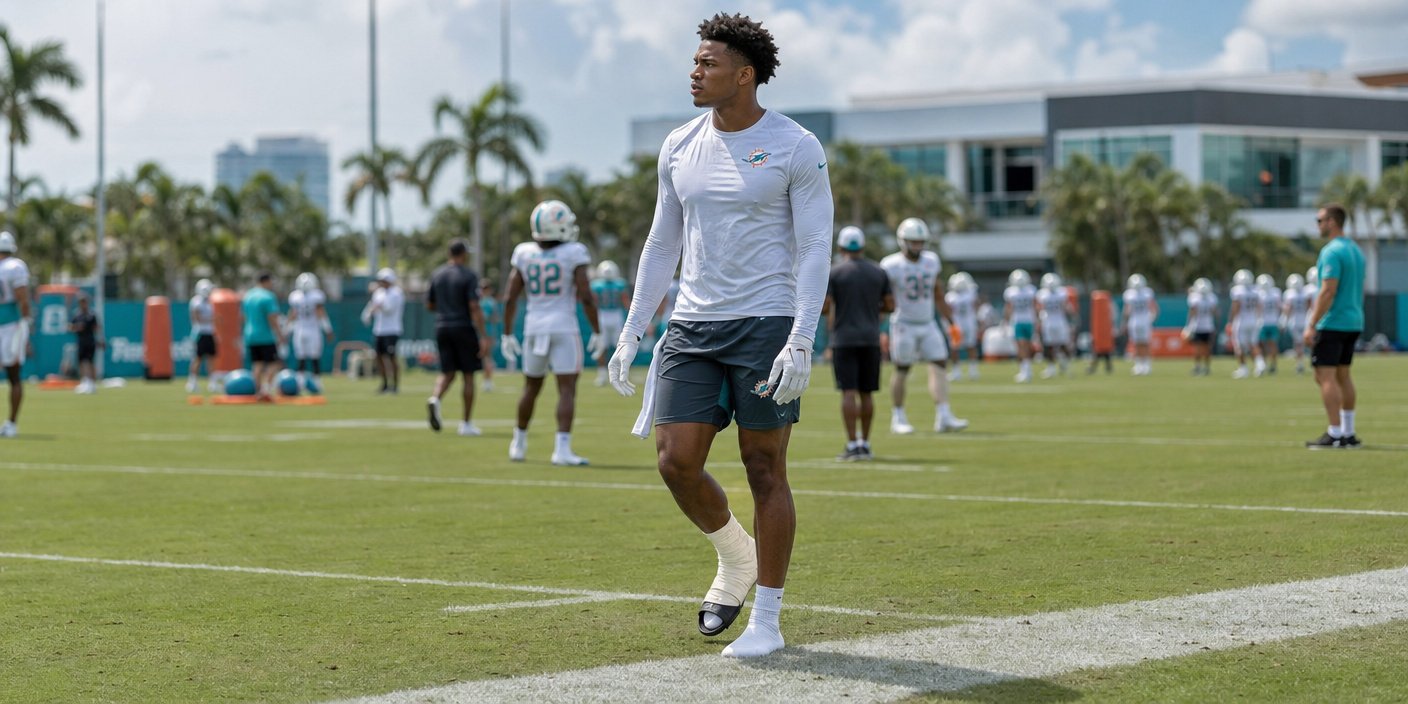
The Miami Dolphins’ offensive rhythm will face a significant test this week as rookie wide receiver Caleb Douglas has been officially ruled out for the highly anticipated showdown against the Minnesota Vikings. The news, confirmed by the team’s medical staff following the week’s final practice, marks a pivotal shift in preparation for a game where roster depth and schematic versatility were expected to be at a premium.
Key Highlights
- Status Confirmed: Rookie sensation Caleb Douglas will not suit up against the Minnesota Vikings due to an ankle injury sustained earlier in the season.
- Strategic Pivot: Head Coach Mike McDaniel is now forced to recalibrate the passing attack, likely increasing the workload for veteran receivers.
- Injury Timeline: The injury, which has been managed over the last several weeks, flared up during mid-week conditioning, necessitating a cautious approach to ensure long-term availability.
- Next Man Up: Expect the coaching staff to rely on situational personnel packages to compensate for the specific speed-threat dimension Douglas brings to the field.
Navigating the Absence: Tactical Shifts and Roster Adjustments
The loss of Caleb Douglas is more than just a name removed from the active roster; it represents the absence of a specific tactical weapon that the Dolphins have utilized to stretch the field. Douglas, who has been a revelation in his debut season, provides a unique combination of vertical speed and route-running precision that has consistently forced opposing defensive coordinators to adjust their shell coverages.
The Impact of Ankle Pathology on Wide Receiver Performance
From a biomechanical standpoint, the ankle is the fulcrum of a receiver’s performance. For a player like Douglas, whose game is predicated on explosive cutting, rapid deceleration, and sudden changes of direction, even a minor ankle complication can degrade efficiency significantly. When a receiver cannot trust their plant foot, the timing of the entire passing game is compromised. Quarterbacks require receivers to be in specific spots at precise windows; if the receiver is a fraction of a second late due to discomfort, the margin for error against a disciplined secondary like Minnesota’s shrinks to near zero.
Tactical Redundancy: The ‘Next Man Up’ Philosophy
In the wake of this news, all eyes turn to the Dolphins’ depth chart. The coaching staff has long preached the concept of ‘positionless football’ and interchangeable parts, and this week will be the ultimate litmus test for that philosophy. We expect to see an increased reliance on veteran receivers who possess a different skill set—perhaps shifting toward a more possession-oriented attack rather than the deep-ball dependency that Douglas facilitates. This shift may also see the tight ends utilized more heavily in the seam, acting as a buffer to maintain the integrity of the passing lanes.
Analyzing the Vikings’ Defensive Response
Facing an injured Dolphins receiving corps, the Minnesota Vikings will likely simplify their defensive approach. Without the vertical threat that Douglas poses, Minnesota’s defensive secondary can afford to play more aggressively at the line of scrimmage, utilizing press-man coverage to disrupt the timing of the Dolphins’ routes. This makes the offensive line’s performance—and the ability of the running backs to maintain a balanced attack—critically important. If Miami cannot establish the ground game, the Vikings’ front seven will be free to blitz, putting immense pressure on the quarterback to make quick decisions without his primary deep-threat target available.
Looking Toward Long-Term Recovery
While the disappointment of missing a high-profile game against the Vikings is palpable, the decision to rule Douglas out is a prudent, long-term health management strategy. The NFL season is a marathon, not a sprint. By prioritizing rest now, the medical team is likely attempting to mitigate the risk of a chronic issue developing. The goal remains to have Douglas at 100% for the late-season push and the impending playoff run. The psychological aspect of this recovery is equally vital; ensuring the rookie maintains his mental conditioning while physically rehabilitating will be a key focus for the Dolphins’ support staff over the next seven days.
FAQ: People Also Ask
Q: When is Caleb Douglas expected to return to the field?
A: While no official timeline has been set beyond this week’s game against the Vikings, the team is treating his ankle injury with caution. His progression through rehabilitation protocols next week will dictate his status for the subsequent matchups.
Q: How does this injury affect the Dolphins’ offensive game plan?
A: It forces a shift toward a more conservative, ball-control style of play. Expect to see higher usage of tight ends and slot receivers to compensate for the lack of vertical stretching provided by Douglas.
Q: Is there concern that this injury could linger throughout the season?
A: The Dolphins’ medical staff has characterized the decision to sit him as a proactive measure to prevent aggravation. While all ankle injuries carry a risk of lingering if not managed correctly, the current treatment plan is focused on complete resolution before returning to full-contact play.
Q: Who will replace Douglas in the starting rotation?
A: The team has not officially named a starter, but depth chart rotations indicate a committee approach involving the team’s veteran core, utilizing multiple personnel groupings to fill the void.