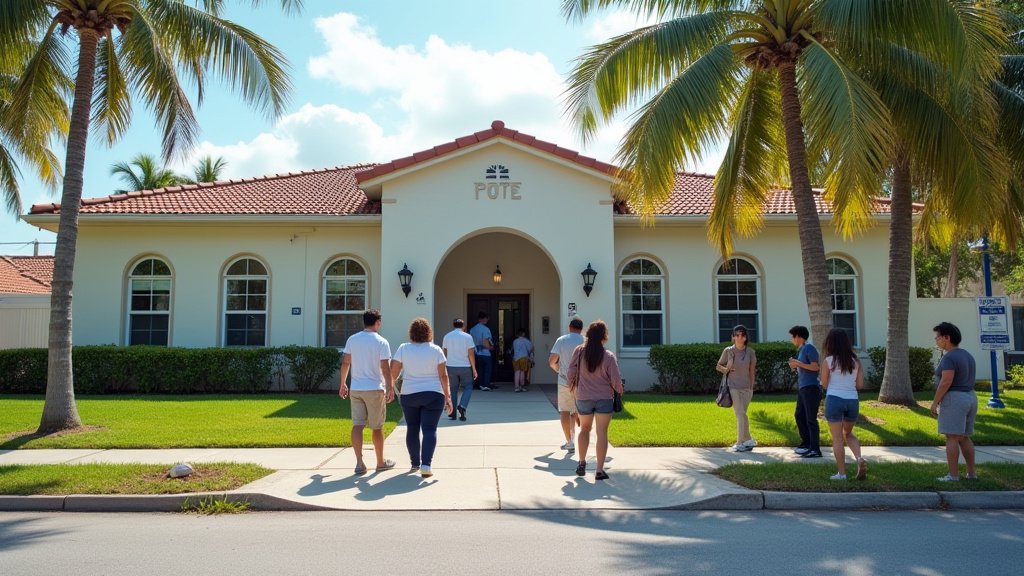
Election Day has arrived in Miami-Dade County. As of this morning, August 18, 2026, polls are officially open, marking a critical juncture for local governance as voters cast their ballots in both the Primary Election and the City of Miami Special Election. This dual-event day carries significant weight for the trajectory of municipal policy and the selection of candidates who will vie for positions in the upcoming general election. Residents are currently navigating polling stations, with the electoral process running smoothly across the county’s diverse precincts.
Key Highlights
- Election Day Date: Voting is occurring today, August 18, 2026.
- Dual-Ballot Structure: The event combines a high-stakes Primary Election with a targeted City of Miami Special Election.
- Results Timeline: Official results reporting is scheduled to commence promptly at 7:15 p.m. this evening.
- Scope of Voting: The ballot covers candidates for local seats and, in specific jurisdictions, critical municipal referendums.
- Polling Access: Polls remain open throughout the day for registered voters in the Miami-Dade jurisdiction.
The Pulse of Miami-Dade: A Critical Civic Day
The dual nature of today’s election—a Primary Election coupled with a City of Miami Special Election—presents a unique logistical and civic challenge for one of the nation’s most politically dynamic counties. While Primary Elections traditionally serve as the gatekeepers for major party nominations, the inclusion of a Special Election adds a layer of immediate policy-making power to the ballot. For the electorate, today is not merely about choosing a political party’s standard-bearer; it is about steering the immediate administrative future of the city.
Decoding the Primary vs. Special Election
In political science, the distinction between a primary and a special election is often technical, but for the voter, it is substantial. The Primary Election serves as the filter for the general electorate, narrowing down party candidates. However, the City of Miami Special Election is distinct. Often triggered by resignations, vacancies, or urgent legislative mandates, special elections are where municipal policy is frequently forged. Because they often occur outside the rhythm of standard general election cycles, turnout can be lower, making the individual impact of every vote cast today mathematically higher.
What Voters Are Deciding: Issues at the Ballot Box
Across the county, voters are grappling with a spectrum of issues. Primary races often center on candidate ideology, party alignment, and the vision for the future of the county administration. In contrast, the Special Election items often involve granular but impactful governance issues—zoning ordinances, municipal bond measures for infrastructure, or specific administrative amendments to the city charter. The entities involved, such as the Miami-Dade Supervisor of Elections, have worked to streamline the ballot to ensure clarity, yet the diversity of the ballot measures requires an informed voter base. The intersection of these two elections means that a voter’s presence at the polling station today is effectively performing two distinct civic functions: party nomination and municipal policy direction.
Behind the Curtain: Administrative Logistics
Running a concurrent primary and special election is a massive undertaking for the Miami-Dade Supervisor of Elections. This office is responsible for the integrity of the process, from the secure transport of ballot boxes to the deployment of electronic voting machines. The meticulous verification of voter rolls and the adherence to statutory requirements for ballot tabulation are paramount. The 7:15 p.m. cutoff for the start of result reporting is not arbitrary; it is the culmination of a day-long synchronization of precinct reporting. As polls close, the transition from local precinct counting to centralized tallying will be a high-pressure environment, as observers from all parties watch for transparency and accuracy.
Beyond Today: The Path to November
While today is the focus, it is also a bellwether for the November general election. Political strategists often view primary turnout numbers as an indicator of voter enthusiasm and ideological shifts within the county. High participation in these specific races can signal momentum, while low turnout might suggest a need for campaigns to reinvigorate their voter outreach. For residents, however, the primary concern remains the immediate selection of representatives who best align with the needs of their neighborhoods, school districts, and municipal zones. As the hours tick toward the evening result releases, the focus remains on the integrity of the ballot and the voice of the community.
FAQ: People Also Ask
Q: What time do the polls close in Miami-Dade County today?
A: In accordance with standard Florida election law, polls typically close at 7:00 p.m. Voters who are in line at 7:00 p.m. are legally entitled to cast their ballot. Please check your specific precinct for any late-breaking adjustments, but 7:00 p.m. is the standard statewide cutoff.
Q: When will the results begin to be reported?
A: Official results reporting for the Primary and City of Miami Special Election is slated to begin this evening at 7:15 p.m. as votes are tabulated.
Q: How can I verify my polling location?
A: Voters can verify their assigned polling location by visiting the official website of the Miami-Dade County Supervisor of Elections and using their voter information portal. You will need your identification and registration details ready.
Q: Is a photo ID required to vote in today’s election?
A: Yes, Florida law requires voters to present a current and valid photo ID with a signature at the polling place. Acceptable forms include a Florida driver’s license, a Florida identification card issued by the DHSMV, a U.S. passport, or other government-issued photo IDs.