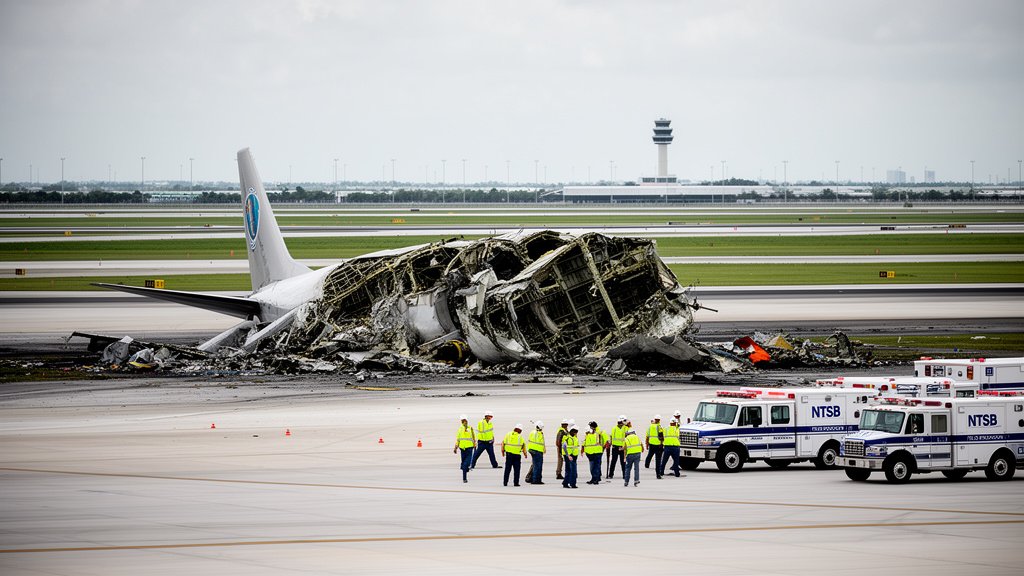
On September 6, a devastating aviation incident occurred at Miami International Airport (MIA) when a Boeing 767 cargo aircraft, operating for Amazon Prime Air, failed to remain on the runway during landing procedures. The aircraft barreled off the tarmac, colliding with ground support vehicles before erupting into a catastrophic fire. Authorities have confirmed that at least five individuals lost their lives in the crash, and several others sustained significant injuries. This event, which temporarily paralyzed operations at one of the busiest cargo hubs in the United States, has triggered an urgent multi-agency investigation as the aviation community grapples with the scale of the loss.
Key Highlights
- Tragic Loss of Life: At least five fatalities were confirmed immediately following the crash, with multiple ground personnel reported injured.
- Operational Stoppage: Miami International Airport (MIA) was forced to suspend all incoming and outgoing flights for several hours to manage the emergency response.
- Cargo Impact: The incident involved a Boeing 767 aircraft operating under the Amazon Prime Air logistics umbrella, raising questions about current runway safety and ground operations protocols.
- Federal Investigation: The National Transportation Safety Board (NTSB) has deployed a ‘go-team’ to investigate the causes of the runway overrun.
The Anatomy of the MIA Runway Tragedy
The Sequence of the Incident
According to preliminary reports from eyewitnesses and airport ground controllers, the Boeing 767 cargo plane was conducting a routine approach to Miami International Airport on the morning of September 6. Conditions at the time of the landing are currently being scrutinized by meteorological experts, as weather patterns in South Florida are notoriously volatile. As the aircraft touched down, witnesses observed the plane failing to decelerate at the expected rate. It proceeded to overshoot the runway, continuing at a high speed through the safety area before impacting stationary ground vehicles positioned near the tarmac.
The force of the impact caused the aircraft to breach its fuel containment, resulting in an immediate and intense blaze that quickly engulfed both the aircraft fuselage and the adjacent service vehicles. Emergency response units stationed at MIA were on the scene within minutes, but the intensity of the jet fuel fire made rescue efforts exceptionally difficult, contributing to the high casualty count among those on the ground and within the flight crew.
The NTSB Investigation and Technical Hurdles
The National Transportation Safety Board (NTSB) has launched a full-scale investigation into the crash. As is standard procedure in aviation disasters, investigators are currently focused on three primary pillars: mechanical integrity, pilot performance, and ground control communication. The Boeing 767, a workhorse of the global air cargo fleet, has a generally reliable safety record; however, the investigation will look closely at whether the specific aircraft had any maintenance discrepancies prior to the September 6 flight.
Furthermore, the investigation will examine ‘runway excursion’ data. An excursion occurs when an aircraft departs the runway surface, and in this instance, investigators will analyze the braking systems, reverse thruster deployment, and the runway surface conditions at the time of the incident. Were there slick spots on the tarmac? Did the flight crew receive inaccurate braking action reports? These questions are at the heart of the NTSB’s efforts to determine why this specific flight could not come to a halt in time.
Amazon Prime Air and the Logistics Ripple Effect
For Amazon, the incident at MIA is not merely a tragedy but a significant logistical challenge. Prime Air relies on the rapid, high-frequency movement of goods to maintain its 24-48 hour delivery promises. The temporary closure of Miami International Airport—a vital gateway for shipments to Latin America and the Caribbean—has disrupted supply chains for thousands of businesses and consumers.
Beyond the logistical delay, the incident brings scrutiny to the operational pace of cargo airlines. While Amazon Prime Air contracts many of its flights to third-party operators, the brand’s name is inextricably linked to the incident. Analysts suggest that this could prompt a temporary suspension of certain routes while Amazon and its partner airlines review safety checklists. The broader implications suggest a potential industry-wide pivot toward enhanced runway safety training for cargo pilots, who often operate on tighter, overnight schedules compared to commercial passenger aviation.
Airport Infrastructure and Emergency Response
The management of the post-crash scene at MIA highlights the criticality of emergency preparedness at international airports. Miami International is one of the busiest facilities in the world, and the sudden cessation of operations created a ‘cascading delay’ effect that was felt across North America. Airports utilize specific zones for ground support equipment, and this tragedy has sparked debate regarding the proximity of service vehicle parking to active landing strips.
Airport authorities are now expected to conduct a safety review of all runway adjacent zones. The goal is to minimize the risk of collisions during runway excursions, ensuring that if a plane does leave the pavement, it does not strike populated service areas. The human cost of this tragedy has ignited a somber conversation about the inherent risks of logistics speed-efficiency and the rigorous safety standards required to protect human life in the process.
FAQ: People Also Ask
Q: What is a runway overrun?
A: A runway overrun occurs when an aircraft is unable to stop within the designated length of the runway during a landing. This can be caused by excessive speed, poor braking conditions, mechanical failure, or adverse weather.
Q: How does this incident impact Amazon delivery times?
A: In the short term, customers in the affected region can expect delays. Miami International Airport is a major cargo hub; the closure of the airport resulted in grounded cargo and diverted flights, creating a backlog that may take several days to clear.
Q: Is the Boeing 767 considered a safe aircraft?
A: Yes, the Boeing 767 has been a staple of aviation for decades with a strong safety record. The NTSB investigation will specifically determine if the cause was mechanical, human error, or environmental, rather than an inherent design flaw in the 767 airframe.
Q: What happens to the evidence at the crash site?
A: The NTSB secures the crash site, often using GPS and laser scanning to map the wreckage. Flight Data Recorders (the ‘black boxes’) are recovered to analyze the cockpit voice recordings and flight telemetry up until the moment of impact.