South Florida is currently at the epicenter of the global climate adaptation movement. With projections from the National Oceanic and Atmospheric Administration (NOAA) indicating that sea levels in Miami-Dade County could rise by 10 to 17 inches by 2040, local authorities and private innovators are moving beyond traditional, carbon-intensive concrete barriers. The new frontier in this defensive strategy involves 3D-printed living seawalls, a technology pioneered by companies like Miami-based Kind Designs, which aims to reconcile the urgent need for structural fortification with the necessity of ecological preservation.
Key Highlights
- Ecological Integration: Unlike standard gray-concrete seawalls that create sterile barriers, these 3D-printed panels are designed to mimic natural reef structures, providing a habitat for oysters, mangroves, and other marine organisms.
- Speed and Efficiency: Robotic 3D printing significantly accelerates production timelines, allowing for the rapid deployment of complex, custom-engineered panels in a fraction of the time required by traditional casting methods.
- Material Innovation: The technology utilizes proprietary, pH-neutral concrete mixtures that are less environmentally disruptive, reducing the carbon footprint associated with traditional coastal engineering.
- Adaptive Zoning: The focus is on Biscayne Bay and other high-risk corridors where the interaction between human infrastructure and marine biodiversity is most critical for long-term survival.
Reshaping the Coastline: The Rise of 3D-Printed Seawalls in South Florida
For decades, the standard response to rising tides in Miami has been the construction of heavy, flat, poured-concrete walls. While functional in preventing immediate flooding, these structures—often derided by conservationists as “sterile deserts”—contribute to the degradation of the delicate marine ecosystems in Biscayne Bay. Today, the coastal engineering sector is witnessing a paradigm shift. The integration of 3D-printed technology, spearheaded by innovators like Marianna Hernandez of Kind Designs, represents a pivot from defensive fortification to regenerative infrastructure.
The Technical Architecture of ‘Living’ Seawalls
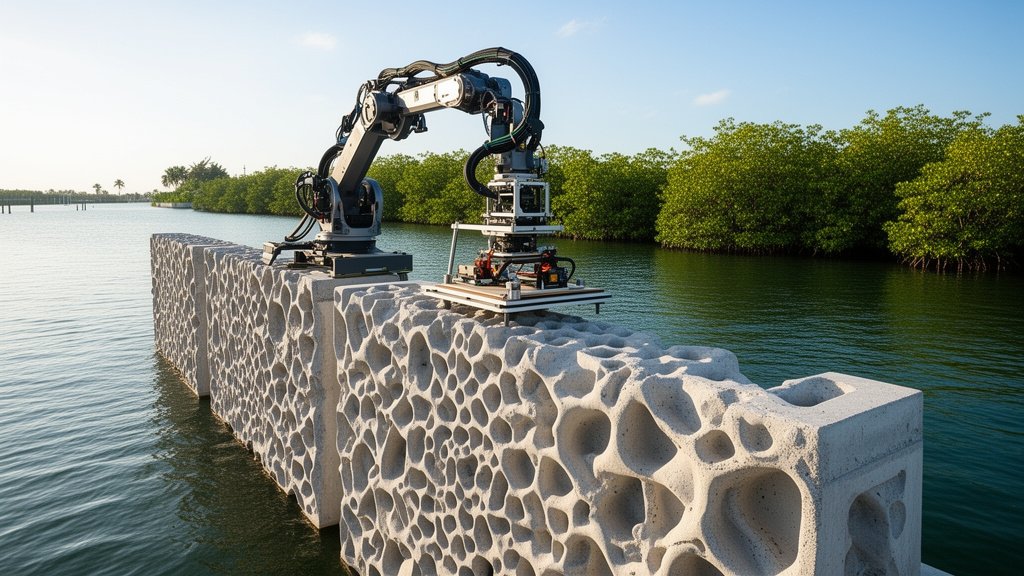
The science behind these living seawalls relies on advanced additive manufacturing. By employing large-scale robotic arms, manufacturers can print complex, cavernous geometries directly into the concrete panels. These voids and ridges are not merely decorative; they serve as structural niches for juvenile fish, crustaceans, and filter-feeding organisms like oysters.
Traditional construction often involves pouring concrete into rigid molds, which limits the geometric complexity of the finished product. In contrast, 3D printing allows for precise control over porosity and surface texture. This “biomimetic” approach—designing structures that mimic the complexity of a natural coral reef—enables the seawall to act as a living organism rather than a static barrier. As marine life colonizes the wall, the structure becomes stronger and more effective at dissipating wave energy, effectively turning the seawall into a carbon-sequestering, self-healing system over time.
Economic and Logistical Efficiencies
Beyond ecological benefits, the economic argument for 3D-printed infrastructure is compelling. Traditional seawall construction is labor-intensive and plagued by supply chain bottlenecks, particularly in a region where coastal real estate demand is high.
3D printing reduces the labor hours required to manufacture individual panels by roughly 75% to 80% compared to traditional casting. Because the printers can operate in modular, localized micro-factories, the transportation costs—a major component of construction expenses—are slashed. This modularity also allows for rapid replacement and scalability. If a section of the coast requires an upgrade, digital files can be adjusted to print custom-fit panels that accommodate the specific topography of the waterfront property, eliminating the need for expensive, on-site manual formwork. This capability is critical for municipal planners looking to stretch limited climate-resilience budgets across vast stretches of urban coastline.
Ecological Restoration as a Primary Metric
The shift toward living seawalls is also a recognition that coastal protection and ecological restoration are not mutually exclusive—they are mutually dependent. In the context of South Florida, the health of the coastline is inextricably linked to the health of the seagrass meadows and mangrove forests that act as natural storm buffers.
By integrating native ecology into the defense system, these walls help improve water quality. The organisms that attach to the walls act as natural filters, consuming nutrients and particulates that would otherwise contribute to algal blooms—a recurring problem in Biscayne Bay. Furthermore, the ability of these panels to harbor marine life provides a much-needed nursery ground for species that have lost habitat due to development. This “triple bottom line” approach—providing flood defense, enhancing biodiversity, and reducing carbon emissions—is setting a new standard for urban coastal engineering, not just in Florida, but globally.
FAQ: People Also Ask
Q: How durable are 3D-printed seawalls compared to traditional poured concrete?
A: They are engineered for high durability. The concrete mixes used are often reinforced with sustainable additives and designed to withstand the saline, high-moisture environment of South Florida. The additive manufacturing process creates a uniform, high-density structure that is often more resilient to cracking than traditional, hand-poured variants.
Q: Are these seawalls expensive to install?
A: While the initial investment in robotic manufacturing technology is significant, the long-term costs are competitive. By reducing labor, transportation, and onsite installation time, the total project cost often aligns with or beats traditional methods, especially when considering the reduced need for environmental remediation.
Q: Where can these seawalls be deployed?
A: They are primarily designed for residential waterfront properties, municipal canal systems, and areas requiring seawall repair or reinforcement. Their modular nature makes them highly adaptable to varied waterfront topography, from private docks to public seawalls along Biscayne Bay.