The Florida Immigrant Coalition (FLIC) has launched a strategic, multi-channel advocacy campaign, blanketing the greater Miami area with billboards and Spanish-language radio advertisements. This initiative is designed to increase public pressure on the Mayor of Miami and the City Commission to officially rescind the municipality’s 287(g) partnership with U.S. Immigration and Customs Enforcement (ICE). This move marks a significant escalation in the ongoing debate over the role of local law enforcement in federal immigration detention and deportation efforts.
The Mechanics of the 287(g) Program
The 287(g) program, a provision of the Immigration and Nationality Act, allows the Department of Homeland Security (DHS) to delegate specific immigration enforcement authority to local law enforcement agencies. Essentially, this creates a formal, documented partnership where local officers, after receiving training from ICE, are empowered to perform the functions of immigration agents. This can include interviewing individuals in local custody to determine their immigration status, issuing detainers, and initiating deportation proceedings.
Critics of this program, including the Florida Immigrant Coalition, argue that such agreements fundamentally transform local police from community guardians into federal enforcement agents. They contend that this shift erodes the trust between law enforcement and immigrant communities, making victims of crimes and witnesses hesitant to report incidents to the police for fear of triggering an immigration investigation. In the context of Miami, a city with a deeply diverse, multi-generational immigrant population, this tension is particularly acute. The campaign asserts that the current 287(g) agreement undermines the city’s social fabric and diverts limited local resources toward federal priorities that do not necessarily align with local public safety needs.
Strategic Advocacy: Billboards and Radio
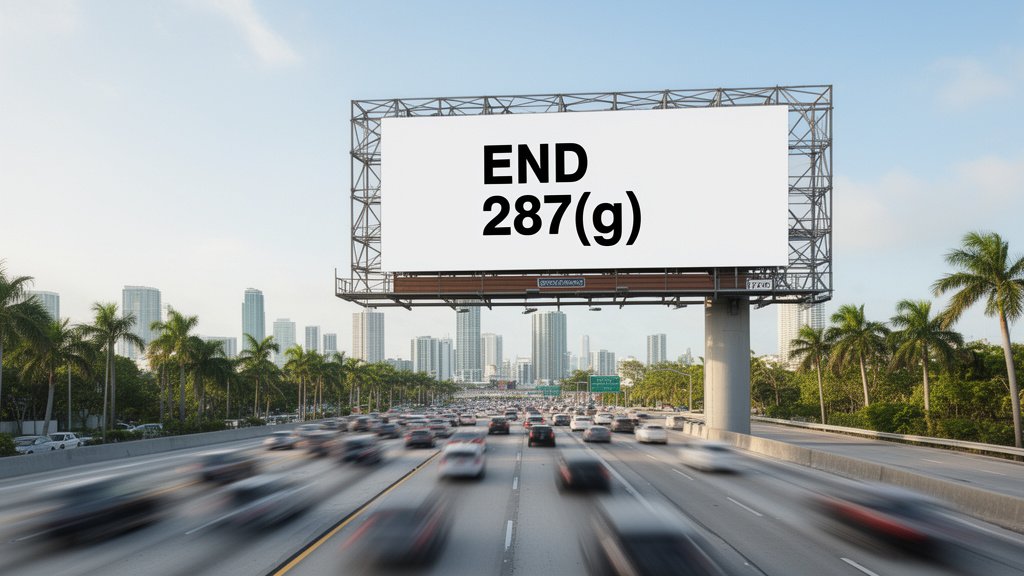
The FLIC campaign is not subtle. By utilizing roadside billboards—highly visible, high-traffic visual anchors—and Spanish-language radio, the coalition is bypassing traditional lobbying channels to speak directly to the constituents of Miami. Radio, specifically, remains a critical medium in Florida’s Hispanic market, offering a level of intimacy and reach that digital advertising often lacks. The ads are designed to frame the 287(g) agreement not merely as a policy decision, but as a moral and economic choice that impacts every resident in the city.
These tactics reflect a sophisticated understanding of local media dynamics. The billboards are strategically placed in areas known for high foot traffic and heavy commuting, ensuring that the issue remains front-and-center for both the public and local officials who traverse these routes daily. By keeping the issue in the public consciousness, the coalition is attempting to make the political cost of maintaining the agreement higher than the cost of repealing it.
The Argument for Community Trust
A primary pillar of the campaign’s messaging is the concept of ‘community policing.’ Proponents of the repeal argue that for law enforcement to be effective, it requires the cooperation of all residents. When local police are viewed as an extension of ICE, that cooperation evaporates. The coalition cites the ‘chilling effect’ that detention policies have on local safety. If a resident believes that a routine traffic stop could lead to deportation proceedings, they are statistically less likely to report crimes, participate in investigations, or engage with emergency services. This creates a public safety vacuum that affects the entire community, not just the immigrant population.
Moreover, the economic argument for repeal is gaining traction among certain stakeholders. The administrative costs associated with maintaining 287(g) agreements—including training, dedicated staffing, and potential legal liabilities—are often borne by local taxpayers. FLIC’s campaign suggests that these funds would be better directed toward community programs, youth services, or general policing infrastructure that supports all residents, regardless of status.
Historical Context and Political Polarization
To understand the gravity of the current pressure, one must look at the historical context of Miami’s immigration policies. Over the past decade, the region has been a focal point for national immigration debates. In 2021, Miami-Dade County took a significant step by ending its previous policy of honoring all ICE detainer requests, a move that was met with both widespread support and intense criticism. The current push against the 287(g) agreement is the next logical step for activists who view the 2021 victory as incomplete.
However, the political landscape remains fraught with polarization. Opponents of the repeal argue that such partnerships are essential for maintaining public safety and ensuring that criminal offenders are processed efficiently through the system. They emphasize the necessity of cooperation between local and federal authorities to combat transnational crime and maintain border security integrity. This fundamental disagreement on the purpose and scope of local government involvement in immigration enforcement suggests that the conflict is unlikely to resolve without significant legislative or judicial intervention.
Looking Toward the Future: The Road Ahead
The outcome of this campaign remains uncertain, but the impact is already being felt. The pressure on local officials is palpable, as they must navigate the demands of advocacy groups against the backdrop of state-level pressure to maintain rigorous immigration enforcement. This campaign serves as a case study in modern local politics, where grassroots organizations utilize mass communication to force a public referendum on federal policies.
Moving forward, the conversation will likely shift toward legal scrutiny of 287(g) agreements. As more municipalities nationwide reconsider these partnerships, the precedent set in Miami could have far-reaching implications for other cities struggling to balance federal mandates with local community values. For now, the Florida Immigrant Coalition’s billboards continue to serve as a constant, public reminder of the unresolved tension at the heart of Miami’s immigration policy.