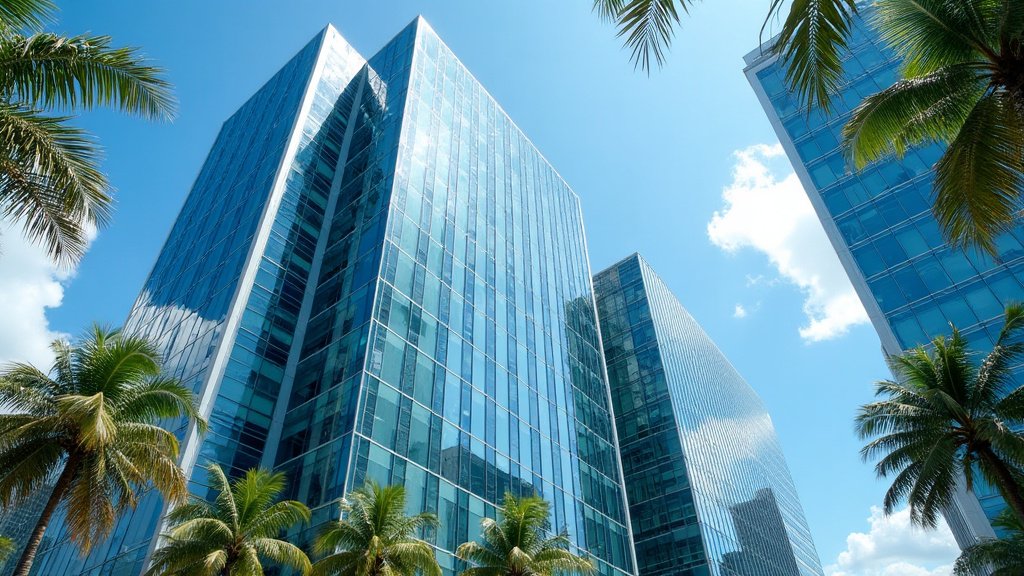
The Dubai International Chamber has officially cemented its commitment to North American market integration by opening a new representative office in Miami. This strategic move, designed to serve as a high-level conduit for trade and investment, represents a significant escalation in the UAE’s efforts to diversify its non-oil economy and foster deeper business-to-business synergies between the Middle East and the United States.
Strategic Rationale: Why Miami?
The selection of Miami as the second U.S. destination for the Dubai International Chamber is far from incidental. While the UAE has maintained a long-standing financial and political presence in Washington, D.C., and New York, Miami offers a unique value proposition: it is the primary gateway to Latin America and the Caribbean. By planting a flag in South Florida, Dubai Chambers is effectively positioning itself at the crossroads of three major economic regions.
This office is intended to streamline the entry of Dubai-based businesses into the U.S. market while simultaneously incentivizing American corporations to utilize Dubai as their regional headquarters for the Middle East, Africa, and South Asia (MEASA) region. The move aligns with the ‘Dubai Global’ initiative, a massive undertaking aimed at positioning Dubai as one of the world’s top four global financial hubs by 2033.
The ‘Dubai Global’ Initiative Context
The broader context of this expansion is the ‘Dubai Global’ initiative, which aims to establish a network of 50 integrated commercial representative offices across five continents. By staffing these offices with local experts and trade specialists, the Dubai International Chamber is moving away from generic diplomatic outreach and toward tactical, B2B-focused economic development.
The Miami office will focus on several critical sectors that are currently driving economic growth in both regions: technology, sustainability, logistics, and finance. For American firms looking to scale in the MENA (Middle East and North Africa) region, the office provides a direct line to Dubai’s regulatory authorities, local venture capital networks, and government-backed incubators, effectively de-risking the expansion process.
Catalyzing Bilateral Trade and Investment
Historically, the U.S.-UAE trade relationship has been dominated by large-scale defense and infrastructure contracts. However, this new representative office signals a shift toward the SME (Small and Medium Enterprise) sector. The chamber’s mandate in Miami involves identifying partnership opportunities for local American startups to leverage Dubai’s tax-efficient ecosystem, world-class port infrastructure, and position as a global logistics hub.
Furthermore, the office will act as an advocate for reducing trade barriers. As supply chain volatility remains a global concern, having a dedicated on-the-ground presence in Miami allows Dubai officials to coordinate more closely with U.S. logistics firms. This is critical for businesses operating in sectors like e-commerce, where rapid delivery and efficient customs procedures are the primary competitive differentiators.
Future Outlook: Beyond the Border
Looking ahead, the success of the Miami office will likely be measured by the volume of joint ventures and the number of U.S. companies setting up operations in Dubai within the next 24 to 36 months. With the UAE having already positioned itself as a crypto-friendly and AI-forward jurisdiction, there is significant potential for cross-pollination between the burgeoning tech scenes in South Florida and the technological infrastructure in the UAE.
As the Dubai International Chamber continues to fill its global map with new offices, the Miami branch stands out as a bridge not just to the U.S. economy, but to the broader commercial networks of the Americas. This development underscores the reality that in the modern global economy, trade is not merely about physical goods; it is about the flow of capital, talent, and technological standards between key global hubs.
FAQ: People Also Ask
1. Why did the Dubai International Chamber choose Miami over other U.S. cities?
Miami is considered a crucial gateway for trade between the U.S. and Latin America. By locating in Miami, the Dubai Chamber captures opportunities across the entire Americas region, rather than just the domestic U.S. market, while benefiting from a business-friendly environment and established logistics hubs.
2. What is the ‘Dubai Global’ initiative?
‘Dubai Global’ is a strategic program launched by the Dubai government to establish a network of 50 representative offices across five continents. The goal is to strengthen Dubai’s position as a global business hub and attract foreign direct investment while helping local businesses expand abroad.
3. Will the Miami office offer financial services?
The office functions primarily as a representative body for business development, trade facilitation, and networking. While it does not provide direct banking services, it connects businesses with financial institutions, regulatory bodies, and venture capital networks in both Dubai and the U.S. to facilitate investment and operational scaling.
4. How does this impact U.S. businesses?
U.S. businesses interested in expanding into the Middle East, Africa, or Asia can use the Miami office as a primary resource to understand Dubai’s regulatory environment, find local partners, and access a vast network of commercial opportunities in the MEASA region without the need to navigate the process entirely remotely.